

By Andrew Danielson
Just to the east of New Haven, Indiana, resides a window to the cosmos: the Fort Wayne Astronomical Society’s Star*Quest Observatory.
Located at 1730 South Webster Road, the Star*Quest Observatory houses telescopes and advanced technology that allow the user to gaze into the heavens with an unblinking eye.
“We are very pleased with the operation,” Gene Stringer said.
Stringer, a long-time member of the Fort Wayne Astronomical Society, led the society’s campaign to build the new Star*Quest Observatory, a modern facility packed with incredible technology.
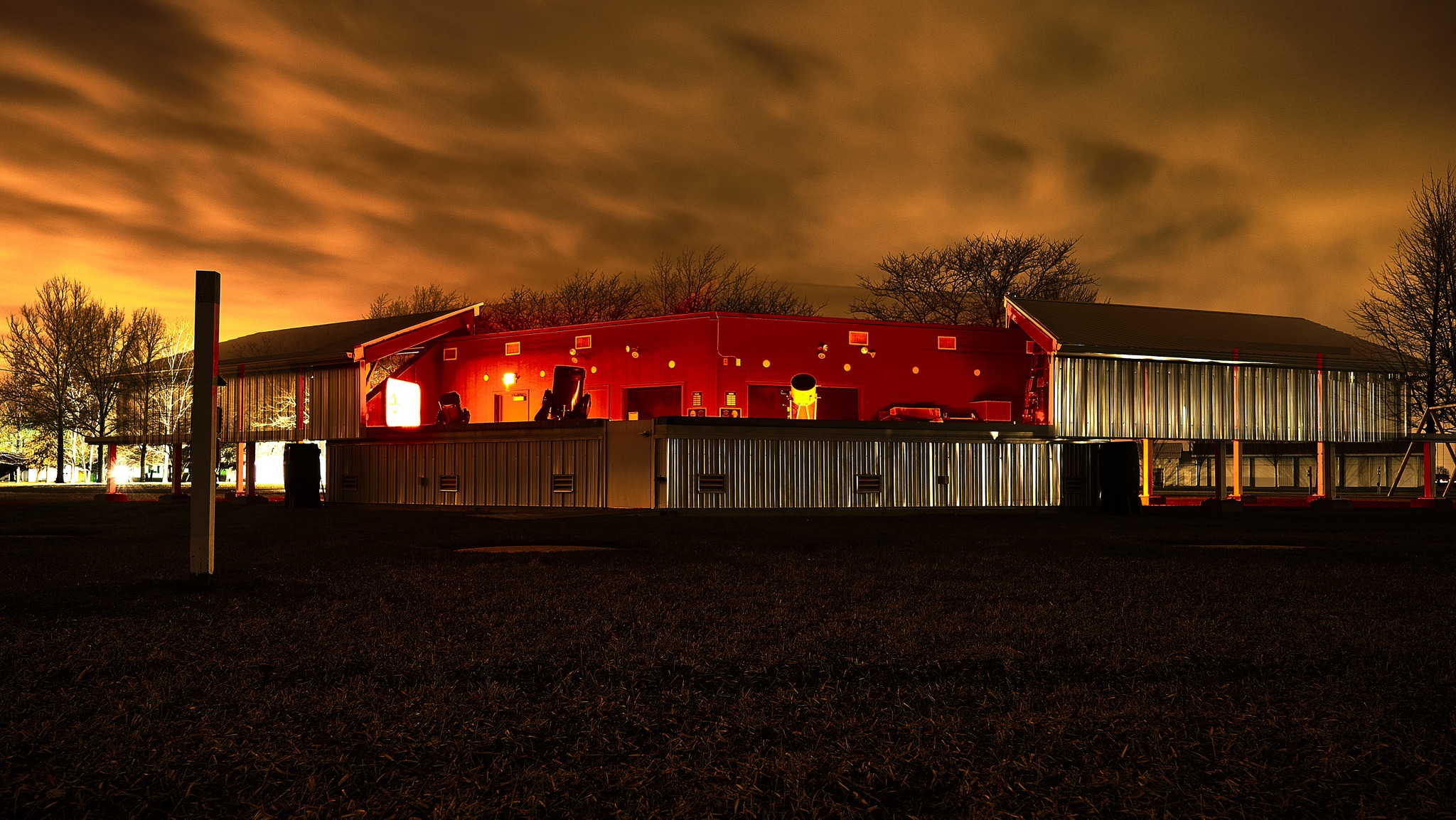
The design process of the observatory includes an interesting anecdote tying the facility to local educational institution: Students from PFW’s (then IPFW) School of Structural Engineering assisted in creating a design for the new observatory.
Additionally, professors from both IPFW and Ball State University joined FWAS members and other committee volunteers to choose a final observatory design from architectural firms.
The final design for Star*Quest is what Stringer calls a “delta wing” design.
The building includes two main sections. The front section has swept-back “wings,” with room for up to four telescopes. A control room with additional technology and items makes up the other portion of the observatory.
To facilitate easy sky viewing down to the horizon, the delta-wing sections of the observatory split apart. The roof rolls backward in two different sections via tracks, allowing an uninterrupted view of the heavens for much of the sky.
In addition to the new 16” telescope, Star*Quest also hosts a large computer with 7 terabytes of data storage, computer monitors, and other equipment, as well as the society’s original 12.5” telescope.
The new computer technology, made possible by an approximately $15,000 grant from the Foellinger Foundation, allows the FWAS to host a variety of visitors, including school groups, and offer a diverse array of educational programming.
One of those items of high-tech gear Stringer mentioned was what he called a “spectroscope,” a device that enables scientific research with the telescope by splitting incoming starlight into its composite “spectra.”
“A spectroscope is one of the prime instruments that every observatory wants to have in order to do scientific work,“ Stringer explained. “Most of what we have learned about the sky has been through the use of the spectroscope in order to understand what it is we’ve been looking at.”
According to the Center for Astrophysics, analyzing the spectrum of light and the various colors of that spectra can provide great insight into celestial objects.
“The specific colors and relative amounts of each color reveal information about temperature, what atoms are present, and the speed of the astronomical object being observed, which reveals the distances to far-off galaxies,” the center states.
Star*Quest Observatory and Its Predecessors
Star*Quest has its roots with the origins of the society and their original observatories.
Stringer said that the Fort Wayne Astronomical Society (abbreviated FWAS) began in the mid-1950s. In 1959, the society was incorporated as a not-for-profit organization with 60 original members.
Shortly after the founding of the society, two members of the organization, Glenn Harnishfeger and Maurice Crow, led efforts to build a 12.5” Newtonian-style telescope and observatory for use by the society.
The new members document for the society records that the original observatory and telescope were completed in 1963.
Stringer said that the location of that first observatory is now the site of a grocery store, located off of Lima Road.
The FWAS’ website mentions that the society moved their observatory and telescope in the 1970s to a new location in Fox Island County Park which had been a Christmas tree farm in its prior life.
At that point in time, any trees on the former Christmas tree farm were only a few feet tall, and the society enjoyed great viewing conditions with low levels of light pollution and good views to the horizon.
However, over a 30-year period, the trees on the site grew up, gradually blocking the views of the observatory. This meant that celestial objects that the society wanted to view with their telescope, such as some select planets, were blocked by the growing trees.
In the mid 2000s, the FWAS undertook a project to find a new location for their observatory and telescopes.
“We started the project to build the observatory in 2006,” recounted Stringer, who served as the project manager for the Star*Quest Observatory project.
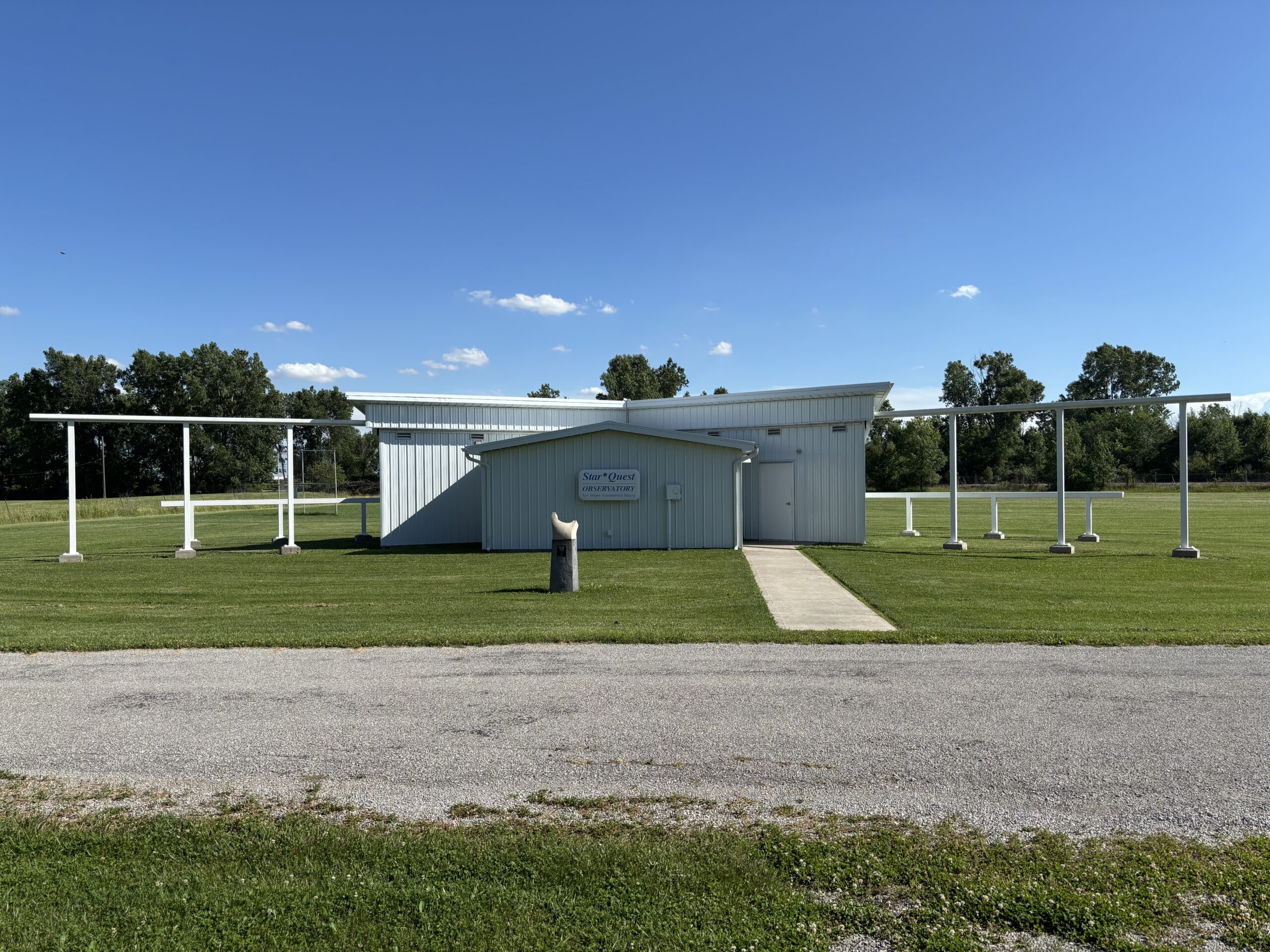
That project was complicated, as it included finding a new observatory site, fundraising and building a new observatory with modern technological equipment, and getting the word out about the new site to the public.
The FWAS found a new location for their future observatory in Jefferson Township Park. The park provides several desirable characteristics for astronomical observing, including fairly dark skies and clear views down to the horizon of celestial objects.
But a new location was only one of the challenges facing the society. A new observatory required funding.
Stringer said that the FWAS raised approximately $250,000 to build the new, modern observatory, which was completed and opened to the public in 2017.
Named the “Star*Quest” observatory, the facility sports up-to-date technology.
The new members’ document mentions the society’s new 16” Meade RCX400 telescope, which now is the primary telescope for the FWAS. The telescope is equipped with a GPS receiver as well as a 100,000+ object computer database of celestial objects.
Star*Quest Observatory Offers Educational Opportunities
But the new observatory and its technological muscle are available for more than just researchers or FWAS members.
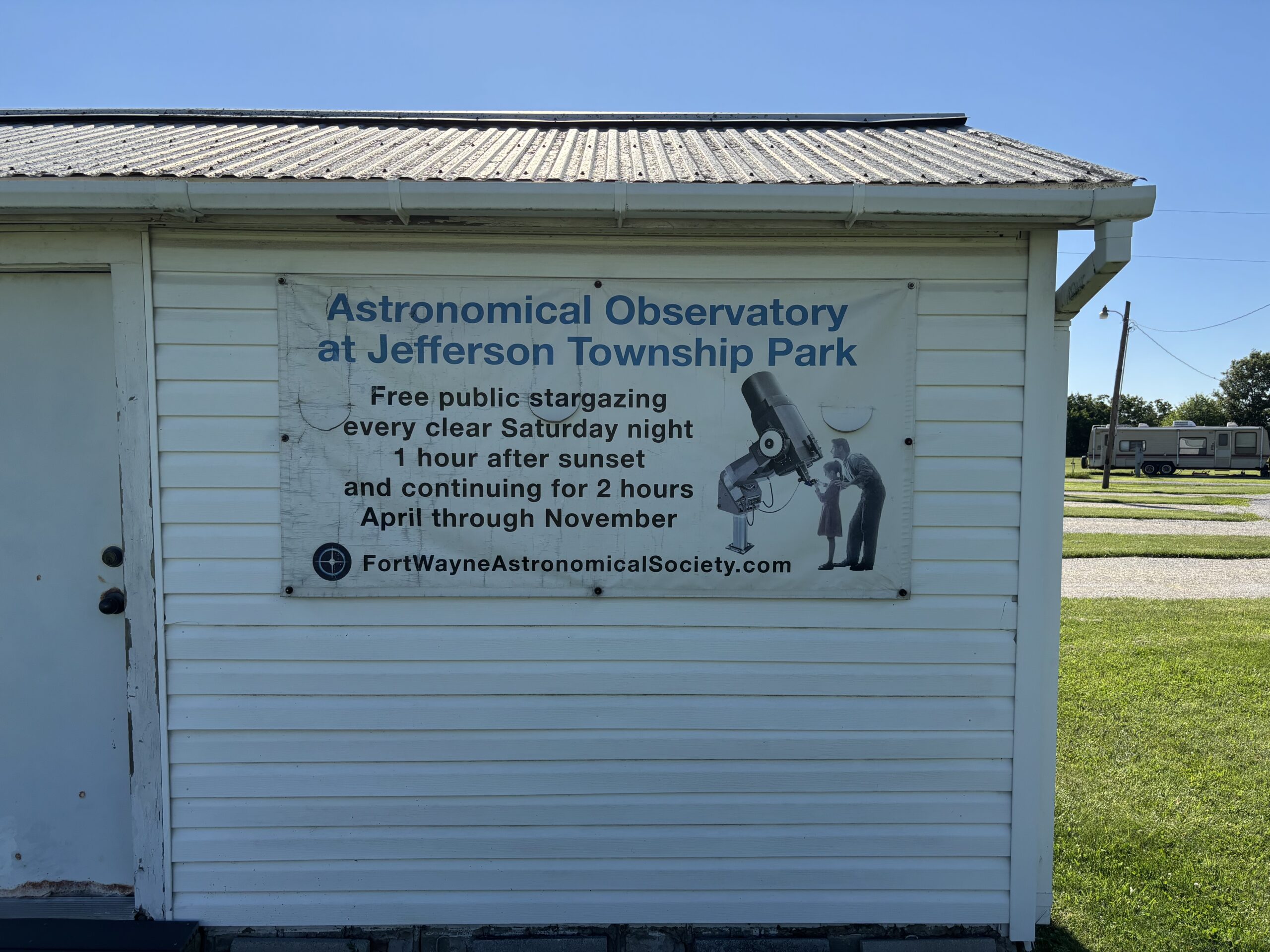
The newsletter of the FWAS, The Eyepice, mentions that on every clear Saturday night, from April till November, the public is invited and welcome to come for star gazing at Star*Quest. Those public viewing hours start one hour after sundown and continue for two hours.
Stringer said that, if any person from the public wants advice on how to use their own personal telescopes, they can bring their equipment to the public-viewing times. Members of the FWAW will provide assistance and instruction in using the scope, all free of charge.
In addition to hosting the Saturday viewing times, the society has partnered with a variety of area organizations for astronomy-focused activities, including Canal Days, Fox Island Sol Fest, the Homeschool Fair, and other events.
The FWAS also enjoys hosting visitors for astronomical events, such as total solar eclipses.
Stringer said that, during the April 2024 solar eclipse, the Star*Quest Observatory hosted an estimated 800-1000 visitors.
How to Get Involved
Anyone interested in attending events hosted by the Fort Wayne Astronomical Society has a variety of offerings from which to choose.
The society’s general meeting is typically held the third Tuesday evening of every month on the campus of PFW in the Walb Student Union. Meetings start at 7:30 p.m. and generally run till 9 p.m.
Annual memberships in the FWAS for individuals, including their family, are $40. Student memberships are $25 a year. Membership in the society comes with an automatic membership in the Astronomical League, as well as access to the FWAS’ online forum and members-only events. The society’s newsletter, The Eyepiece, listing current and future events can be downloaded from their website.
Although Stringer has spent over 60 years in the world of astronomy, he continues to enjoy sharing the cosmic views seen through a telescope with anyone interested in the heavens.
“Truly, what you see through the eyepiece of a telescope cannot be shown in any other venue,” he said. “You have to look through the scope live to see that sparkling star.”