
By Andrew Danielson
A student wants to build microcontrollers in Silicon Valley.
Another wants to travel back to India and provide counseling to troubled young people.
A third student wants to specialize in bio-technologies.
These are just a few of the stories behind some of the students who participated in PFW’s Global Student Celebration.
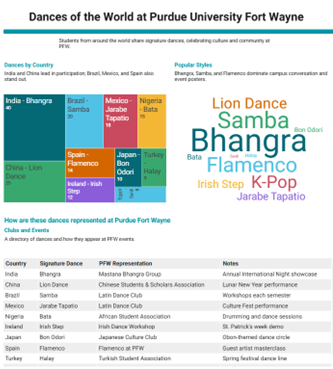
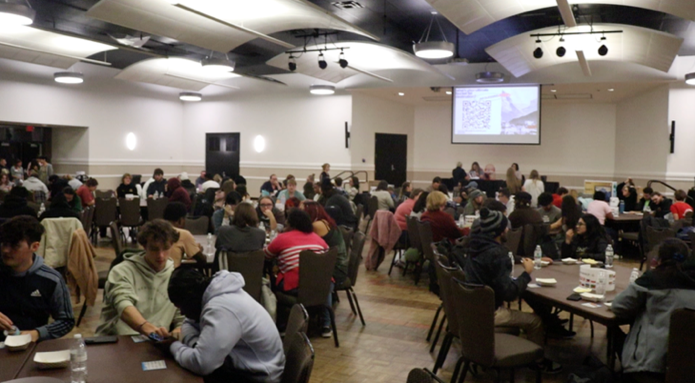
Held Friday evening on November 21, the Global Student Celebration is a fun occasion that caps a week of festivities at PFW, as international students share a snapshot of their culture with their fellow Dons through food, music, and dance.

But this week of celebrating international studies and students at PFW is actually part of a broader movement called “International Education Week.”
Sponsored by the U.S. Department of State and the U.S. Department of Education, International Education Week is held annually. According to the department of educations’ website, the event holds dual purposes.
First, the week is part of the department’s efforts to prepare Americans for studying abroad. It also serves as a method to educate the future leaders of other nations who are studying in the United States.
In other words, International Education Week is an opportunity for the US to engage in scholastic diplomacy with potential long-term benefits for both the United States and for countries around the globe.
How the process works for an international student to come and study in America is a fascinating and sometimes arduous process.
Coming to Study in America
Like any American college student, an international student must first decide on a college to attend. Name recognition can go a long way toward influencing where an international student decides to apply and study.
For Ajinkya Naik, an international student from India, going to college and getting an education has been a goal since his youth.
“From childhood, I always wanted to get a good quality education in college,” Naik said.
Naik explained that it was Purdue’s good name and reputation that drew him to enroll in the computer science program at PFW.
“In hindsight, it was a great decision,” Naika said with a smile.
But for students like Naika, enrolling at an American university typically requires more than just the normal college-enrollment paperwork.
International students wishing to pursue their academic studies in the United States must first obtain an F-1 category visa. They can only apply to study at universities which have received a Student and Exchange Visitor Program (SEVP) certification.
Besides paperwork, another challenge international students must navigate includes culture shock as they enter the American collegiate system.
John LaMaster, senior instructor of Mathematics at PFW, has observed some of that culture shock in his international undergraduate and graduate students.
“In other countries, those in higher education are much more select,” LaMaster said. “It isn’t an education for all in other countries.”
He explained that, in other countries, only a select group of students usually get the opportunity to study at a university.
When an international student comes to study at an American university, that student is already highly motivated to perform at a very high academic level. That means that, most likely, an international student would find it unthinkable to sign up or register for a class and never attend, since even one class is an invaluable resource and opportunity.
But it’s not just the academic system that’s a culture shock to international students.
Farah Combs, director of Honors and Experiential Learning at PFW, shared her story of coming to the United States as an immigrant.
Combs explained she and her family emigrated to the United States from Kuwait shortly before Combs was about to enter college.
One of the culture shocks Combs experienced was the level of free speech Americans enjoyed.
“I would say one of the major ones [culture shocks] is honestly … how much freedom of speech people have in regards to talking about the government,” Combs said. “That is not happening back home.”
Beyond culture shock and college applications, international students face another hurdle after graduation: staying in the United States to live and work.
After completing their degrees, international students have limited options for employment in the U.S. These range from working under the Optional Practical Training (OPT) program to obtaining a green card. Many of these pathways are highly competitive and often temporary, lasting only a few years and requiring renewal processes that must work their way through government bureaucracy and red tape.

Advantages International Students Bring to the United States and the Globe
Although there are challenges to coming to the United States for academic study, international students bring a host of benefits to America and the global community.
Maureen Linvill, director of International Education at PFW, explained that many international students will, upon graduation, return to their home countries and start implementing their academic knowledge in their professional lives.
“A lot go home to share what they’ve learned,” Linvill said.
Other international students, including those coming to PFW, hope to stay in the United States and contribute to American society.
For computer science major Ajinkya Naik, career goals include continuing his higher education in the United States and using his computer science degree to improve the bio-technology and health care fields.
International students at U.S. universities and colleges contribute $42.9 billion to America’s economy according to NAFSA: Association of International Educators. For every three international students, one job in the United States is either created or supported.
| International Students in the United States |
|---|
| In the 2024/2025 academic year, international students helped support over 355,000 jobs. |
| The top five countries of origin for international students are China, India, South Korea, Canada, and Vietnam. |
| The 1.1 million international students represent 6% of U.S. enrollments as of 2024. |
Locally, international students help improve the PFW community by introducing their colleagues at student housing to new experiences.
Shelby Mansfield, assistant director for International Student Services at PFW, explained how international and domestic students living in the same student housing help encourage each other to try new things.
“They get each other to do something new,” Mansfield said.
Trying something new and sharing a global perspective is part of what helps broaden domestic PFW students’ perspectives.
Director Combs mentioned that, for American and international college students, getting to study together in a university setting like PFW is a life experience that students can take with them into their future careers.
“When you go to the workforce, you don’t know what you’re going to be talking to in the business,” Combs said. “It [studying with international students] makes you a better person because you have better understanding.”