Urban Heat Islands in Fort Wayne: A Growing Local Challenge 

By Cincade Drudge

It starts as a walk. The kind you’ve taken a hundred times before, down the same familiar city streets, past the same buildings, maybe heading to a nearby store or just trying to get some fresh air. But something feels different. The heat seems to cling to the pavement, rising up toward you with every step. There’s no breeze between the buildings, no tree-shade to break the sun. Even as the evening sets in, the air doesn’t cool the way you expect it to. You find yourself wondering: Has it always felt this hot? 

As we find ourselves heading into the warmer seasons of the year, this question becomes more and more common. City folks increasingly find themselves victims of the sweltering effects of Urban heat islands, often referred to as UHIs, which are an increasingly visible part of city life, especially during the summer months.  

The concept is simple: urban areas experience significantly higher temperatures than their rural surroundings. But the causes and consequences are far more complex. As cities expand and natural landscapes are replaced with concrete, asphalt, and buildings, heat becomes trapped, creating pockets of elevated temperatures that can reshape how communities experience their environment. 

In Midwestern cities like Fort Wayne, this effect is especially noticeable. Paved roads, parking lots, and rooftops absorb heat throughout the day and release it slowly at night, preventing the city from cooling down. While rural areas benefit from vegetation and open space that allow for quicker temperature drops, urban environments hold onto heat. The difference can be striking, sometimes as much as 8 degrees warmer than the surrounding areas

At the heart of the urban heat island effect is a shift in land use. Trees and green spaces, which naturally cool the environment through shade and evapotranspiration, are often replaced with materials that do the opposite. Asphalt and concrete have low reflectivity and high heat absorption, meaning they store solar energy and gradually release it back into the air. Buildings can also trap heat by limiting airflow, creating what some describe as “heat canyons” between structures. 

This buildup of heat comes with a range of environmental costs. Temperatures remain elevated well into the night, increasing overall exposure during heat waves. As a result, energy demand rises, with more residents relying on air conditioning to stay comfortable. This not only leads to higher utility bills but also puts added strain on local power grids. Increased energy use often means higher greenhouse gas emissions, particularly when electricity is generated from fossil fuels, contributing to a cycle that reinforces climate change. 

Beyond environmental impacts, urban heat islands pose serious public health risks. Prolonged exposure to high temperatures increases the likelihood of heat-related illnesses such as heat exhaustion and heatstroke. Vulnerable populations, including the elderly and those without reliable access to air conditioning, face the greatest risks. Heat can also worsen air quality by accelerating the formation of ground-level ozone, while raising water temperatures in nearby rivers and streams, affecting local ecosystems. 

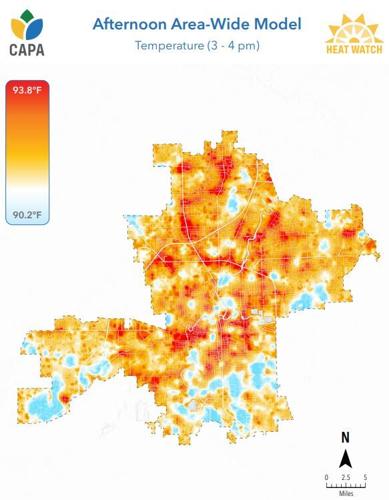
Fort Wayne has taken steps to better understand and address this issue. In a recent local study, volunteers collected ground-level temperature data across the city, revealing just how uneven heat distribution can be. Some neighborhoods were recorded as much as 10 degrees hotter than others, highlighting how urban heat islands are not evenly spread but concentrated in specific areas. 

Afternoon Temperature Chart From Fort Wayne Study. Sourced from WFFT-TV

One of the most effective solutions to this problem is also one of the simplest: planting more trees. Expanding tree canopy coverage helps reduce both surface and air temperatures by providing shade and releasing moisture into the air. Even a single mature tree can make a measurable difference, and when scaled across neighborhoods, these efforts can significantly reshape local microclimates. 

Local initiatives, including those supported by organizations like the Community Greenways Fund, are working to increase tree coverage and promote green infrastructure. These efforts often focus on neighborhoods with fewer existing trees, helping to address both environmental concerns and social disparities. In addition to cooling benefits, trees improve air quality, reduce stormwater runoff, and enhance overall quality of life. 

However, it is important to note that the effects of urban heat islands are not felt equally. Communities with less tree cover and more pavement tend to experience higher temperatures, and these areas are often home to lowerincome populations.  

This creates a situation where those with the fewest resources are exposed to the greatest environmental risks. At the same time, city infrastructure, from roads to power systems, faces increased stress under prolonged heat, leading to higher maintenance costs and long-term challenges for local governments. 

Addressing urban heat islands requires a combination of strategies. Tree planting is a key piece, but it is not the only one. Cities can invest in green infrastructure such as rain gardens, green roofs, and permeable pavement, all of which help reduce heat absorption while improving water management. Reflective materials used in “cool roofs” and “cool pavements” can also limit how much heat is absorbed in the first place. 

Policy plays an important role as well. Local governments can implement zoning regulations that encourage green space, provide incentives for sustainable development, and invest in long-term environmental planning. Partnerships between city officials and community organizations help ensure that these efforts are both effective and equitable. 

Public awareness is another critical factor. Many residents may not fully realize how much impact something as simple as a tree can have on their neighborhood’s temperature and livability. Encouraging community involvement in tree planting and maintenance can strengthen not only environmental outcomes but also civic engagement. 

Urban heat islands may not always be as apparent as other environmental issues, but their effects are felt every day, on sidewalks that radiate heat, in homes struggling to stay cool, and in neighborhoods that bear the brunt of rising temperatures. As cities like Fort Wayne continue to grow, the challenge will be finding ways to build and adapt in a way that keeps communities not just functional, but livable. 

Climate Policy in a Divided Nation: Why States Take Different Paths

By Cincade Drudge

Climate change policy in the United States is anything but consistent. Our policies can be described as fragmented and contradictory, with no real uniform policies linking all the states. This lack of connection is not an accident. It reflects a deeper reality for the United States: while the federal government sets broad environmental standards (or chooses not to set standards), much of the authority over energy, infrastructure, and regulation lies with the states. The result is a country where climate policy is shaped as much by geography and economics as it is by politics.

At the center of this divide is the all too familiar distinction of “red” and “blue” states. These labels, while imperfect and reductive, point to broader governing ideas that influence how states approach climate change. Some states prioritize rapid emissions reductions and regulatory action, while others focus on economic stability, energy independence, and marketdriven solutions. Neither approach exists in a vacuum, and both are shaped by the practical realities each state faces.

“Red, Blue, and Purple” States by Control of State Legislatures. Sourced from CenterForPolitics.org

Of course, as the labels of red and blue would suggest, one of the most significant drivers of these policy differences is political ideology. Over the past several decades, national party platforms have increasingly influenced state-level policy decisions. Democratic leadership has generally supported emissions targets, renewable energy mandates, and participation in climate agreements. Republican leadership has often emphasized skepticism toward regulation, opposition to carbon taxes, and support for domestic energy production.

Public opinion tends to mirror this divide. Surveys consistently show that concern about climate change and support for government intervention vary widely across regions. In some areas, climate change is framed primarily as an environmental and public health issue. In others, it is discussed more as an economic or regulatory question. These differences in framing shape not only policy outcomes, but also the political feasibility of certain solutions.

Needless to say, state economics also plays a decisive role. States that rely heavily on fossil fuel production face a different set of incentives than those with more diversified economies. In energy-producing states like Texas and West Virginia, policies that restrict oil, natural gas, or coal can carry immediate consequences for jobs and tax revenue, which will affect local communities in these areas. By contrast, states with less dependence on these industries may find it easier to adopt aggressive emissions targets or transition toward renewable energy.

State Government Fossil Fuel Revenue. Sourced from Resources for the Future

Even within this divide, the picture is more nuanced than it first appears. Texas, often categorized as a red state, leads the nation in wind energy production. This growth has been driven less by climate-focused mandates and more by favorable geography, existing infrastructure, and market incentives. It serves as a reminder that positive climate outcomes, like expanding renewable energy, can emerge from very different motivations than expected.

Demographic factors further shape how climate policy is experienced and debated. States with large urban populations often face visible environmental challenges such as air pollution, heat islands, and flooding. These conditions can make climate action feel immediate and tangible. In more rural states, concerns may focus on energy costs, agricultural impacts, and land use. It should be noted, though, that some policies, like those perceived to increase fuel or electricity prices, can face almost universally strong resistance, regardless of their environmental intent.

At the core of these differences is a divide over the role of government in addressing climate change. Some states favor regulatory approaches, such as mandating emissions reductions, setting renewable energy standards, and adopting legally binding climate goals. While others emphasize limited intervention, focusing on voluntary action, innovation, and market-driven solutions.

These contrasting philosophies are reflected in areas like transportation policy, where some states are phasing out gasolinepowered vehicles while others resist mandates but still support electric vehicle production for economic reasons. These approaches often extend into the legal system, where states challenge federal climate policies as either too aggressive or too weak, contributing to ongoing uncertainty and shifting policy direction.

However, at the end of the day, we will all feel the effects of climate action or the lack thereof. Some may experience higher upfront costs associated with transitioning to cleaner energy systems, alongside long-term environmental and public health benefits. Others may benefit from lower regulatory burdens and stronger ties to traditional energy industries, while facing a slower shift toward renewable energy and more potential for future climate ramifications.

At the same time, the impacts of climate change itself do not follow political boundaries. Extreme weather, shifting growing seasons, flooding, and heat waves affect communities across the country, regardless of how their states approach policy. This shared vulnerability exists alongside deeply different strategies for addressing it.

Climate change will ultimately affect all communities, regardless of how policy is divided today. While state-by-state approaches may seem workable in the short term, the longterm consequences of inaction will extend across the entire country. The United States may not yet be politically aligned for a unified national response, with a government largely against climate action, but the need for broader dialogue is becoming increasingly difficult to ignore. Climate policy is not a simple binary choice; it reflects a complex balance of economic priorities, political beliefs, and regional realities. As pressures from climate impacts grow, the push for a more coordinated and forward-looking approach will only become more urgent.

Climate Change Tipping Points: When Gradual Warming Becomes Irreversible

Climate change is often discussed as a steady rise in global temperatures, tenths of a degree here, incremental carbon emissions there. But the more urgent concern among scientists is not just gradual warming. It is the risk of crossing crucial tipping points: critical thresholds in Earth’s climate system where small increases in temperature can trigger abrupt, self-reinforcing, and potentially irreversible change. 

A tipping point occurs when a climate system shifts from a stable existence into rapid transformation. Once crossed, feedback loops amplify the damage, making it difficult—or in some cases impossible—to reverse, even if temperatures later stabilize. 

These tipping elements exist across the planet: in ice sheets, forests, permafrost, coral reefs, and ocean circulation systems. Scientists warn that several of them are already under stress as global temperatures rise more than 1.1°C above pre-industrial levels. Crossing 1.5°C to 2°C could push multiple systems beyond their limits. 

One of the clearest and most immediate examples is coral reef collapse

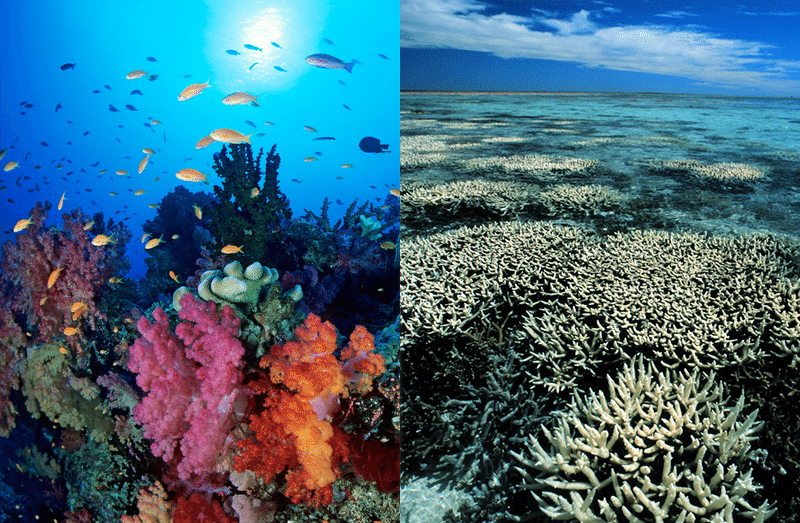
Healthy Coral Reef (Left) versus Bleached Coral Reef (Right).
Left photo by Gary Bell / Oceanwideimages.com. Right photo by Greenpeace / Roger Grace.

Coral reefs are extraordinarily sensitive to temperature. A sustained increase of just 1–2°C can trigger coral bleaching, a process in which corals expel the symbiotic algae (zooxanthellae) that provide them with food and color. Without these algae, corals lose both their vibrant appearance and their primary energy source. 

The world has already experienced multiple global bleaching events, including severe episodes in 1998, 2010, and 2016–2017. In 2016 alone, approximately 29% of coral in the northern section of the Great Barrier Reef died in a single year due to extreme marine heat. 

Bleaching becomes a tipping point when it happens too frequently. If reefs do not have time to recover between heat events, they shift from vibrant, biodiverse ecosystems into algae-dominated rubble. Once that shift occurs, erosion accelerates, fish populations decline, and water quality worsens. Even if ocean temperatures later stabilize, the ecological structure needed for recovery may be gone. 

This matters far beyond marine biology. Coral reefs support roughly a quarter of all ocean species and provide food security, tourism revenue, and coastal protection for more than 500 million people worldwide. Their collapse would represent not just an ecological tipping point, but a social and economic one. 

Coral reefs are not alone in facing dangerous thresholds. 

The Amazon Rainforest presents another looming tipping element. Often called the “lungs of the Earth,” the Amazon plays a crucial role in carbon storage and rainfall regulation. But deforestation, drought, and climate change are pushing it toward a savanna-like state. 

Roughly 17% of the forest has already been lost. Scientists estimate that crossing a 2025% deforestation threshold could trigger widespread dieback, as the rainforest would no longer generate enough moisture to sustain itself. Such a shift would release vast amounts of stored carbon, intensify regional drought, and disrupt global climate systems. 

Communities living in the Amazon are already experiencing longer dry seasons and more frequent wildfires. The tipping point is not theoretical—it is unfolding in real time. 

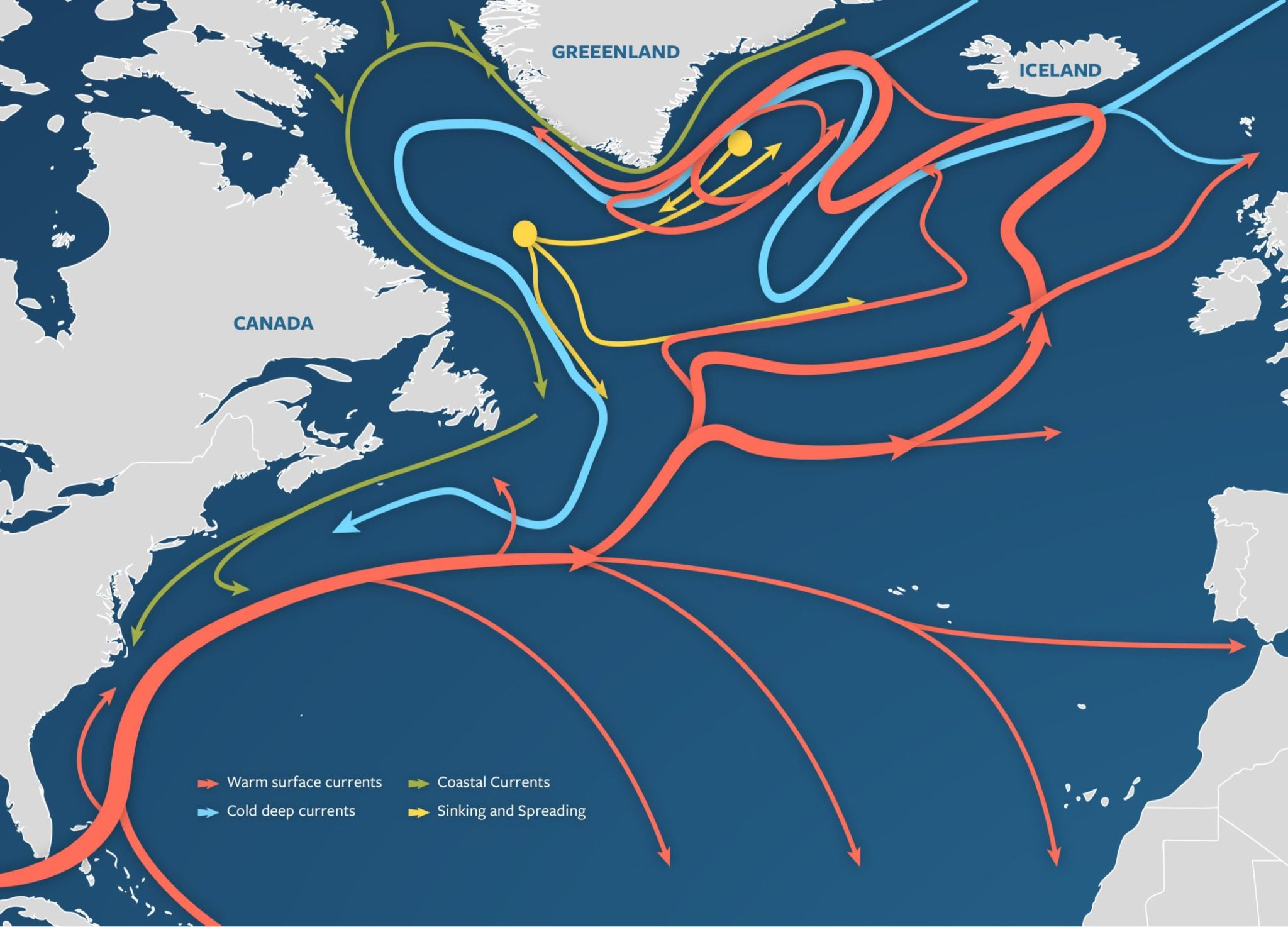
The Atlantic Ocean contains yet another tipping element: the Atlantic Meridional Overturning Circulation (AMOC). This vast system of currents acts like a global conveyor belt, moving warm water northward and cold water southward. It plays a critical role in regulating the climate, particularly in Europe. 

Visual representation of the AMOC (Illustration by Eric S. Taylor, © Woods Hole Oceanographic Institution)

Freshwater from melting Greenland ice disrupts the salinity balance that drives this circulation. Evidence suggests the AMOC has weakened by roughly 15% over the past half-century. Continued slowdown could dramatically alter weather patterns, disrupt food systems, and intensify regional climate extremes. 

Each of these tipping points is different. But they share a common feature: once these negative feedback loops take hold, change accelerates. 

Yet these systems are not beyond influence. The difference between 1.5°C and 2°C of warming may determine whether coral reefs survive in reduced form or largely vanish. It may shape whether ice sheet melt accelerates gradually or crosses into a runaway decline. 

Reducing global greenhouse gas emissions remains the most critical action. Limiting warming slows feedback loops before they spin out of control. This, of course, faces limitations as our government has recently limited its ability to regulate emissions.  

Local and regional measures matter as well. Marine Protected Areas can strengthen coral resilience by reducing overfishing and pollution. Coral restoration efforts—nurseries, selective breeding for heat tolerance, assisted gene flow—are being tested. Improving water quality reduces stress on reef systems. Early warning systems allow faster response to marine heatwaves. 

The concept of tipping points can feel overwhelming. The language of it all: irreversible, collapse, runaway, all suggest inevitability. 

But tipping points are thresholds, not set-in-stone prophecies. 

The climate system responds to actions, not despair. Slowing warming slows negative climate feedback. Stabilizing temperatures stabilizes systems. Action taken before thresholds are crossed carries far greater impact than action delayed. 

The lesson of climate tipping points is not that collapse is certain. It is that timing matters. The window for avoiding the most destabilizing shifts is narrower than it once was, but it remains open for now.  

Whether these systems cross their thresholds depends on decisions made in the present, not centuries from now. 

We (College Students) Are Not Climate Villains — But Our Choices Still Matter

College students are often quick to point out—correctly—that they are not the primary drivers of climate change. Corporations, governments, and fossil fuel industries bear the greatest responsibility for rising emissions.

But that reality does not mean student behavior is irrelevant. On college campuses, everyday choices made by thousands of students add up, shaping both a university’s carbon footprint and the culture around climate action.

Universities contribute to climate change through several types of emissions, often grouped into three categories or scopes.

There are Scope 1 emissions, which come from on-site fuel use, such as heating systems or university vehicle fleets. Along with these are Scope 2 emissions, which include purchased electricity that powers classrooms, dorms, and labs.

The largest category for many campuses, however, is Scope 3 emissions, indirect sources like commuting, air travel, food purchasing, waste, construction materials, and the goods students consume.

It is in this third category where student behavior matters most. Scope 3 emissions are shaped by daily habits: how students get to campus, what they eat, and what they buy.

While students often have lower per-person emissions than older adults due to smaller living spaces and fewer long-distance trips, those advantages can disappear quickly through heavy car use, fast fashion purchases, takeout packaging, and dorm-related waste.

Just as importantly, the habits and norms students develop during college often carry into adulthood. Choices that feel minor now can shape long-term patterns of consumption, transportation, and environmental responsibility, increasing the likelihood of higher-impact behaviors later in life.

At Purdue University Fort Wayne, this issue is especially visible. PFW is widely considered a commuter-heavy campus, with university leaders estimating that roughly threequarters of students commute instead of living on or near campus.

Transportation alone becomes a major climate factor under those conditions. Using EPA averages: A student commuting 10 miles one-way, 4 days/week, over two semesters produces = 1 metric ton of CO₂ per year. When multiplied across thousands of commuters, even modest individual changes begin to matter.

Consumption patterns compound the problem. Overconsumption among younger generations has become normalized, fueled by social media trends, influencer marketing, and constant product cycling.

Trend-driven purchases, whether they be clothing or collectibles like Funko Pops (an especially wasteful product), may feel harmless, but they carry real environmental costs.

Electronics tell a similar story. Many students upgrade phones, tablets, and gadgets frequently, often without properly recycling old devices. Surveys show that a majority of Gen Z and Millennial consumers do not fully understand what electronic waste is, and many throw devices directly into the trash. This creates one of the fastest-growing waste streams in the world and embeds additional emissions into mining, manufacturing, and shipping replacement devices.

What makes this issue particularly frustrating is that students are not indifferent to climate change. Surveys consistently show that a majority of young people are deeply worried about the climate crisis, with many reporting anxiety that affects their daily lives.

Yet awareness does not always translate into action. Research has identified a persistent attitude–behavior gap: students may understand the environmental harm of fast fashion or excessive consumption, but continue to indulge in these habits because they are cheap, convenient, and socially reinforced.

This gap is not simply a failure of personal responsibility. It reflects structural pressures—limited transit options, affordability constraints, and digital ecosystems designed to encourage constant consumption.

As long as trend culture and algorithm-driven marketing dominate student spaces, climate concern alone will struggle to turn into consistent behavior change. However, institutional support—especially around transportation and food systems—can help shift habits in areas where students have the greatest opportunity to make lower-impact choices.

There are, of course, simple ways in which students can adjust their lives to reduce impact. Carpooling, combining errands, adjusting class schedules, or using transit where available can reduce emissions. Small energy habits, such as turning off lights, lowering the heat or air conditioning when away, and using energy-saving device settings, also add up. Choosing plant-forward meals occasionally, reducing food waste, and reusing textbooks or dorm goods can lower emissions without demanding major lifestyle overhauls.

Beyond individual choices, students hold real influence over institutional action. Universities often respond to student pressure, whether through climate action plans, renewable energy targets, or improved transit and recycling infrastructure.

On many campuses, including this one, students are already working, formally and informally, to push sustainability efforts forward, demonstrating that change is possible and that individual involvement contributes to a broader, ongoing movement rather than starting from scratch.

Student organizations, campus committees, and student government all offer avenues to push for transparency and accountability. Civic engagement, such as voting and participating in local community and governmental planning extend that influence beyond campus borders.

Students are not the villains of the climate story. But neither are they powerless bystanders. The reality lies somewhere in between. Our daily choices shape campus emissions, signal our climate stance values, and influence whether our climate concern becomes real action. At commuter-heavy schools like PFW, those choices matter even more. Climate progress does not begin and end with students—but it does pass through them.

Building Global Connections at Purdue Fort Wayne

By Cincade Drudge

As campuses across the country recognized International Education Week (IEW), Purdue Fort Wayne used the Nov. 17-21 celebration not just to highlight global cultures for a few days, but to showcase a growing community of international and multicultural students who enrich campus life year-round.

PFW has been participating in the week-long event for over a decade. According to Shelby Mansfield, assistant director for International Student Services, IEW has been part of U.S. higher education since 2001.

Mansfield explained that International Education Week began as a joint initiative between the U.S. Department of State and the Department of Education.

“So it was a collaborative effort to really highlight the value of international education and also exchange opportunities for U.S. students going abroad and the value of having exchange students come to the U.S.,” she said.

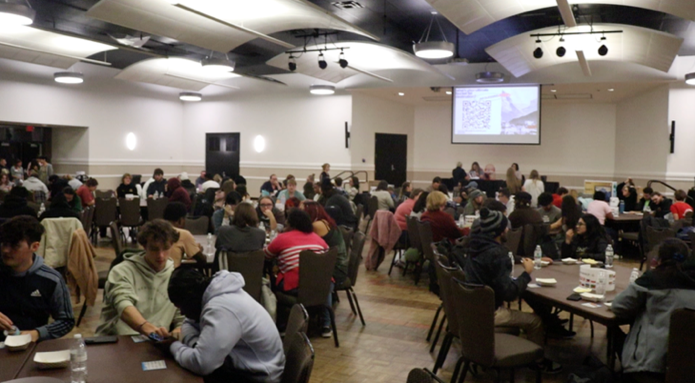
For PFW, the centerpiece of the week is the Global Student Celebration, a Friday-night event featuring cultural food, performances, and the annual Parade of Nations.

“The International Ballroom is typically full, sometimes standing room only at the sides,” Mansfield said. “It’s an awesome opportunity to exchange culture through food and performance.”

One of her favorite moments each year is the parade. “Students come on stage, and they say something [typically a greeting] in their native language,” she said. “It gives me goosebumps because it might sound like a really simple idea, but it’s just awesome when you’re in a room when that happens.”

This year’s events also included international bingo and trivia events hosted by the Office of International Education. Mansfield spoke on how the events are connected to international education.

“Not necessarily each prize, but each round of bingo will have something international attached to it,” Mansfield stated. Trivia night, she added, is a campus favorite: “It’s super fun because we have a couple of student workers that help create this trivia … We all try to see how well we did at the international-themed trivia.”

The purpose of all these events is to shed light on and provide a sense of community for the international students. PFW currently enrolls 269 international students, with representation from more than 50 countries. India, Pakistan, Bangladesh, and Ghana are among the most represented.

Mansfield emphasized that affordability and the Purdue name continue to attract international students to come to PFW from their home countries.

 “The Purdue degree, the reputation behind what that means when they’re getting a job, and searching for a job after graduation, but also affordability,” she explained.

International students arrive through a mix of recruitment strategies. PFW’s admissions staff physically visits countries to recruit students. They also host virtual fairs that high school students or current college students can attend.

But Mansfield stressed that the support for these students goes far beyond recruitment. Her office assists with everything from immigration advising and how to avoid scams to simply helping students adjust to their new environment.

For many students, the Global Student Celebration is a rare opportunity to publicly represent where they come from.

Nishad Parulekar, an engineering student from India, said he chose PFW for its close-knit campus feel and supportive faculty. But adjusting to life in the United States came with challenges.

“Being away from family was the hardest part,” he said. “But events like this help you interact with people.”

Nishad performed at this year’s celebration, sharing a piece of his culture with the campus community. He said International Education Week personally represents a time to “meet people, share traditions, and understand what other students have experienced.”

His dream is to work in robotics, hopefully in Germany, a place he believes offers strong opportunities for engineers. But for now, PFW has provided a sense of belonging for him.

Not all students who participated in the celebration are international; some are domestic students with multicultural backgrounds who use the event to express identities that often go unnoticed.

Milayi, who grew up in Fort Wayne but whose family is from Myanmar, performed a dance she choreographed for the Water Festival, her ethnic group’s New Year celebration. Many people assume she is Burmese, she said, but she is actually part of a minority ethnic group within Myanmar.

“Not many people know who we are,” Milayi said. “So it’s meaningful to represent my culture here.”

She added that IEW gives students a chance to learn how many cultures exist on campus, cultures that might not be visible in everyday classroom interactions.

While IEW is designed with internationally connected students in mind, domestic students are also engaging with global cultures on campus.

Siddharth Vemparala, a domestic student who attended the international-themed bingo night because he heard about it from friends, said events like these broaden student perspectives.

“I’ve learned that people grow up with completely different experiences,” he said. “When you meet students from other countries, you gain a lot of perspective. It changes how you see the world.”

He recalled friendships with former dorm neighbors who shared meals from their home countries with him. “It’s really fun to learn from each other and try their local dishes,” he said. “PFW does a good job mixing students in classes and housing, so you interact naturally.”

While International Education Week is a highlight, assistant director Mansfield emphasized that its true purpose extends beyond the celebration itself.

“Every institution has its own spin on it,” she said. “So the main goals of it would be to share, I would say, share culture and traditions, and to help promote that sense of belonging on your own campus.”

As PFW’s international community continues to grow, IEW offers a window into the friendships, challenges, and cultural exchanges that shape campus life, not just in a single week, but year-round.

Climate Change Is Transforming Midwestern Winters     

As climate change continues to shape weather patterns across the globe, some of its most visible effects are emerging not in blistering summer heat waves or devastating hurricane seasons, as one might expect from the effects of global warming, but in the quiet months of winter. Across the Midwest and northern states, including Indiana, winters are shifting in ways that are unexpected and contrary to popular understandings.  

While climate change is widely associated with warming temperatures, its influence on winter weather is far more complex. It actually intensifies weather extremesscrambling weather patterns, and fueling heavier storms. Atmospheric patterns become more volatile, producing sudden temperature swings. Snowfall decreases overall, yet the snowstorms that do occur can be stronger than before.  

Much of the confusion stems from a common misconception: the belief that if cold days or snowstorms still occur, climate change must not be real. This conflation of weather and climate, short-term conditions versus long-term trends, remains one of the biggest barriers to public understanding. Even as the planet warms, individual winters can and will still deliver bursts of frigid weather. In fact, some of the most intense winter storms are now fueled by a warmer, wetter atmosphere. 

These changes are increasingly clear across Indiana, where winter is now a season defined by unpredictability. Indiana’s Thanksgiving weekend storm this year is a clear example of how this new weather pattern works. Even though average winters are warming, the storm delivered heavy snow, sudden temperature drops, and pockets of freezing rain. 

But behind these day-to-day variations lies a broader pattern: midwestern winters are warming, destabilizing, and becoming less reliable. 

Across Indiana, winter temperatures have risen steadily over the past several decades. Extremely cold days are less common, and winter nights are warmer than they were for previous generations. On the surface, this might sound appealing to those who hate cold weather, but the consequences ripple out in ways that touch ecosystems, infrastructure, and public safety. 

Warmer air means precipitation increasingly falls as rain rather than snow. Winter rainstorms, once rare, now commonly bring flash flooding and icy roads. 

Another growing challenge is the sudden back-and-forth swings between freezing and thawing. Instead of long stretches of consistent cold, Indiana now sees rapid temperature shifts, sometimes within a single day. These cycles damage roads and bridges, destabilize ice on rivers and lakes, stress plants, and create dangerous conditions for anyone spending time outdoors. 

These new winter patterns are reshaping not only the human world, but the natural world just as dramatically. 

Animals that rely on predictable cold seasons are struggling. Species that hibernate, such as bears, groundhogs, and bats, can emerge too early during warm spells, burning through precious energy reserves long before spring food is available. Small mammals like rabbits and mice lose their protective blanket of snow, leaving them exposed to predators and harsh cold snaps. 

Plants and vegetation are equally vulnerable. Early thaws can trigger out-of-season growth, only for sudden freezes to destroy these new shoots. Herbivores such as deer and moose then face food shortages, while heavy winter rains can wash away stored plant matter or disrupt food caches.  

Amphibians that wait out the winter in mud or under ice are especially vulnerable: repeated freeze–thaw cycles caused by erratic winter temperatures can stress or even kill them. 

Migratory species, mainly birds, are feeling the effects too. Unpredictable seasonal cues cause early or delayed migrations, leading to mismatches between arrival times and food availability. 

The weather changes, and ecological shifts are only part of the story. Warmer, wetter winters create substantial challenges for communities across Indiana. 

Rain replacing snow increases flood risk by producing immediate runoff instead of slow snowmelt. Cities are already seeing more burden on storm drains, bridges, and roads. Agriculture suffers when soils repeatedly freeze and thaw, damaging crops and disrupting planting cycles. Infrastructure takes a hard hit as well: potholes, frost heaving, and water damage drive up maintenance costs. 

Winter-based recreation is also changing. Winter sports like skiing, ice skating, and snowmobiling depend on consistent cold that the Midwest and northern states increasingly lack. While Indiana is not as dependent on winter tourism as northern states, snow-based recreation remains a nostalgic and formative part of childhood. Losing reliable snow means losing opportunities for outdoor play that many Hoosiers grew up with. 

The winter as we know it, in all its harshness and joy, is slipping away. If we continue on our present path, many of the defining features of Midwestern winters may disappear entirely. Preserving the season we know will require recognizing the changes already underway and taking meaningful action before they accelerate further. 

Cincade Drudge is a student journalist at Purdue University Fort Wayne and a Waterfield Environmental Intern at the Environmental Resources Center on campus. 

Climate Change Preparedness Faces Political and Practical Challenges

By Cincade Drudge

As extreme weather events grow more and more frequent and devastating, the question shifts from how to prevent climate disasters to how to prepare for when they strike.  

Around the world, weather-related disasters have already affected more than 2.5 billion people, caused 2 million deaths, and resulted in over $4 trillion in economic losses the last fifty years.  

Floods, droughts, and heat waves are intensifying, and their effects are rarely consistent. A region may face drought one year and flash flooding the next. These unpredictable swings make preparedness one of the most complex challenges in the fight against climate change. 
Preparation for climate change may be complex, but it is not an optional venture; it is vital. Because climate change cannot be fully prevented, adaptation and resilience efforts are now a core part of protecting at-risk communities. Preparedness now means developing plans, strengthening infrastructure, and improving response systems before disaster hits. 

These actions can take many forms: updating stormwater systems, building cooling centers, restoring wetlands, expanding urban tree cover, or ensuring emergency alerts reach residents in multiple languages. The question then becomes, where will the money to fund all this come from?  

The cost of funding preparedness is a frequent complaint of opponents. However, it has been found that every dollar spent on climate preparedness yields a $13 return in avoided damages and cleanup costs. In other words, investing in resilience pays off even if a disaster never occurs. 

Federal agencies like the Environmental Protection Agency (EPA), the Department of Homeland Security, and the National Oceanic and Atmospheric Administration (NOAA) have all developed adaptation plans that integrate climate data into their operations and emergency planning. 

Funding programs such as FEMA’s Hazard Mitigation Assistance and the EPA’s Climate Pollution Reduction Grants help turn these plans into reality, supporting states and cities with the resources to build resilience.  

Federal legislation like the Bipartisan Infrastructure Law and the Inflation Reduction Act further bolsters clean energy and climate resilience investments, helping to fund clean energy projects and develop a federal climate planning strategy.  

But these positive efforts have not been without political friction. The current administration has signaled its intent to scale back environmental regulations and limit the authority of federal agencies, threatening to undo years of progress.

Some of the agencies that lead on preparedness have even faced existential threats through budget cuts, workforce reductions, and policy rollbacks. In addition, the administration has imposed new limitations on scientific bodies such as NOAA, restricting data collection and suppressing climate-related research. These moves have extended even to the political policing of language; agencies were reportedly discouraged or outright banned from using terms like ‘climate change’ in official documents.

That tension is especially visible at the state level, where climate preparedness can depend heavily on politics. In Indiana, for example, climate planning has faced major obstacles.  

The Indiana Department of Environmental Management (IDEM) recently created a Priority Climate Action Plan under an EPA grant, identifying vulnerabilities like flooding, extreme heat, and agricultural disruption. 

However, that work came to an abrupt halt. Governor Mike Braun ordered the agency to cease developing federal climate plans without his or the legislature’s approval—effectively freezing the project. IDEM returned the remaining federal funds, leaving no clear path forward. 

Regional organizations, like the Northwestern Indiana Regional Planning Commission (NIRPC), have tried to fill the gap with localized climate documents and community engagement. Yet, without state-level backing, these efforts often lack the resources and authority to create widespread change. 

This leaves much of the responsibility to local governments, who often face the steepest challenges and the greatest need, with fewer resources.  

Leaders have tried to step up here locally in Fort Wayne; under the Sustaining Fort Wayne Initiative, the city developed its Climate Action and Adaptation Plan (CAAP), a blueprint for both emissions reduction and resilience.  

The plan outlines practical steps such as improving stormwater management, expanding urban forestry to combat extreme heat, and protecting waterways from contamination during severe storms. 

Inclusion is a core focus of Fort Wayne’s strategy. Emergency communications are being adapted to reach non-English-speaking residents, and the city uses the Hoosier Resilience Index to measure progress and identify vulnerable populations.  

These actions demonstrated that meaningful preparedness can happen from the ground up, even when higher levels of government falter. 

However, while these efforts marked meaningful groundwork, movement appears to have slowed in recent years. Since the second Trump administration began, there have been few visible updates or expansions to the city’s climate plans, raising concerns that momentum has stalled at a time when local leadership is increasingly critical.

Still, the road ahead is anything but simple. Many local governments lack the funding, staffing, and expertise to carry out large-scale adaptation projects. Federal support fluctuates with each election cycle, and state politics can either bolster or block local action. 

The result is a patchwork of preparedness across the country; some regions are building up preparedness and resilience with strong leadership and investment, while others remain dangerously unprepared. 

The stakes could not be higher. Climate preparedness isn’t about distant future threats; it’s about protecting lives, homes, and communities right now. Investing in preparedness saves money, prevents loss, and ensures a safer, more stable future for everyone. 

While Fort Wayne has already made a meaningful attempt at preparedness, we can always push for more support for these efforts and encourage similar preparedness efforts in surrounding communities and on a federal level.  

Cincade Drudge is a student journalist at Purdue University Fort Wayne and a Waterfield Environmental Intern at the Environmental Resources Center on campus. 

Environmental Disinformation Poses Growing Threat

By Cincade Drudge

Part of the challenge of protecting our planet today is not just the very real effects of the changing climate itself, but the flood of false and misleading information regarding it. 

Environmental disinformation, which is the intentional effort to mislead the public about environmental issues, has become one of the biggest barriers to meaningful action. It often comes from industries or political actors with a financial stake in delaying change. 

Climate misinformation has surged in recent years, with multiple studies showing that misleading posts from unreliable sources often attract two to three times more engagement than accurate information on platforms like Facebook and Instagram. 

We’ve seen this playbook of purposeful falsehoods before. Tobacco companies once funded doubt about the dangers of smoking, delaying public health reforms and costing countless lives. 

Take the myth ​of plastic recycling. For decades, the plastics industry​ ​has promoted recycling as a solution to environmental damage caused by plastic waste​, even though only about 5% of plastic in the U.S. is actually recycled.

The result? People blame themselves for not recycling enough instead of asking why so much single-use plastic is produced in the first place. 

Or consider “clean coal.” Despite the name, coal remains one of the dirtiest energy sources on Earth, responsible for air pollution and millions of dollars in public health costs. Marketing it as “clean” allows companies to appear responsible while avoiding meaningful reform. 

Perhaps most crucially, the fossil fuel industry has taken this same strategy to a global scale, using misinformation to question the reality of climate change and the science behind it. The goal is the same across industries: to confuse, divide, and stall progress. 

Why should you care? Because disinformation doesn’t only distort the debate around climate change, it changes real material outcomes. When the public is unsure what to believe, it’s easier for policymakers to do nothing.  

Every year that passes without decisive climate action adds to the cost, environmentally, economically, and socially. Before long, we will find ourselves in a world of hurt, with a destroyed climate and a population too steeped in disinformation to do anything about it. 

These stories are not isolated; they form a pattern of deception that benefits a few while harming many. And now, with social media, this misinformation spreads faster than ever.  

Influencers, podcasts, and partisan outlets amplify misleading claims, often without fact-checking or accountability. Consider this: eight of the top 10 online shows are spreading climate misinformation.  

So what can be done? Transparency would be a start. When corporations, politicians, and media outlets are required to disclose who funds their messages, the public can make informed decisions about credibility.  

Media literacy is another key step: teaching people how to recognize biased sources and understand how scientific consensus is built. 

This scientific consensus concept leads to another important point: Scientists, too, must meet the public halfway by communicating clearly and openly, without the technical jargon that can alienate audiences.  

The need for scientific clarity doesn’t erase the blame we as individuals face. We must take steps (no matter how small) toward reaching climate accuracy via verifying info before sharing, supporting credible journalism, and challenging falsehoods when we see them. 

The battle for truth is part of the fight for a livable planet. If we allow disinformation to shape public understanding, the consequences will be very real.  

Take voting, for example; U.S. voters’ opinion on climate change has been found to have swayed enough voters in 2020 to account for a 3% swing in the popular vote. This shift, if reversed by disinformation, could have switched the winner of the presidential election, dramatically shifting U.S. Climate policy.  

This shows that holding powerful actors accountable and demanding honesty in environmental communication isn’t optional; it’s vital to securing a bright future for both us and hopefully those long after us. We can’t allow misinformation to affect the outcomes of our elections, our policies, or our future.  

If you encounter misleading environmental claims or wish to learn how to identify them, consider using resources such as Science Feedback, Media Bias/Fact Check, and Hot Air, each of which provides accessible tools for fact-checking and misinformation reporting. 

We all have a role in protecting not just our environment, but the truth that helps us defend it. 

Cincade Drudge is a student journalist at Purdue University Fort Wayne and a Waterfield Environmental Intern at the Environmental Resources Center on campus. 

AI in Education: A Gift or a Curse?

By Cincade Drudge

A stressed student sits at a table in the Helmke Library, considering their options. They click from the tab containing their research notes to the Word document showing their barely started research paper.

The student is facing a 12-page research paper with a rapidly approaching due date. The paper’s dull topic makes it even harder to find motivation to work on it, especially while juggling the workload from their other classes and a part-time job. 

Thinking of the time and effort it would take to write the whole paper in the little time they had remaining, the student makes an all-too-common choice: turning to ChatGPT for assistance.


This anonymous student isn’t alone in this course of action. Whether they are using it for brainstorming, to check grammar, or even to write entire assignments, artificial intelligence tools like ChatGPT have become common tools in the arsenal of many college students.

Some see it as a revolutionary tool for evolving learning, while others view it as a threat to critical thinking. Regardless of one’s personal stance on it, one thing is clear: AI is here, and it is affecting education for better or worse.

According to a survey from the Digital Education Council, 86 percent of university students already use AI in some form for their studies. The degree to which students use AI, and the frequency of use, can vary, but the numbers collected in the survey paint a striking picture.


Of all students surveyed, around 54 percent use AI on at least a weekly basis, with nearly 1 in 4 of all respondents using AI daily. The degree to which students use AI goes from simple tasks like searching for information or checking grammar to more complex, ethically gray uses like drafting entire assignments.

The rise of AI tools and their application to educational assignments has sparked debate on college campuses across the country. Students and faculty are forced to reimagine how learning happens to keep up with the times. With that comes a flurry of questions about ethics, integrity, and what education is supposed to look like in the digital age.


On a student level, AI usage is all about choice. Students can choose not to use AI at all, to use it responsibly, or to abuse it.

Zach Grindle, a sophomore student at PFW, doesn’t shy away from using AI; however, he aims to keep his use of it ethically acceptable.

“I look at it as a learning tool, not as a way to cheat,” he said. “I don’t have it write assignments for me, but if I don’t understand something, I’ll ask ChatGPT. It helps fill the gap between Googling and going to a professor.”

Grindle’s measured use of AI represents a positive usage of AI as more of an academic assistant rather than a shortcut. He’s also careful to follow the intent of professors’ guidelines on AI and respect their opposition to AI, even if he personally disagrees.

“I think if you teach students how to use it correctly, it becomes a benefit,” he said. “If you ignore it, students will just use it anyway.”

But not all students maintain such a balanced relationship with the technology.

The overwhelmed student from the beginning of this story, who asked to remain anonymous, admits to having relied on AI far too heavily in the past.

“Last year, I used it to an unhealthy degree,” they said. “It wrote most of my assignments for me. I’d just change the wording to avoid detection.”

They know it’s hurting their learning but find it difficult to stop using it.

 “It’s just so useful—it’s hard not to use it,” they said.

For a final research paper last semester, they fed ChatGPT all of their research and had it draft the paper section by section.

This student’s experience with AI underscores the danger of resources like ChatGPT, as it can become a crutch that harms students’ academic development.

On a faculty level, professors have both optimism about the potential of AI and concerns about students exploiting it. 

Kevin Stoller, a professor at PFW and a faculty member at the university’s Center for the Enhancement of Learning and Teaching, has an optimistic view of AI’s potential.

“I encourage students to use AI to dig deeper and create better assignments,” Stoller said. “It helps them brainstorm and see different perspectives. I see it as an opportunity for learning, not a threat.”

For Stoller, the key is engagement.

“If you critique the AI’s response, analyze it, and think through what it’s telling you, then you’re learning. If you just copy and paste, you’re not,” he said.

He acknowledges the risks, especially for students who cut corners, but believes the solution is creating assignments that allow for students to critically engage with both course material and AI.

 “We have to equip students to use it responsibly,” he said. “Almost every job they enter in the future will expect them to know how to use AI.”

Through the Center, faculty are given multiple templates for AI policies. Some professors ban it outright. Others allow limited use with transparency. The university encourages each instructor to choose what best fits their teaching goals while pursuing academic honesty.

Deborah Bauer, a history professor at PFW, shares both optimism and concern when it comes to AI’s influence in higher education.

“I both find ChatGPT and AI beneficial but also worrying,” she said.

On the one hand, she’s found AI helpful in developing more creative assignments for her online courses, especially for non-history majors who may struggle adapting to more traditional formats of teaching.

“I do kind of turn to AI when I’m trying to think of new kinds of creative assignment ideas. I’m working on redesigning online versions of some classes where the assignments may be easily answered by AI,” Bauer said. “The AI has been neat, suggesting things like timeline assignments and poster assignments and different things like that.”

To Bauer, AI has its uses, but her core concern lies with students who rely too heavily on AI before they have developed basic academic skills.

“It’s stressful when I get answers that look AI-generated,” she said. “Some submissions feel like they were prompted directly into ChatGPT. They don’t draw from class lectures or materials.”

While she recognizes the signs of AI usage: the tone, phrasing, or even suspiciously polished structure, Bauer finds herself stopping short of accusing students.

“I can’t prove it, and I don’t want to falsely accuse anyone,” she said.

Professor Bauer believes AI is best used by students who already know how to evaluate its suggestions.

“I worry that students who haven’t mastered research or writing don’t even realize when AI gives them the wrong information. They can’t tell,” Bauer said.

She still sees AI as an opportunity. But for her, the soul of learning lies in human connection.

“One of the best parts of teaching is seeing students’ faces, responding in real-time, and watching them learn from each other. That can’t be replaced,” she said.

Educators like Professors Stoller and Bauer face the same problems as many educators across the country and begin asking questions: What counts as cheating? What happens when AI can paraphrase well enough to dodge plagiarism checkers? And how do you teach critical thinking in a world where answers are instantly available? Are AI detection tools accurate?

The answers to many of these questions remain unclear, as the educational debate on AI continues.

As AI continues to evolve, so too must education. Students and professors alike argue that banning AI entirely is both unrealistic and counterproductive.

As Professor Stoller said, AI will be used in these students’ future careers, but the point raised by Professor Bauer about human connection in the classroom is also relevant as we consider how education will evolve along with AI.

Students like Grindle and the anonymous student will serve as test cases in the first generation of learners to adapt to AI. Whether this will in the end be to their benefit or detriment remains to be seen. But nothing can put that genie back in the bottle; AI is here, and students and professors alike will be forced to adapt to it.

And back at Helmke Library, that stressed-out anonymous student stares at the screen as the AI-generated paragraphs build. It’s fast. It’s convenient. But it’s not their voice, and deep down, they know it.

Tackling Food Insecurity: How PFW’s Campus Pantry and Community Organizations Are Making a Difference

By Cincade Drudge

Food insecurity, or the lack of reliable access to sufficient amounts of food, is a growing concern among many Allen County residents, with college students in particular struggling to balance the costs of tuition, housing, and other basic living expenses with healthy eating.

At Purdue University Fort Wayne, the FRIENDS of the University Pantry is tackling this issue head-on by providing essential resources to students and other local residents in need. It works alongside other community organizations, such as the Community Harvest Food Bank, to ensure that students have access to nutritious food while pursuing their education.

On a national level, college students experience relatively high levels of food insecurity, with data from the National Library of Medicine estimating food insecurity among American college students ranging from 19% to 56%.

Chart Source: USDA, Economic Research Service using U.S Department of Commerce, Bureau of the Census, Current Population Survey Food Security Supplements Data

On a national level, college students experience relatively high levels of food insecurity, with data from the National Library of Medicine estimating food insecurity among American college students ranging from 19% to 56%.

While there is no data directly researching food insecurity rates at PFW, one can infer that insecurity exists at the university from the number of people using the FRIENDS of the University Pantry, which is around 9,000 annually, suggesting that a substantial number of PFW students rely on its services.

Eric Manor, associate chief for campus and community wellbeing at PFW, who oversees the pantry, highlighted this growing need and exponential usage since the pantry started in 2017.

“In 2023 and 2024, we’ve seen about 9,000 visits each year, a number that had been steadily increasing until it recently leveled off. While we can’t say exactly how many students are food insecure, the demand—both from students and community members—shows that more people are relying on the pantry than ever before,” he said.


Nationally, this increase in demand can be seen in the food insecurity rate, which hovers around 13.5%, according to the most recent USDA data, showing an increase from recent years. Feeding America reports that Allen County has a similar food insecurity rate of 13%. The USDA data also indicates that around 5% of total food-insecure people experience “very low” levels of food insecurity, meaning they often have to skip meals due to low food budgets, eventually leading them to negative consequences for their health.

A multitude of factors contribute to food insecurity, including rising costs of living, low wages, unemployment, and inflation. Inflation is a significant driver of food insecurity, making it difficult even for individuals who get wage increases to overcome it.

Logan Haffner, the impact manager at Community Harvest Food Bank, highlighted how inflation and food accessibility contribute to the issue.

“You could have a certain amount of income living in this space, and then two years later, you still have that job, and maybe you’ve even gotten a raise, but life has become more expensive, and two grocery stores near you have closed. So now you are food insecure and living in a food desert when two years ago, you weren’t,” Haffner said.

The food deserts mentioned by Haffner are another important aspect of food insecurity. These areas, where residents have limited access to affordable and nutritious food, disproportionately affect lower-income individuals and college students who may not have reliable access to transportation to reach grocery stores outside their immediate neighborhoods.

In these areas, individuals often resort to purchasing cheaper, processed foods that lack nutritional value, further exacerbating health issues such as obesity, diabetes, and malnutrition. Certain areas of Fort Wayne have been classified as food deserts, further intensifying the food insecurity problem in Allen County.

To combat these food insecurity challenges, the FRIENDS of the University Pantry at PFW serves as a critical resource for both university students and local residents facing food insecurity. The pantry provides fresh produce (depending on the time of year), shelf-stable food, and refrigerated/freezer food; individuals can receive up to 15 or 20 items per week, depending on where the items are sourced from. These cut-offs are necessary since some of the food comes from state-run programs, while the majority of it comes from the Community Harvest Food Bank.

Manor, the overseer of the pantry, spoke of the requirements, or lack thereof, to receive goods from the pantry.

“There are no eligibility requirements required. It’s really just show up as you are. There is a short form participants fill out the first time they come once they fill out that for the first time, they can just come in, type in their name, get their food, and then they can go,” he said.

Manor clarified that although the government requires them to collect certain information, they are not necessarily obligated to verify its accuracy, leaving that decision to the participants themselves. Additionally, exit surveys are submitted to Community Harvest on a monthly basis.

Among those involved with the FRIENDS Pantry is Abigail Coates, a PFW student who initially volunteered at the pantry for a class project.

Since being hired at the pantry in November 2024, Coates has taken on a variety of roles at the pantry, including bagging food for visitors and stocking shelves. Coates emphasized how eye-opening the experience has been.

“It made me realize that the little things in life can mean so much to some people,” she said. “For me, I can just go to the grocery store and get whatever I need, but for some of these people, it’s so amazing to see how it impacts their lives. I’m so grateful to be the one to do that.”

To students hesitant about using the pantry, Coates emphasized the inviting atmosphere of the pantry.

“It is a very judgment-free zone. Even if you aren’t struggling on a large scale, I think it’s a wonderful resource. It’s very easy to use, and it’s very beneficial,” she said.

Coates’ experience with the pantry highlights the role students can play in addressing food insecurity not just as beneficiaries of the pantry, but as active participants in combating the issue of food insecurity.

Beyond campus, the Community Harvest Food Bank plays a vital role in addressing food insecurity throughout Allen County. The organization distributes food to thousands of families each month, partnering with local pantries, churches, and community organizations to maximize its reach. Celebrating its 42nd year in operation, Community Harvest served an impressive 91,500 people last year.

Community Harvest offers 10 distinct service programs aimed at helping different groups of people, including veterans, seniors, children, and families. They also offer a program called Saturday Helping Hands, which, similarly to the FRIENDS pantry, is open distribution, asking for no eligibility requirements.

Front of the Community Harvest Food Bank (Courtesy of Community Harvest Food Bank)

Despite these achievements, Impact Manager Haffner emphasized that the organization still has a long way to go when it comes to reaching its ultimate goal of putting an end to food insecurity.

“When I first started working at Community Harvest two years ago, we had never served a thousand households in a distribution ever. Then we broke that record, and now we’re almost twice that for the average,” Haffner said. “Part of this, we can chalk up to successful marketing and making more people aware. We’re always excited to help those in need, but seeing those numbers climb—it feels like the issue is getting worse faster than we’re able to keep up.”

Adding to these concerns are the additional challenges organizations like these two face: funding, volunteer availability, and raising awareness are constant hurdles.

Manor stressed funding challenges organizations like his face.

“We face lots of challenges regarding the funding, and we’re not alone in that. We’re not university-funded, so all funds that we have are generated through either grants, donations, or food drives. We do a number of different things in the campus community to try to kind of get a supply of steady goods rolling through the pantry as well,” he said.

Looking ahead, organizations like the FRIENDS Pantry and Community Harvest Food Bank are exploring ways to expand their services. Mobile food pantries, partnerships with local grocery stores, and policy advocacy are all part of broader efforts to address food insecurity in sustainable ways.

For those in need, resources are readily available. The FRIENDS of the University Pantry offers essential items with no barriers to entry:

  • Thursday: 10 a.m.–2 p.m. | Walb Union, Room G36
  • Monday & Tuesday: 4–7 p.m. | Student Housing, Clubhouse

Meanwhile, Community Harvest Food Bank continues its mission through multiple distribution programs, including the Farm Wagon and Saturday Helping Hands, ensuring food reaches those who need it most.

As food insecurity remains a pressing issue for both students and local residents, solutions-driven initiatives like these serve as models for how communities can come together to create lasting change.