This past week, all three of Peter Jackson’s Lord of the Rings movies (the extended editions) were re-released in theaters worldwide. Surprisingly, I had never seen these films before, and have no nostalgia for this franchise at all. But I am intrigued by it. This felt like the perfect opportunity to finally experience this franchise in some way for the first time.
I decided to watch only the first movie because reviewing the entire trilogy in one go would be too massive of an undertaking, especially given that I’m relatively new to reviewing movies. Even so, I thought it would be interesting to take a look at The Fellowship of the Ring from the unique perspective of someone experiencing Tolkien’s world for the very first time.
Theatrical release poster / New Line Cinema
As a new, fresh cinematic experience for me, I have to say this was absolutely incredible—magical, even. I was immediately in awe of the scenery, as I had heard a bit about the filming locations, but seeing them in motion was mesmerizing. Much of the first hour takes place in the Shire, home of the Hobbits, and many of my favorite aspects of the movie are introduced here.
The score, for example, is one of the most beautiful things I have ever heard. The end-credits theme, the themes that play in the Shire scenes, and the Rivendell motifs are all going on my sleep playlist for sure. It is an astounding achievement not just in film scoring but in music overall. The soundtrack transports you to the world of Middle-Earth just as effectively as the visuals do. Maybe even more so.
Experiencing Tolkien’s storytelling in any form for the first time was truly special. Of course, I don’t know which lines of dialogue are directly from the novel, but I thought the dialogue in this movie had a compelling earnestness to it, and was also genuinely poetic at times. Gandalf, in particular, delivers several moments of powerful “sage wisdom” that felt really impactful. Regardless of how much of the dialogue in this adaptation is Tolkien’s own words, I can really understand why people consider him one of the greatest writers of all time.
I was also incredibly impressed that, despite this being the extended edition of The Fellowship of the Ring —clocking in at 3 hours and 28 minutes— it never felt like it dragged. I’ve seen extended cuts of movies before where the added content disrupts the pacing, but this version of Fellowship flowed perfectly for me.
Given that this is a film based on Tolkien’s novels, one of the most iconic works of high fantasy ever created, there’s plenty of larger-than life scenery and breath-taking action sequences in this film. My favorite was the final battle with the orcs in the forest. I love the camera work, special effects, and fight choreography on display in this sequence.
And [[SPOILERS AHEAD]] Boromir’s sacrifice was truly emotional and became one of my favorite moments in the film. Another standout scene was Gandalf fighting the Balrog. As a new viewer, getting to see the “You shall not pass!” moment on the big screen is something I will never forget. Both scenes are incredibly powerful and speak to how much of a cinematic achievement this film is.
To conclude, Peter Jackson’s version of The Lord of the Rings: The Fellowship of the Ring is a timeless film. Even as someone with zero nostalgia for the franchise, I found that it holds up one thousand percent. It’s an easy recommendation for anyone looking for a truly memorable viewing experience.
By Andrew Danielson / Photos by Lauren Lee and Justin Moore
A species of ground squirrels. A unique camera trap with motion-activated cameras. And the states of California and Rhode Island.
As it turns out, all those items have a lot in common, particularly when it comes to the wildlife biology laboratory of Dr. Scott Bergeson, associate professor of animal biology at Purdue University Fort Wayne in the department of biological sciences.
For over a year, two of Bergeson’s graduate students, Justin Moore, originally from Rhode Island, and Lauren Lee, who hails from California, have been working on separate but complementary research projects focusing on wildlife conservation and management.
Lee, who received her undergraduate degree in biology from the University of California, Santa Barbara, is working on a project to survey and identify the variety of small mammal species that exist throughout Indiana.
“The goal is to survey the entire state for small mammals,” Lee said.
Lee’s mentor, Bergeson, explained that the last time a survey of small mammals in Indiana was completed was around 2007. That means that wildlife conservation officials such as those at the Indiana Department of Natural Resources have no fresh statistics on the health and population figures for small mammals.
Mammals are good indicators of the health of a particular ecosystem. If there is a diverse population of mammals in the area, that ecosystem is probably healthy.
“All of these small mammals and all of the other things help maintain the health of these natural spaces,” Bergeson said. “Even our agriculture would suffer if we didn’t have the natural spaces that help filter the pollutants that would otherwise get into our crops. Everything is connected.”
Smile – You’re on Camera
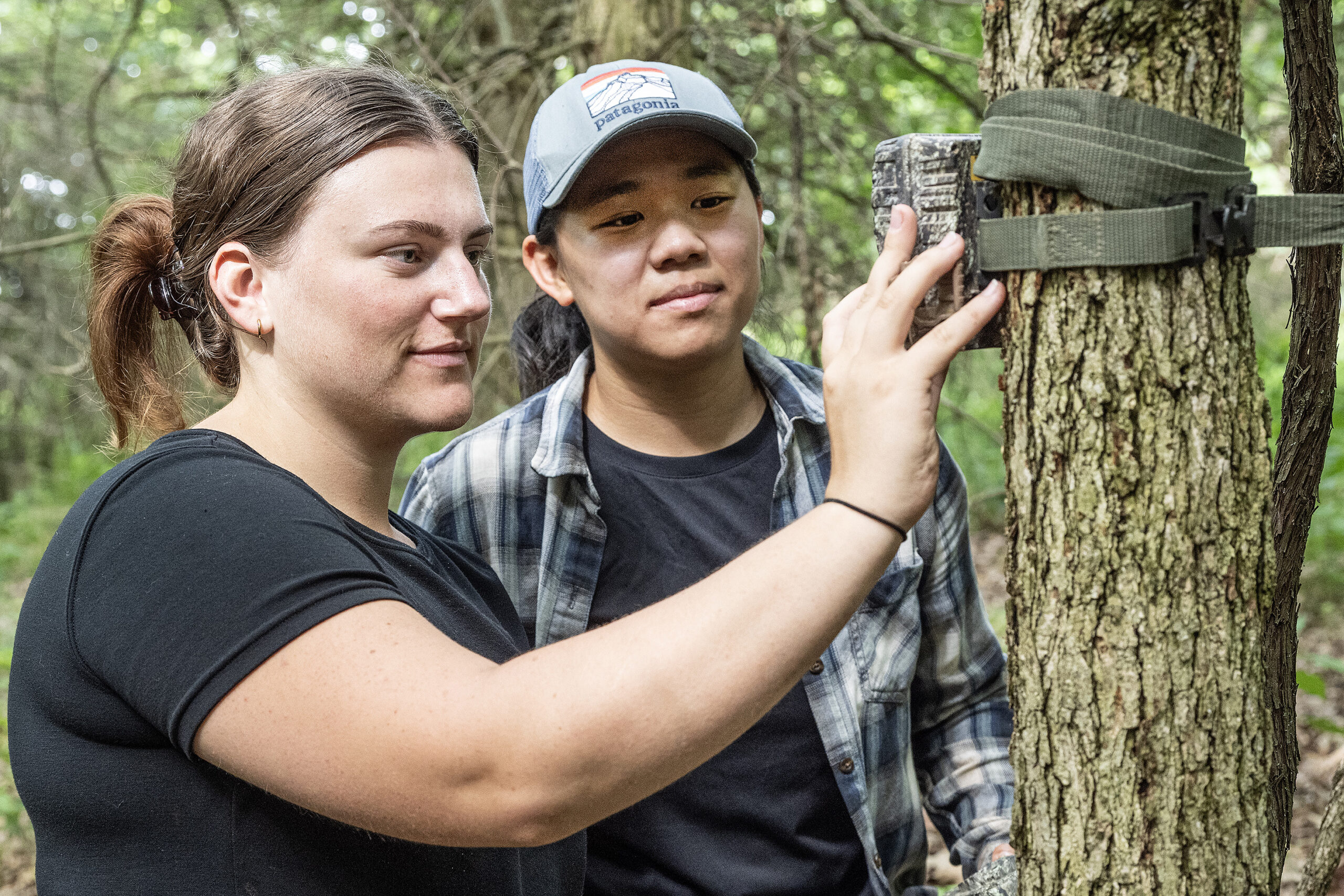
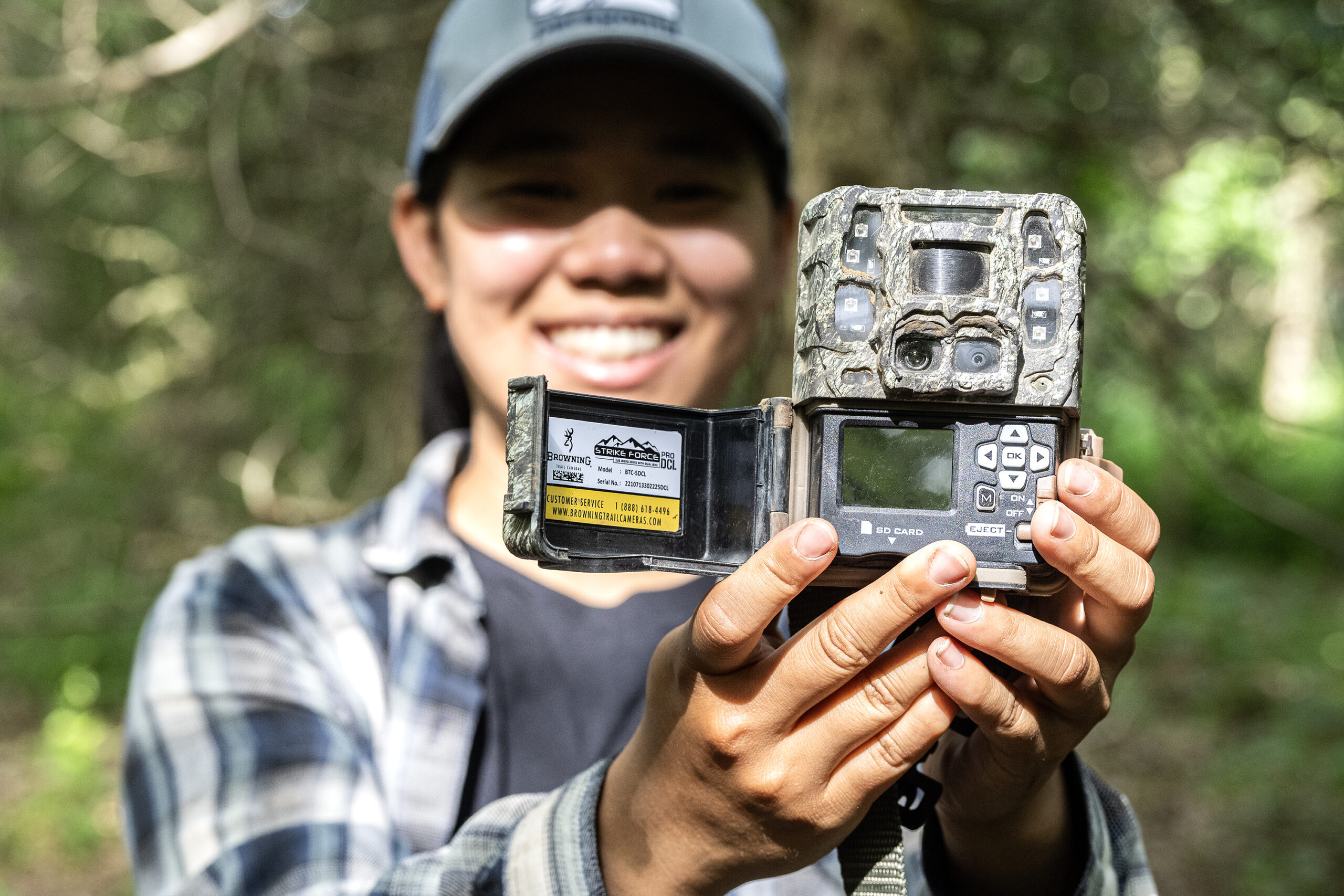
Lauren Lee and one of her technicians, CJ Klopfenstein, inspect one of the cameras used in the projectGraduate student Lauren Lee
Lee’s project, which is funded by a $150k grant from the Indiana Department of Natural Resources, is ambitious to say the least. If she were to use traditional trapping methods to conduct her survey, as was done in the 1960s, her project would take many years to complete.
But Lee and Bergeson have a solution: camera technology and upside-down buckets.
Lee explained that she installs “camera traps” on publicly-owned property, at least 100 meters away from any trail or road.
Each camera trap consists of a temporary “wall” made of a plastic material that leads to overturned buckets. An upside-down bucket with entrance holes cut into the bottom houses the actual camera.
The traps don’t use any bait, relying instead on animals’ natural curiosity or scent. When an animal approaches the trap, the “wall” barrier naturally guides them to the hole in the bucket. Once the animal walks into the bucket, their photo is snapped.
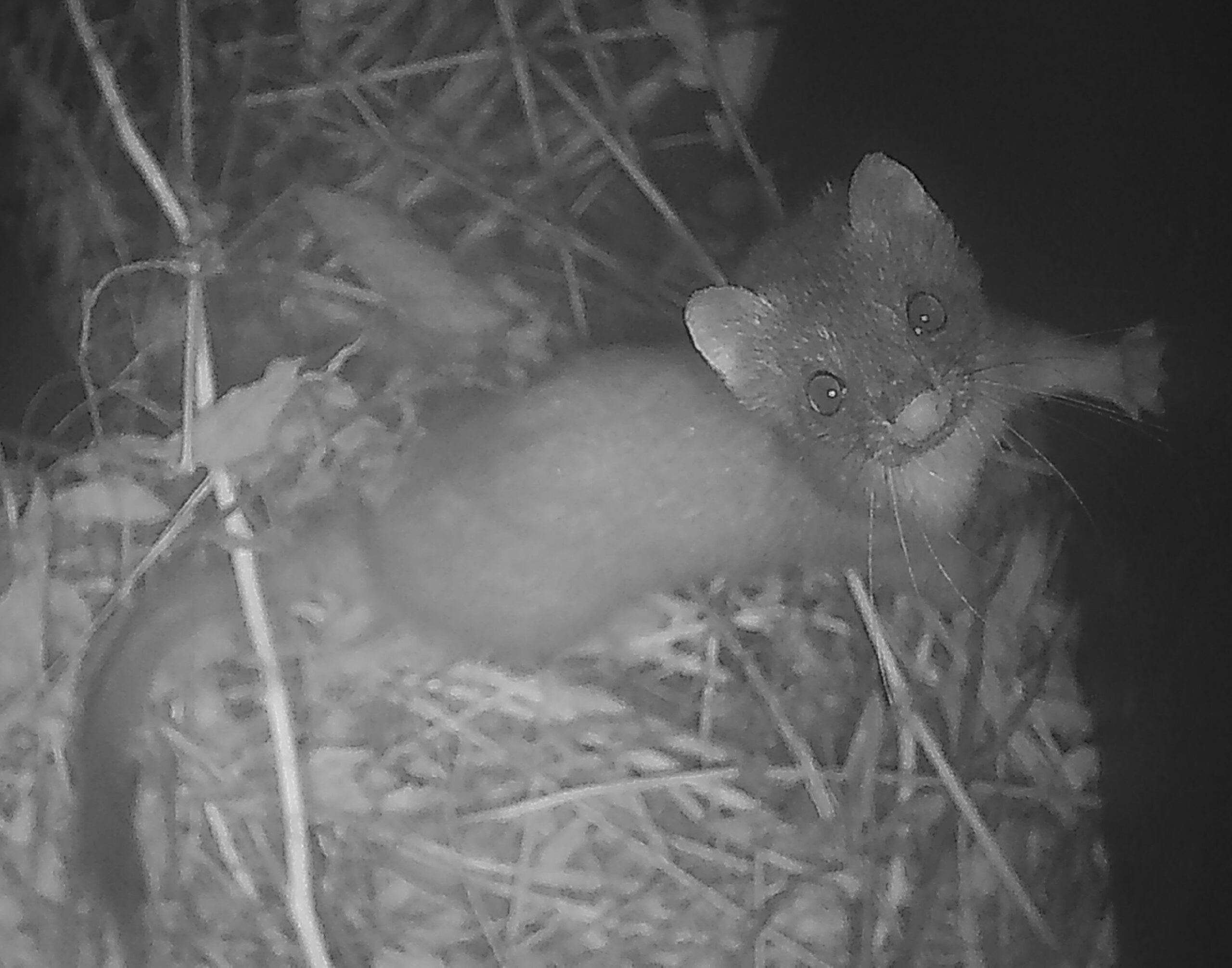
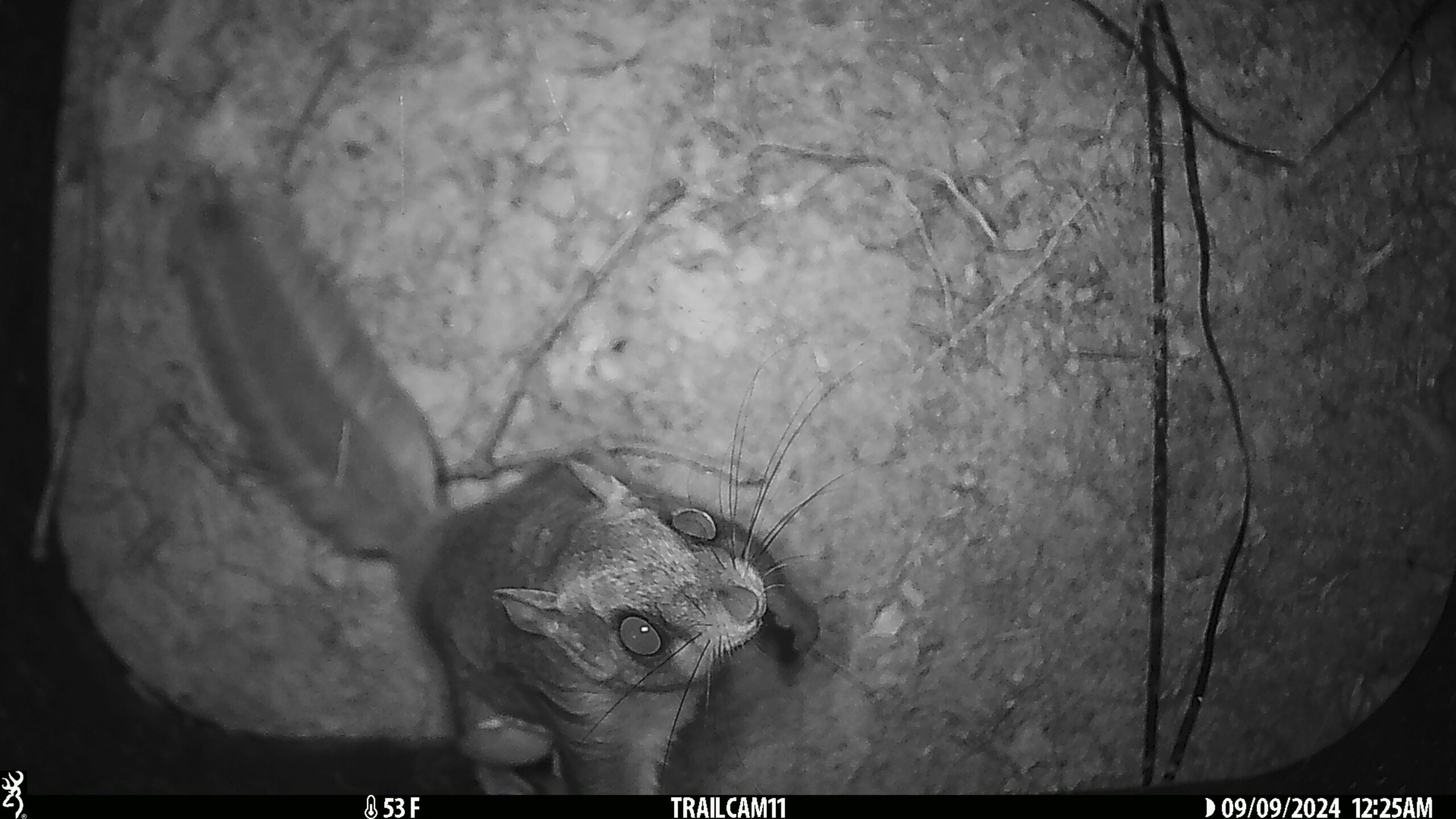
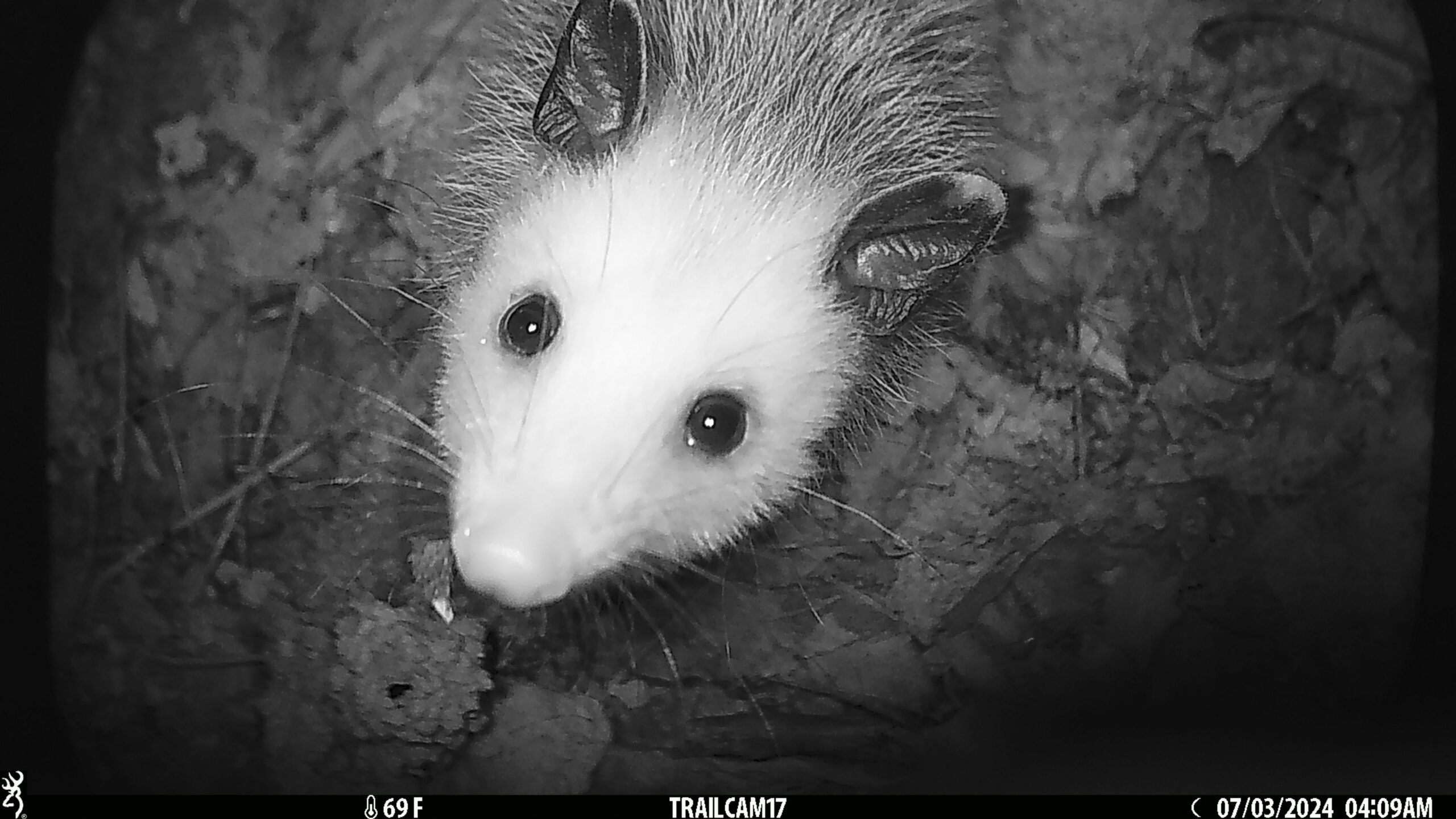
The cameras are infrared-equipped and motion activated, so there’s no bright flashes when the camera snaps photos. The lenses used on the camera are designed to provide close-up, magnified views of the animals, providing easier identification of the small furry visitors.
Long-tailed weaselSouthern flying squirrelJuvenile Virginia Opossum
Lee explained that she currently has 102 camera trap sites, spread across the entire state. To collect the photos taken from her cameras, she has to drive to each site, swap out SD cards in the cameras, and perform maintenance on the site as needed.
From those sites, Lee has collected 1.5 million photos, with hundreds of thousands of photo sequences.
To help collect and process all of that information, Lee is being assisted by two undergraduate technicians and an artificial intelligence software. The AI automatically sorts through the sequences of photos and provides Lee with some basic species identification. She then checks what the artificial intelligence has done, making sure that the identifications are accurate.
“So, the whole idea is that we have this huge database of photos from everywhere and then for the next 100 years we can start mining that data to figure out other sorts of things,” Bergeson said.
A Squirrel’s View on Indiana
Yet another of Bergeson’s graduate students, Justin Moore, is also undertaking an ambitious wildlife conservation project with the assistance of two undergraduate technicians.
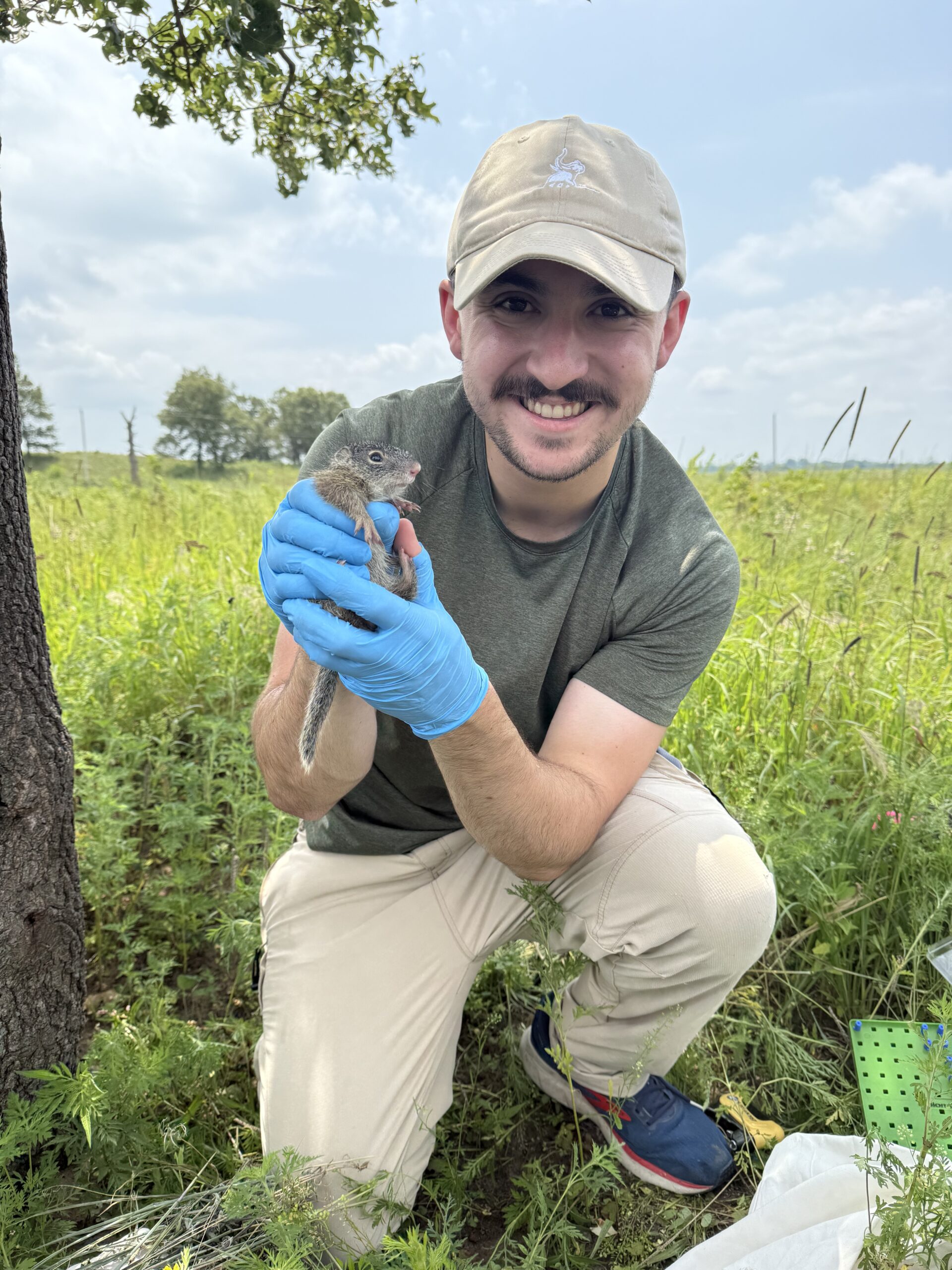
Moore, who received his undergraduate degree in wildlife conservation from the University of Rhode Island, is working to help stabilize a population of ground squirrels here in Indiana, called the Franklin’s ground squirrel.
Moore explained that ground squirrels are similar to tree squirrels, but they’re actually separate species with different diets, preferred habitat, and behavior.
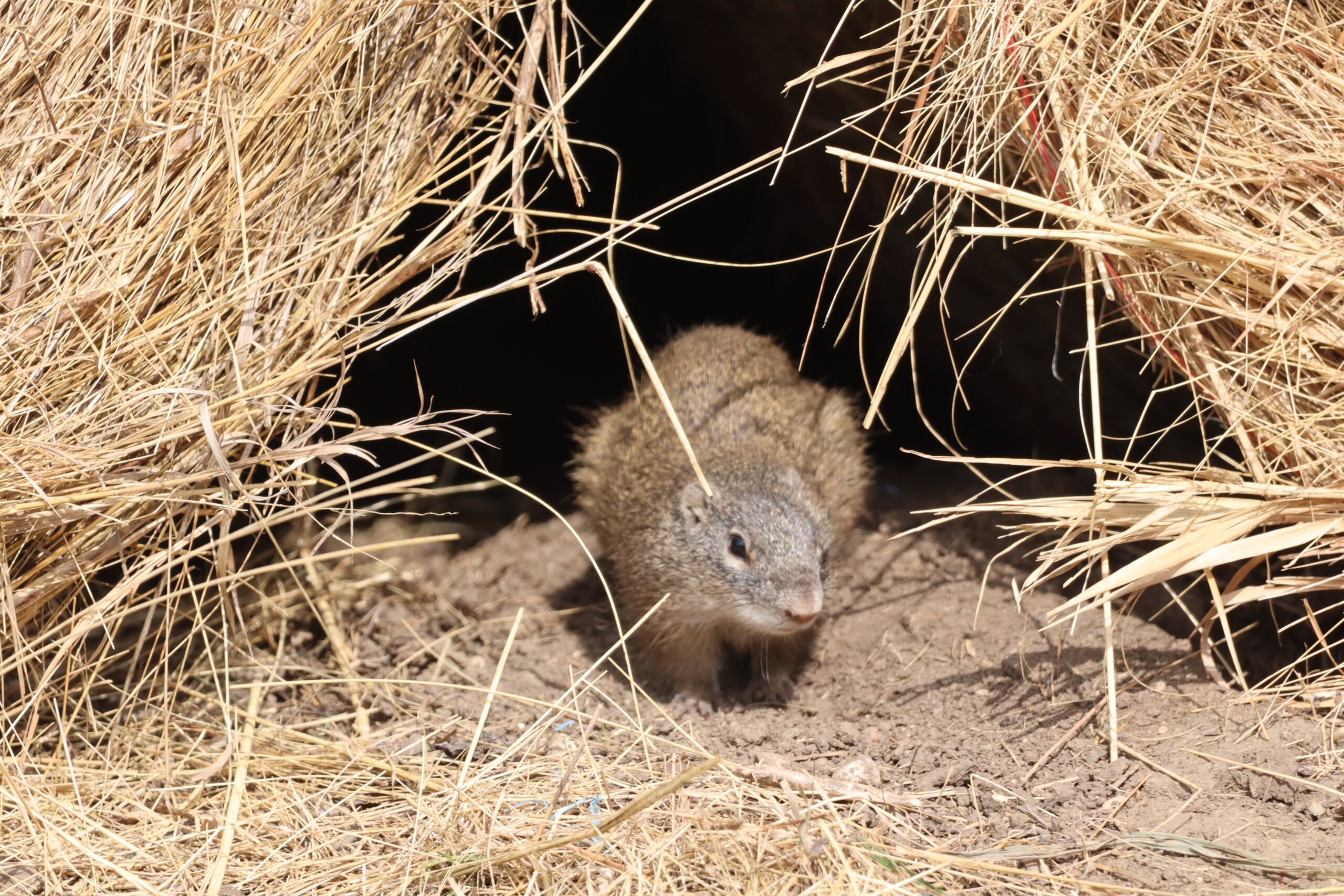
According to Moore, Franklin’s used to have a fairly wide range in Indiana. However, due to the loss of prairies across the state, the ground squirrel’s preferred habitat, that population has shrunk to just one natural population in the region.
Franklin’s ground squirrel leaves its burrow in a hay bale
“They are state endangered in Indiana, and they’re declining across most of the Midwest,” Moore said.
Moore’e project, which is also fully funded by a roughly $200k grant from the Indiana Department of Natural Resources, is to help stabilize the Franklin’s population by re-locating healthy specimens from other states to Indiana. His project is a pilot study, so the techniques he is using will help in future re-location projects of either Franklin’s or other small animals that are endangered.
How to Move a Squirrel: Carefully!
Moore explained that, together with his mentor Bergeson, they identified a strong, healthy population of Franklin’s in South Dakota. Moore and Bergeson quickly formed an agreement between wildlife conservation officials in South Dakota and Indiana, enabling them to bring Franklin’s from South Dakota back here to Indiana.
But moving squirrels is no easy task.
“There’s a lot that goes into the trapping to make sure that the squirrels and we [the researchers] are safe,” Moore said.
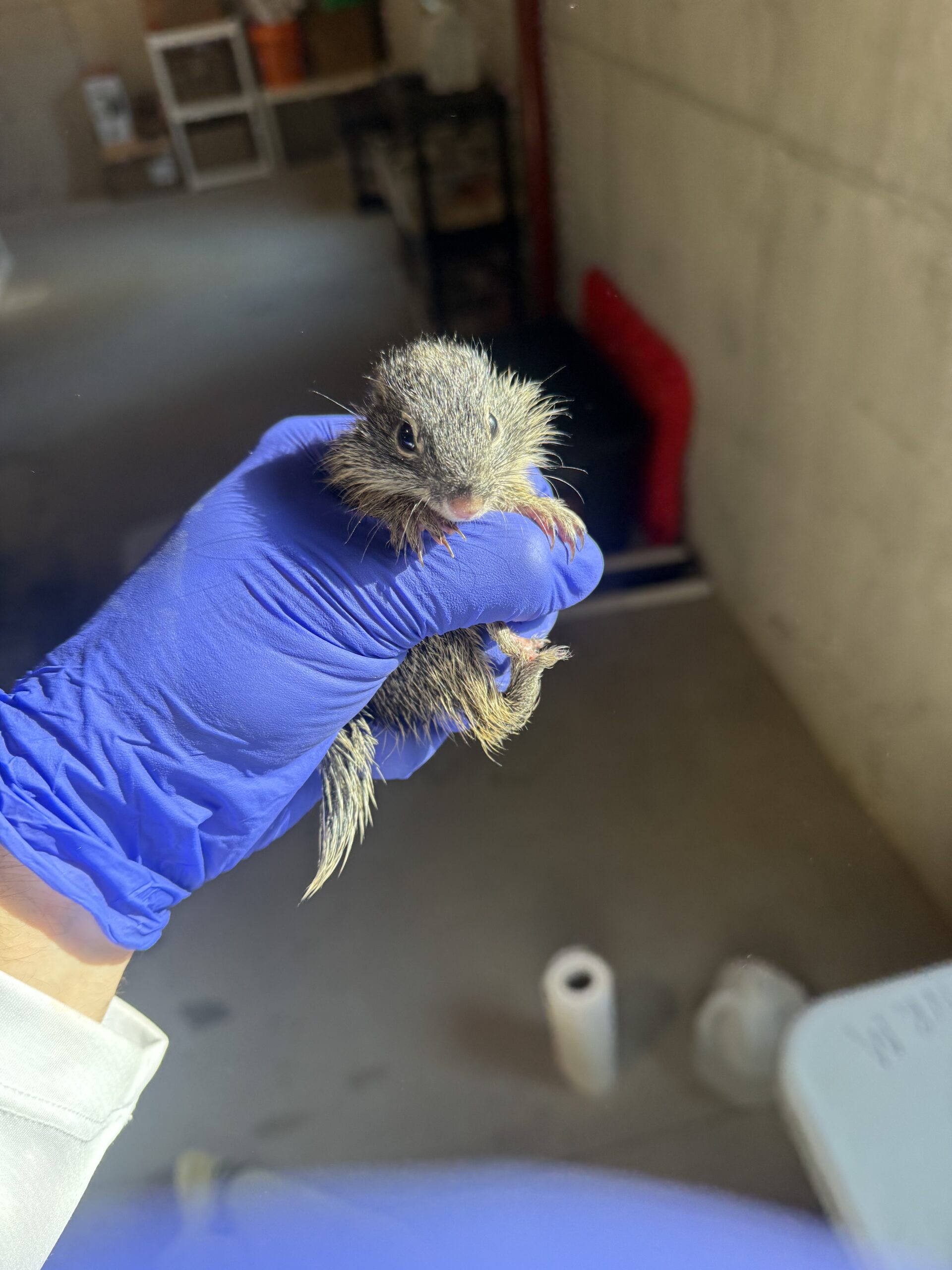
Handling of a baby Franklin’s ground squirrelJustin Moore holds a Franklin’s ground squirrel
The capture sites for the squirrels in South Dakota are designed to minimize stress and discomfort to the animals, including routine checks on the traps and special coverings to provide shade to captured animals in the traps.
Researchers receive rabies vaccines before interacting with the animals, and all captured animals are initially handled through special handling cones that keep the squirrels calm and unable to bite the researchers.
Once the animals have been captured, they undergo a thorough process of medical checkups, including treatments for any diseases spread by ticks or lice. A veterinarian check-up and a full 21-day quarantine period are also rigorously followed to ensure that diseased animals are not brought into Indiana.
Once Moore brings the squirrels to Indiana, he releases them into what are called “soft release” enclosures, allowing the newly translocated squirrels to get used to their new habitat before being fully released into their Indiana home.
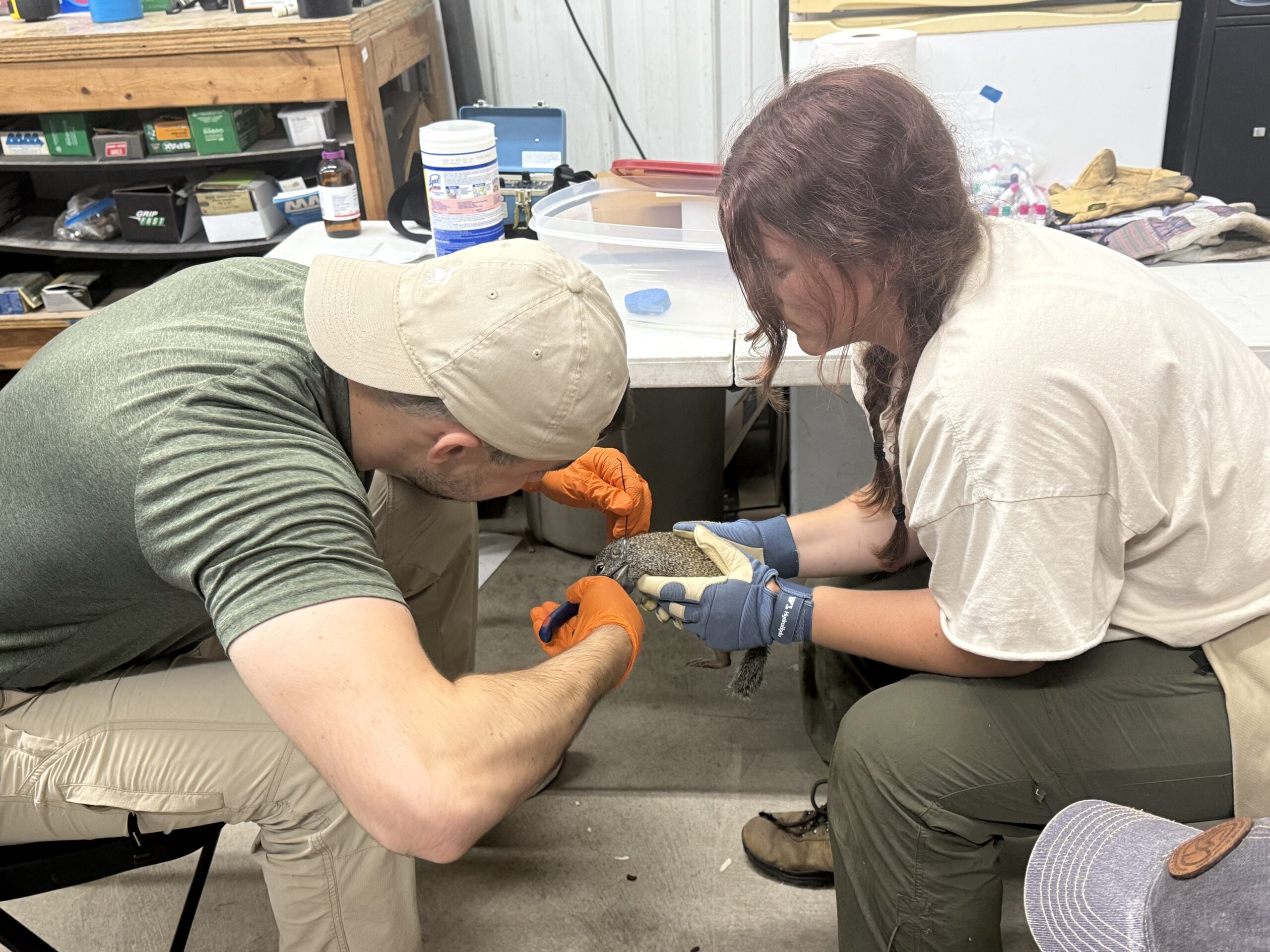
Moore is assisted by technician CJ Klopfenstein as they collar a Franklin’s ground squirrel
To keep tabs on the squirrel population and its well-being, Moore uses small radio transmitters attached to the Franklin’s that allow him to track their movements using a small receiver and antenna.
The new Franklin’s ground squirrels being brought to Indiana are being released in Newton County on property owned by The Nature Conservancy, a non-profit group that advocates for wildlife conservation.
PFW Biology Students Having National Impact with Research
Both of these research projects are forging new ground in the world of wildlife conservation.
Dr. Bergeson said that Lee’s project has already resulted in a research protocol that is now being shared among various states engaged in wildlife research. That protocol, coupled together with her unique use of artificial intelligence, will provide other researchers with tools and techniques needed in today’s field of wildlife conservation.
Moore’s project is also making inroads into the field of wildlife conservation.
As he talked about his project, Moore said that the project will hopefully result in Franklin’s populations stabilizing. That means the population will, one day, grow strong enough to be removed from the state endangered classification.
And these projects are already paying dividends for their researchers, as Moore, Lee, and their technicians, all gain conservation experience from their projects.
“I feel like any new experience with any kind of wildlife is really, really cool,” Lee said.
Moore agrees with that view.
“I couldn’t imagine doing anything else,” he summarized.
It’s a win-win situation for Lee, Moore, and their two undergraduate research technicians who assist them with their projects. They all gain valuable research experience and the opportunities to do future projects or write and publish their findings in research journals.
For the undergraduate technicians, the field research training they are gaining will help them strengthen their potential future applications to graduate school.
But perhaps the greatest benefit these projects are providing is the effect they have on wildlife conservation.
Bergeson said that projects like Lee’s camera traps and Moore’s squirrel translocations are having valuable impacts on Indiana’s conservation efforts.
“Our lab has actual impacts on that, which is super cool,” Bergeson said.
College students are often quick to point out—correctly—that they are not the primary drivers of climate change. Corporations, governments, and fossil fuel industries bearthegreatestresponsibilityforrisingemissions.
But that reality does not mean student behavior is irrelevant. On college campuses, everyday choices made by thousands of students add up, shaping both a university’s carbon footprint and the culture around climate action.
Universities contribute to climate change through several types of emissions, often grouped into threecategoriesorscopes.
There are Scope 1 emissions, which come from on-site fuel use, such as heating systems or university vehicle fleets. Along with these are Scope 2 emissions, which include purchased electricity that powers classrooms, dorms, and labs.
The largest category for many campuses, however, is Scope 3 emissions, indirect sources like commuting, air travel, food purchasing, waste, construction materials, and the goods students consume.
It is in this third category where student behavior matters most. Scope 3 emissions are shaped by daily habits: how students get to campus, what they eat, and what they buy.
While students often have lower per-person emissions than older adults due to smaller living spaces and fewer long-distance trips, those advantages can disappear quickly through heavy car use, fast fashion purchases, takeout packaging, and dorm-related waste.
Just as importantly, the habits and norms students develop during college often carry into adulthood. Choices that feel minor now can shape long-term patterns of consumption, transportation, and environmental responsibility, increasing the likelihood of higher-impact behaviors later in life.
Trend-driven purchases, whether they be clothing or collectibles like Funko Pops (anespeciallywastefulproduct), may feel harmless, but they carry real environmental costs.
Electronics tell a similar story. Many students upgrade phones, tablets, and gadgets frequently, often without properly recycling old devices. Surveysshowthata majorityofGen Z and Millennial consumers do not fully understand what electronic waste is, and many throw devices directly into the trash. This creates one of the fastest-growing waste streams in the world and embeds additional emissions into mining, manufacturing, and shipping replacement devices.
What makes this issue particularly frustrating is that students are not indifferent to climate change. Surveysconsistentlyshowthata majorityofyoungpeople are deeply worried about the climate crisis, with many reporting anxiety that affects their daily lives.
Yet awareness does not always translate into action. Research has identified a persistent attitude–behavior gap: students may understand the environmental harm of fast fashion or excessive consumption, but continue to indulge inthese habits because they are cheap, convenient, and socially reinforced.
This gap is not simply a failure of personal responsibility. It reflects structural pressures—limited transit options, affordability constraints, and digital ecosystems designed to encourage constant consumption.
As long as trend culture and algorithm-driven marketing dominate student spaces, climate concern alone will struggle to turn into consistent behavior change. However, institutional support—especially around transportation and food systems—can help shift habits in areas where students have the greatest opportunity to make lower-impact choices.
There are, of course, simple ways in which students can adjust their lives to reduce impact. Carpooling, combining errands, adjusting class schedules, or using transit where available can reduce emissions. Small energy habits, such as turning off lights, lowering the heat or air conditioning when away, and using energy-saving device settings, also add up. Choosing plant-forward meals occasionally, reducing food waste, and reusing textbooks or dorm goods can lower emissions without demanding major lifestyle overhauls.
Beyond individual choices, students hold real influence over institutional action. Universities often respond to student pressure, whether through climate action plans, renewable energy targets, or improved transit and recycling infrastructure.
On many campuses, including this one, students are already working, formally and informally, to push sustainability efforts forward, demonstrating that change is possible and that individual involvement contributes to a broader, ongoing movement rather than starting from scratch.
Student organizations, campus committees, and student government all offer avenues to push for transparency and accountability. Civic engagement, such as voting and participating in local community and governmental planning extend that influence beyond campus borders.
Students are not the villains of the climate story. But neither are they powerless bystanders. The reality lies somewhere in between. Our daily choices shape campus emissions, signal our climate stance values, and influence whether our climate concern becomes real action. At commuter-heavy schools like PFW, those choices matter even more. Climate progress does not begin and end with students—but it does pass through them.
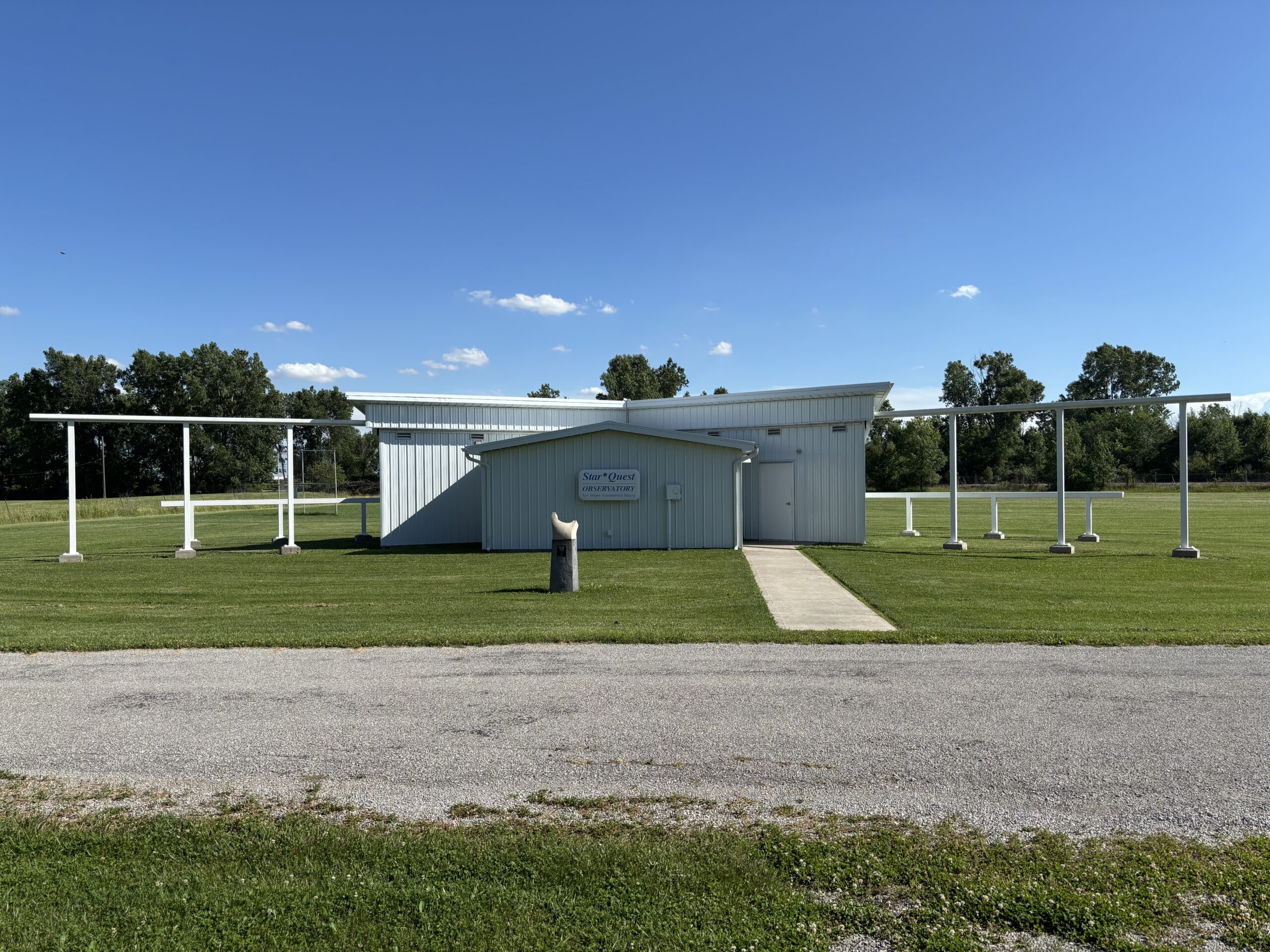
Just to the east of New Haven, Indiana, resides a window to the cosmos: the Fort Wayne Astronomical Society’s Star*Quest Observatory.
Located at 1730 South Webster Road, the Star*Quest Observatory houses telescopes and advanced technology that allow the user to gaze into the heavens with an unblinking eye.
“We are very pleased with the operation,” Gene Stringer said.
Stringer, a long-time member of the Fort Wayne Astronomical Society, led the society’s campaign to build the new Star*Quest Observatory, a modern facility packed with incredible technology.
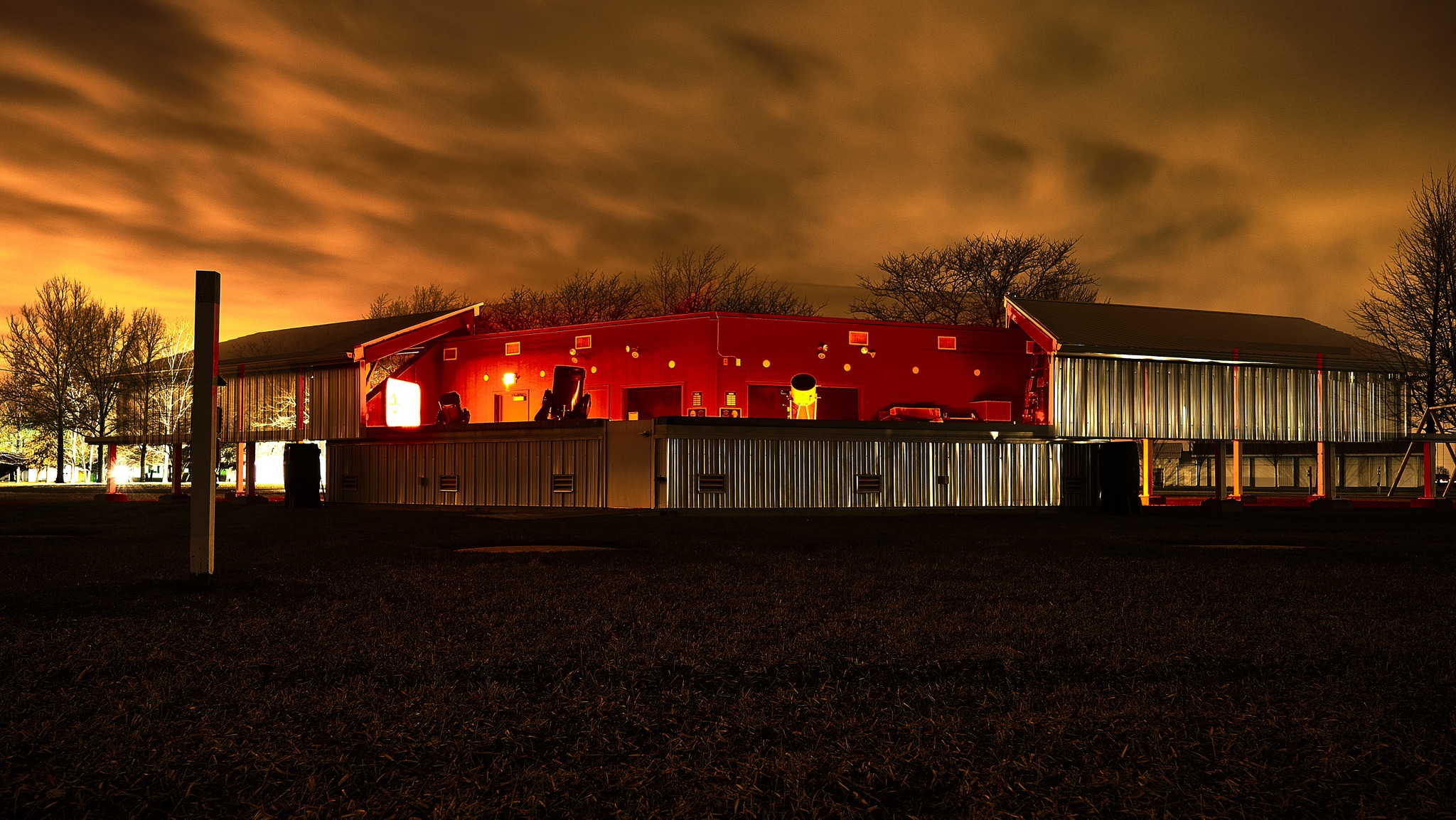
Photo Credit: Russell Ainslie (Reproduction: Facebook)
The design process of the observatory includes an interesting anecdote tying the facility to local educational institution: Students from PFW’s (then IPFW) School of Structural Engineering assisted in creating a design for the new observatory.
Additionally, professors from both IPFW and Ball State University joined FWAS members and other committee volunteers to choose a final observatory design from architectural firms.
The final design for Star*Quest is what Stringer calls a “delta wing” design.
The building includes two main sections. The front section has swept-back “wings,” with room for up to four telescopes. A control room with additional technology and items makes up the other portion of the observatory.
To facilitate easy sky viewing down to the horizon, the delta-wing sections of the observatory split apart. The roof rolls backward in two different sections via tracks, allowing an uninterrupted view of the heavens for much of the sky.
In addition to the new 16” telescope, Star*Quest also hosts a large computer with 7 terabytes of data storage, computer monitors, and other equipment, as well as the society’s original 12.5” telescope.
The new computer technology, made possible by an approximately $15,000 grant from the Foellinger Foundation, allows the FWAS to host a variety of visitors, including school groups, and offer a diverse array of educational programming.
One of those items of high-tech gear Stringer mentioned was what he called a “spectroscope,” a device that enables scientific research with the telescope by splitting incoming starlight into its composite “spectra.”
“A spectroscope is one of the prime instruments that every observatory wants to have in order to do scientific work,“ Stringer explained. “Most of what we have learned about the sky has been through the use of the spectroscope in order to understand what it is we’ve been looking at.”
According to the Center for Astrophysics, analyzing the spectrum of light and the various colors of that spectra can provide great insight into celestial objects.
“The specific colors and relative amounts of each color reveal information about temperature, what atoms are present, and the speed of the astronomical object being observed, which reveals the distances to far-off galaxies,” the center states.
Star*Quest Observatory and Its Predecessors
Star*Quest has its roots with the origins of the society and their original observatories.
Stringer said that the Fort Wayne Astronomical Society (abbreviated FWAS) began in the mid-1950s. In 1959, the society was incorporated as a not-for-profit organization with 60 original members.
Shortly after the founding of the society, two members of the organization, Glenn Harnishfeger and Maurice Crow, led efforts to build a 12.5” Newtonian-style telescope and observatory for use by the society.
The new members document for the society records that the original observatory and telescope were completed in 1963.
Stringer said that the location of that first observatory is now the site of a grocery store, located off of Lima Road.
The FWAS’ website mentions that the society moved their observatory and telescope in the 1970s to a new location in Fox Island County Park which had been a Christmas tree farm in its prior life.
At that point in time, any trees on the former Christmas tree farm were only a few feet tall, and the society enjoyed great viewing conditions with low levels of light pollution and good views to the horizon.
However, over a 30-year period, the trees on the site grew up, gradually blocking the views of the observatory. This meant that celestial objects that the society wanted to view with their telescope, such as some select planets, were blocked by the growing trees.
In the mid 2000s, the FWAS undertook a project to find a new location for their observatory and telescopes.
“We started the project to build the observatory in 2006,” recounted Stringer, who served as the project manager for the Star*Quest Observatory project.
That project was complicated, as it included finding a new observatory site, fundraising and building a new observatory with modern technological equipment, and getting the word out about the new site to the public.
The FWAS found a new location for their future observatory in Jefferson Township Park. The park provides several desirable characteristics for astronomical observing, including fairly dark skies and clear views down to the horizon of celestial objects.
But a new location was only one of the challenges facing the society. A new observatory required funding.
Stringer said that the FWAS raised approximately $250,000 to build the new, modern observatory, which was completed and opened to the public in 2017.
Named the “Star*Quest” observatory, the facility sports up-to-date technology.
The new members’ document mentions the society’s new 16” Meade RCX400 telescope, which now is the primary telescope for the FWAS. The telescope is equipped with a GPS receiver as well as a 100,000+ object computer database of celestial objects.
But the new observatory and its technological muscle are available for more than just researchers or FWAS members.
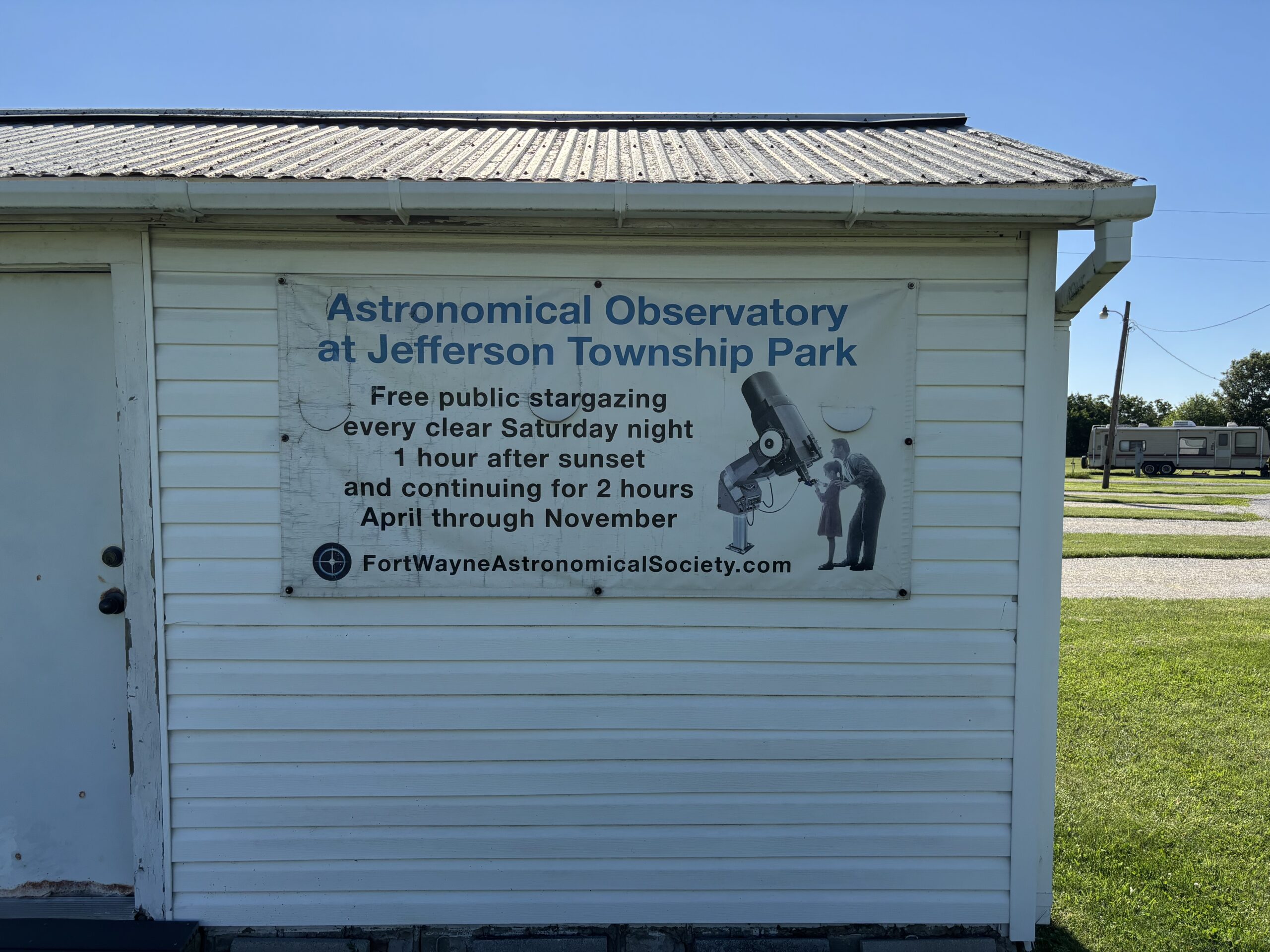
The newsletter of the FWAS, The Eyepice, mentions that on every clear Saturday night, from April till November, the public is invited and welcome to come for star gazing at Star*Quest. Those public viewing hours start one hour after sundown and continue for two hours.
Stringer said that, if any person from the public wants advice on how to use their own personal telescopes, they can bring their equipment to the public-viewing times. Members of the FWAW will provide assistance and instruction in using the scope, all free of charge.
In addition to hosting the Saturday viewing times, the society has partnered with a variety of area organizations for astronomy-focused activities, including Canal Days, Fox Island Sol Fest, the Homeschool Fair, and other events.
The FWAS also enjoys hosting visitors for astronomical events, such as total solar eclipses.
Stringer said that, during the April 2024 solar eclipse, the Star*Quest Observatory hosted an estimated 800-1000 visitors.
How to Get Involved
Anyone interested in attending events hosted by the Fort Wayne Astronomical Society has a variety of offerings from which to choose.
The society’s general meeting is typically held the third Tuesday evening of every month on the campus of PFW in the Walb Student Union. Meetings start at 7:30 p.m. and generally run till 9 p.m.
Annual memberships in the FWAS for individuals, including their family, are $40. Student memberships are $25 a year. Membership in the society comes with an automatic membership in the Astronomical League, as well as access to the FWAS’ online forum and members-only events. The society’s newsletter, The Eyepiece, listing current and future events can be downloaded from their website.
Although Stringer has spent over 60 years in the world of astronomy, he continues to enjoy sharing the cosmic views seen through a telescope with anyone interested in the heavens.
“Truly, what you see through the eyepiece of a telescope cannot be shown in any other venue,” he said. “You have to look through the scope live to see that sparkling star.”
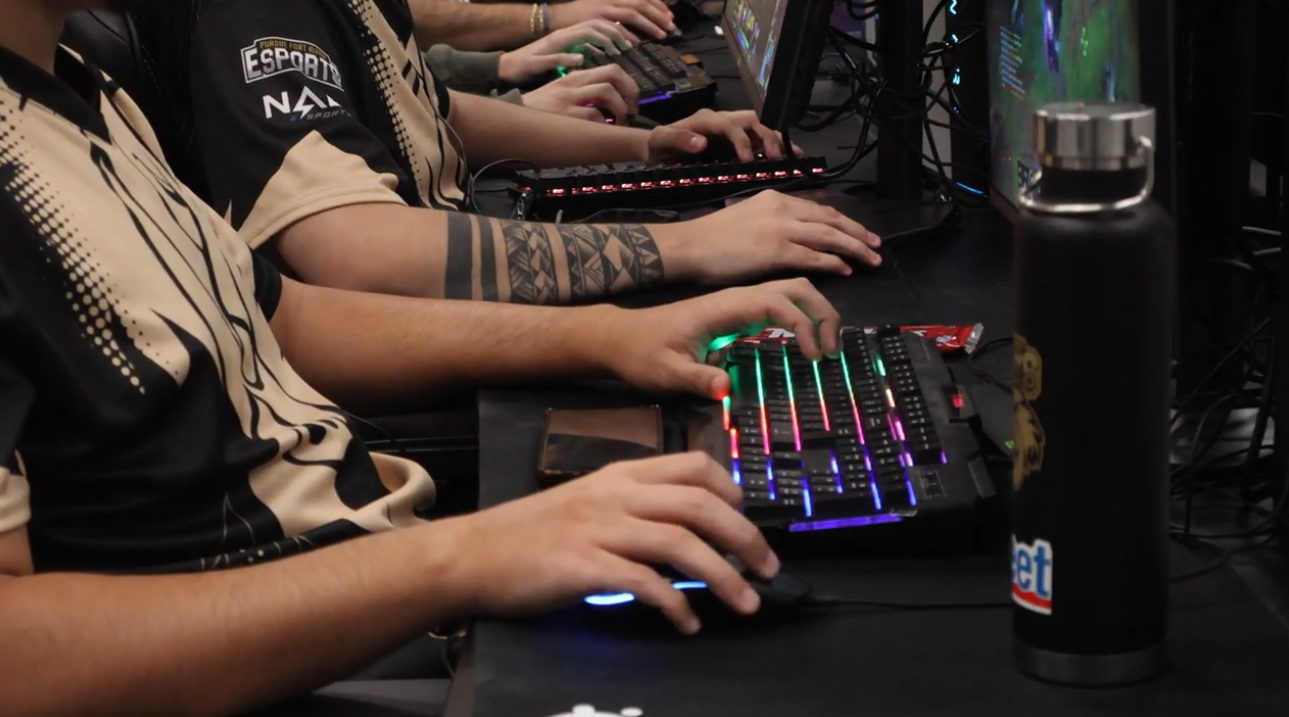
For Jordan Cunningham, computer games aren’t just a means of relaxation. They are an intensive sport requiring concentration, teamwork, and careful organization.
“It’s so accessible for anyone,” Cunningham said. “You just need a computer.”
A graduate of the Indiana Institute of Technology with a degree in psychology, Cunningham is starting his second year as coach of the PFW Esports team.
But he brings a lot of experience to the table when it comes to gaming and coaching.
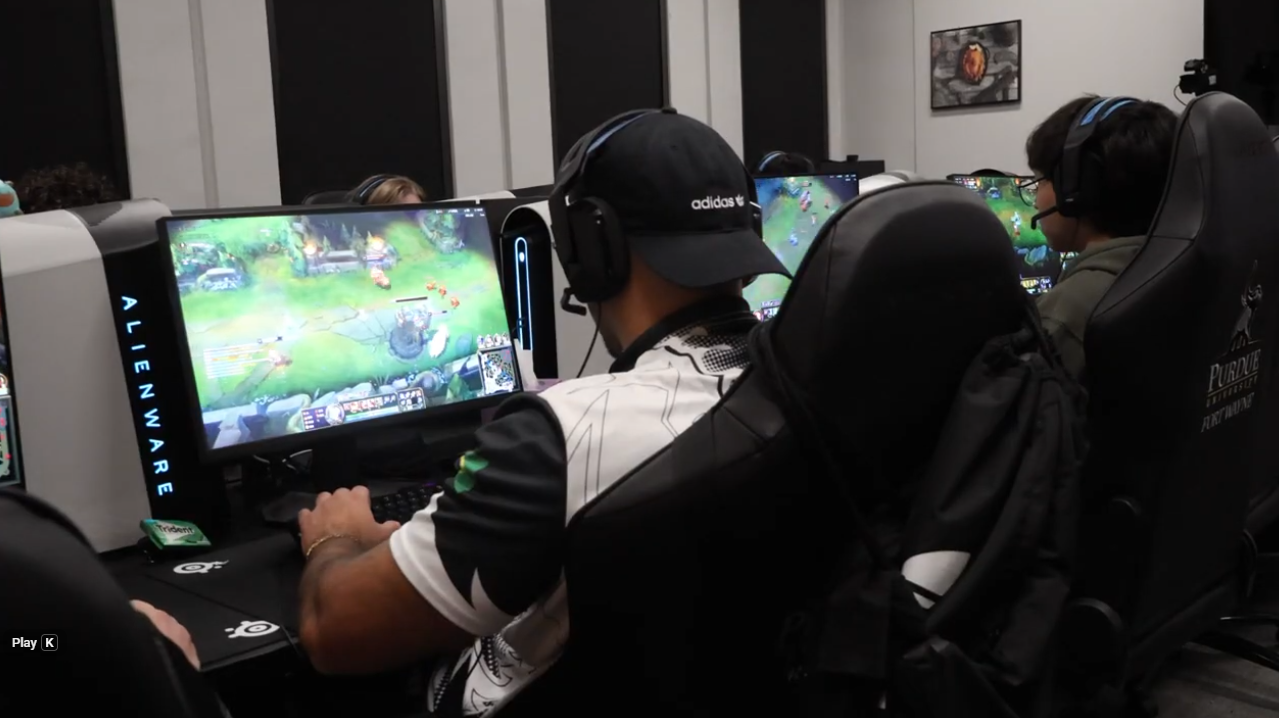
Prior to PFW, Cunningham has been both a competitive player of games such as “League of Legends,” as well as an Esports coach, serving as the coach for Indiana Tech’s Esports team.
There’s a lot that goes into running an Esports team, and that digital world is continuing to grow in popularity among universities across the globe, with Esports programs and arenas being installed at the Purdue West Lafayette campus, Purdue Northwest, and PFW.
Esports Originates at Home
Cunningham explained that Esports originated with enthusiastic League of Legends players when they held a tournament for the game in one of the player’s basements. From there, a formal, global tournament was held in 2011, and the world of Esports gaming was born.
Cunningham said that around the year 2016, Esports teams were beginning to pop up at various universities, with smaller colleges and STEM schools generally being the ones most interested in starting Esports teams.
“They started getting this idea of smaller schools can do something that bigger schools aren’t able to do,” Cunningham said.
He explained that bigger schools with high-level division athletics probably aren’t going to offer Esports. For smaller universities, Esports are a way they can offer students a team experience without the expenses entailed with more traditional team sports.
“The maintenance is so low,” Cunningham said.
Cunningham said that the Esports team at PFW is self-sufficient. Once the basic computer hardware and peripherals like computer mice, headphones, keyboards and software have been purchased, there largely is no maintenance to be done.
Esports – A Team Experience
Cunningham said that when he came to PFW as the Esports coach, one of his first tasks was to write a policy handbook for the team.
That manual is largely based off of the manuals in use by the traditional sports teams at PFW.
“I’m going to run this like an athletics team,” Cunningham said.
Esports team members have the same grade requirements as the other sports teams at PFW. If student grades begin falling, they are restricted from participating in tournaments and games.
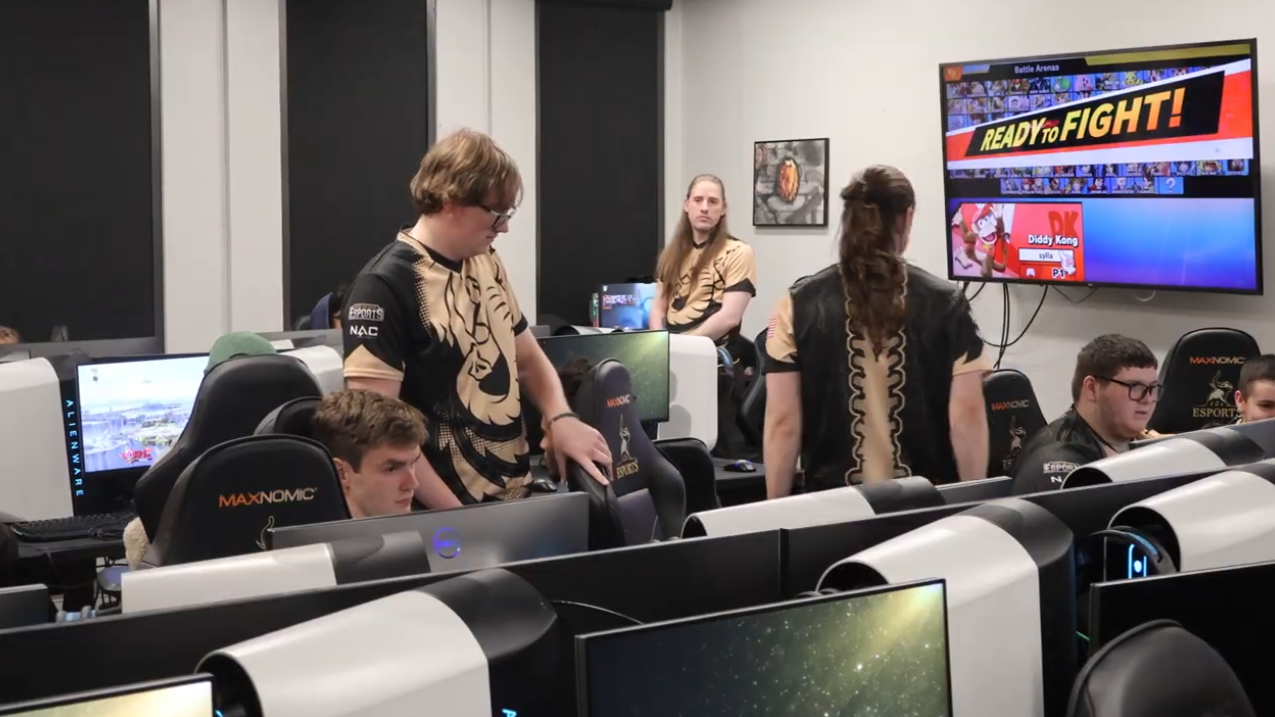
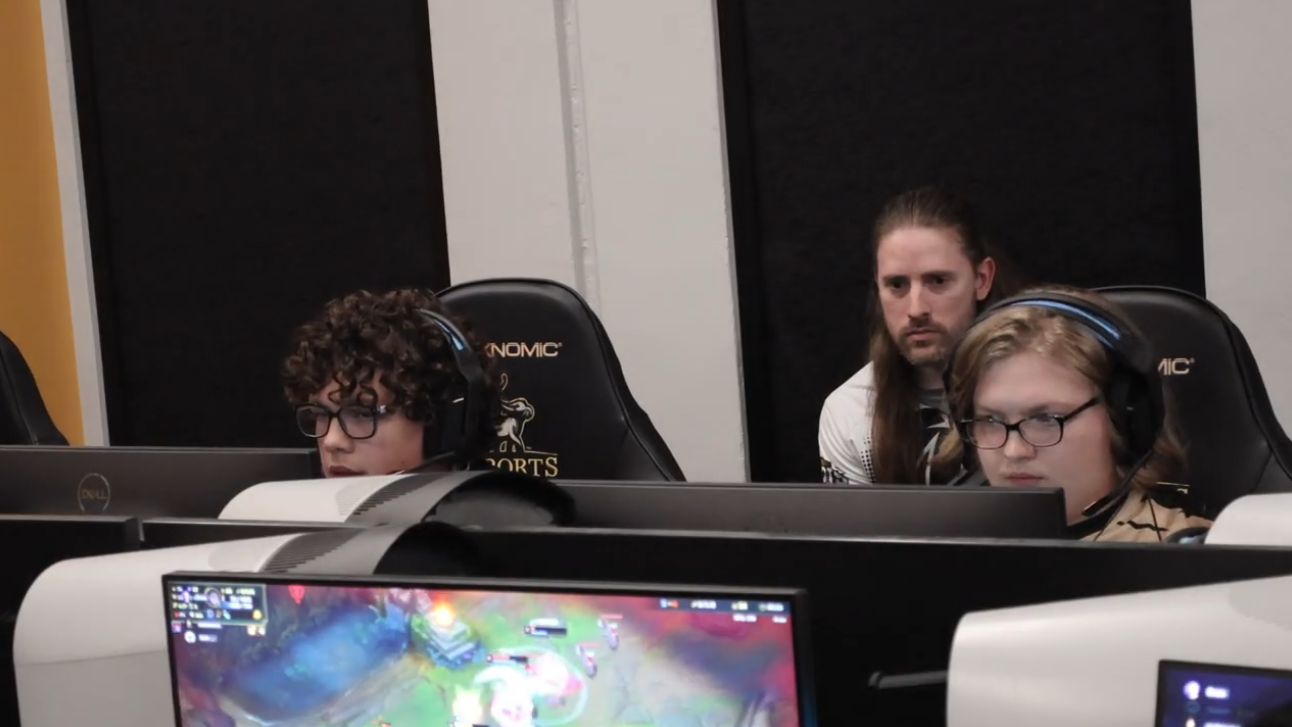
The Esports team mentality and camaraderie are reinforced in a variety of ways beyond grade requirements, including personal hygiene standards and practice sessions called “scrimmages” held once or twice a week. Scrimmages are simulated tournaments where Cunningham and his team play against other college teams in fake-tournament style competition, with each team trying out new tactics that they might use in the future.
Players on the team have the opportunity to travel to tournaments and stay the weekend. Such opportunities give the players the chance to both build team spirit with their fellow Dons and experience what it’s like to travel as a team to a competition.
Esports – Organized and Regimented
Cunningham explained that each player on the team has one game in which they specialize, such as Rocket League or Super Smash Bros. That speciality is the game at which the player is the most proficient and comfortable at playing. When that team member is playing their special game, they are competing in leagues and levels of comparably ranked players across the country.
If a player wants to play a different game in addition to their primary specialty, Cunningham will sometimes allow that player to be part of a lower-ranked team. That way, the player can maintain their skills in their primary game but also have the chance to play something else.
Cunningham said that each game, called a “title,” has its own days when competitions are held. For example, the Rocket League team will play on one particular day, while the Super Smash Bros team may play on a different day.
When it comes to what titles the PFW Esports team plays, there are several criteria that must be met.
“I’m interested in what the students are interested in,” he said.
If students are interested in playing a particular title, Cunningham will investigate and see if that title is worth the time and effort needed for a dedicated team for that game.
But the biggest factor deciding what titles are played by PFW’s Esports teams is whether the game is currently offered in tournament competitions. If there are no tournaments being held for that game, then there’s no point in adding a team for that game.
Esports Coaching Provides Big Picture
Cunningham laughed when he was asked what he does as an Esports coach.
“That’s my favorite question,” he said with a chuckle.
Cunningham explained that his role is to both coordinate the entire Esports program as well as provide coaching for the players. That means he is tasked with keeping the equipment ready to go, purchasing new computers and peripherals as needed, and scheduling games and practice sessions.
For the coaching side of his job, Cunningham said he’s really providing both a macro and a micro level of instruction to his players.
Cunningham said that he gives his players advice and tips on the bigger picture of the game they are playing. That advice helps the players to adjust their strategy to balance the opposing team’s tactics.
“I always just tell them [the players] to treat it like a math equation,” Cunningham said. “What happens on one side of the equation needs to happen on the other.”
Cunningham said that he also focuses on the mental game for his players, helping them to compartmentalize their emotions and engage with the game and their teammates in a healthy, constructive manner. That approach of channeling emotions and learning from one’s mistakes helps the player to become both a better player as well as a better person.
Esports Benefits the PFW Community
For Cunningham, the Esports team provides several benefits to PFW.
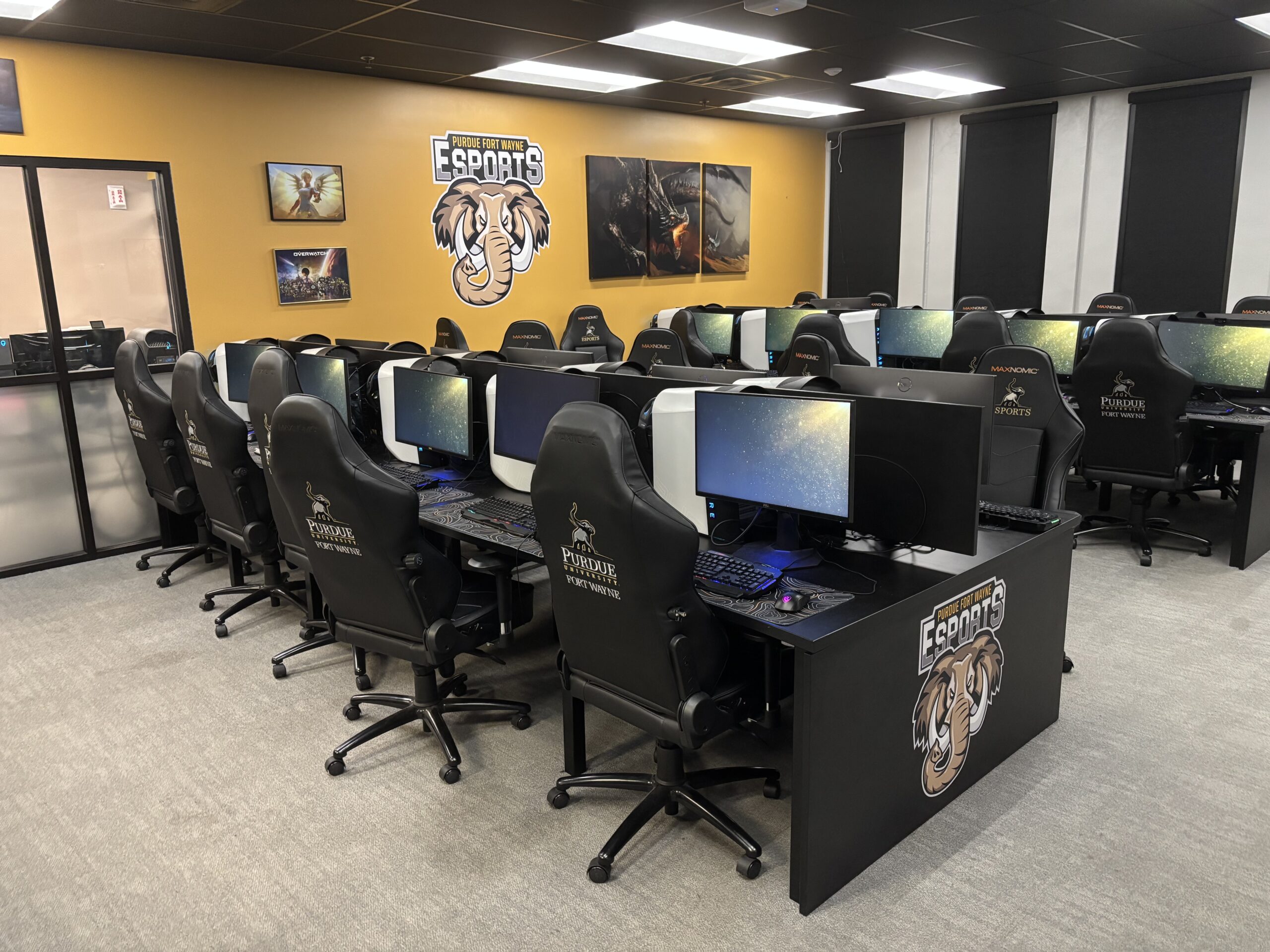
For some students, the chance to play Esports at the collegiate level while working toward a degree is a dream opportunity. With a beautiful arena on the second floor of Walsh containing 21 Alienware gaming computers, that dream can easily be made a reality.
Yet another advantage to having an Esports arena is that any student on PFW’s campus may use the gaming computers for free.
According to the Esports webpage on the PFW website, the Esports arena is open from 9 a.m. to 5 p.m. Monday through Friday and is available for faculty, students, and staff.
But beyond the recruitment and gaming opportunities offered by the Esports arena, Cunningham said that the Esports team gives students an outlet to be part of a team atmosphere – an experience they may never have had.
“They get that team experience,” he reflected.
And that team experience, of bonding with one’s comrades and working towards a goal, has paid dividends for the players and the university.
Cunningham said that the Esports team has great retention, with students staying on the team and most students remaining at PFW for their education instead of transferring to other schools.
“My students are awesome,” Cunningham said with a smile. “We’ve had so little academic issues.”
In summarizing what he hopes to accomplish with Esports, Cunningham was candid about his long-term goals.
“We’re all here to help them get through college, have a good experience,” he said. “It’s seeing those life skills and professional skills that you helped them develop at such a pivotal age.”
The sounds of intense competition permeate the room. PFW athletes communicate in short, terse comments as they strive to overcome the opposing team.
But these athletes are not your typical sports team playing a traditional college sport. These are part of PFW’s esports team, a community of 67 student athletes who compete with universities and colleges across the world in a variety of competitive computer games.
For these student athletes, the Esports team is more than just an outlet for competition. It’s a chance to build community and learn life skills that will support them throughout college and into the future.