The sounds of intense competition permeate the room. PFW athletes communicate in short, terse comments as they strive to overcome the opposing team.
But these athletes are not your typical sports team playing a traditional college sport. These are part of PFW’s esports team, a community of 67 student athletes who compete with universities and colleges across the world in a variety of competitive computer games.
For these student athletes, the Esports team is more than just an outlet for competition. It’s a chance to build community and learn life skills that will support them throughout college and into the future.
A student wants to build microcontrollers in Silicon Valley.
Another wants to travel back to India and provide counseling to troubled young people.
A third student wants to specialize in bio-technologies.
These are just a few of the stories behind some of the students who participated in PFW’s Global Student Celebration.
Held Friday evening on November 21, the Global Student Celebration is a fun occasion that caps a week of festivities at PFW, as international students share a snapshot of their culture with their fellow Dons through food, music, and dance.
Students Ajinkya Naik, from India, Gustavo Corsi da Silva, from Brazil, and Alan Chen-Trejo, from Venezuela
But this week of celebrating international studies and students at PFW is actually part of a broader movement called “International Education Week.”
Sponsored by the U.S. Department of State and the U.S. Department of Education, International Education Week is held annually. According to the department of educations’ website, the event holds dual purposes.
First, the week is part of the department’s efforts to prepare Americans for studying abroad. It also serves as a method to educate the future leaders of other nations who are studying in the United States.
In other words, International Education Week is an opportunity for the US to engage in scholastic diplomacy with potential long-term benefits for both the United States and for countries around the globe.
How the process works for an international student to come and study in America is a fascinating and sometimes arduous process.
Coming to Study in America
Like any American college student, an international student must first decide on a college to attend. Name recognition can go a long way toward influencing where an international student decides to apply and study.
For Ajinkya Naik, an international student from India, going to college and getting an education has been a goal since his youth.
“From childhood, I always wanted to get a good quality education in college,” Naik said.
Naik explained that it was Purdue’s good name and reputation that drew him to enroll in the computer science program at PFW.
“In hindsight, it was a great decision,” Naika said with a smile.
But for students like Naika, enrolling at an American university typically requires more than just the normal college-enrollment paperwork.
International students wishing to pursue their academic studies in the United States must first obtain an F-1 category visa. They can only apply to study at universities which have received a Student and Exchange Visitor Program (SEVP) certification.
Besides paperwork, another challenge international students must navigate includes culture shock as they enter the American collegiate system.
John LaMaster, senior instructor of Mathematics at PFW, has observed some of that culture shock in his international undergraduate and graduate students.
“In other countries, those in higher education are much more select,” LaMaster said. “It isn’t an education for all in other countries.”
He explained that, in other countries, only a select group of students usually get the opportunity to study at a university.
When an international student comes to study at an American university, that student is already highly motivated to perform at a very high academic level. That means that, most likely, an international student would find it unthinkable to sign up or register for a class and never attend, since even one class is an invaluable resource and opportunity.
But it’s not just the academic system that’s a culture shock to international students.
Farah Combs, director of Honors and Experiential Learning at PFW, shared her story of coming to the United States as an immigrant.
Combs explained she and her family emigrated to the United States from Kuwait shortly before Combs was about to enter college.
One of the culture shocks Combs experienced was the level of free speech Americans enjoyed.
“I would say one of the major ones [culture shocks] is honestly … how much freedom of speech people have in regards to talking about the government,” Combs said. “That is not happening back home.”
Beyond culture shock and college applications, international students face another hurdle after graduation: staying in the United States to live and work.
After completing their degrees, international students have limited options for employment in the U.S. These range from working under the Optional Practical Training (OPT) program to obtaining a green card. Many of these pathways are highly competitive and often temporary, lasting only a few years and requiring renewal processes that must work their way through government bureaucracy and red tape.
Graduate Student Teresa Nabangala, from Kenya
Advantages International Students Bring to the United States and the Globe
Although there are challenges to coming to the United States for academic study, international students bring a host of benefits to America and the global community.
Maureen Linvill, director of International Education at PFW, explained that many international students will, upon graduation, return to their home countries and start implementing their academic knowledge in their professional lives.
“A lot go home to share what they’ve learned,” Linvill said.
Other international students, including those coming to PFW, hope to stay in the United States and contribute to American society.
For computer science major Ajinkya Naik, career goals include continuing his higher education in the United States and using his computer science degree to improve the bio-technology and health care fields.
International students at U.S. universities and colleges contribute $42.9 billion to America’s economy according to NAFSA: Association of International Educators. For every three international students, one job in the United States is either created or supported.
International Students in the United States
In the 2024/2025 academic year, international students helped support over 355,000 jobs.
Locally, international students help improve the PFW community by introducing their colleagues at student housing to new experiences.
Shelby Mansfield, assistant director for International Student Services at PFW, explained how international and domestic students living in the same student housing help encourage each other to try new things.
“They get each other to do something new,” Mansfield said.
Trying something new and sharing a global perspective is part of what helps broaden domestic PFW students’ perspectives.
Director Combs mentioned that, for American and international college students, getting to study together in a university setting like PFW is a life experience that students can take with them into their future careers.
“When you go to the workforce, you don’t know what you’re going to be talking to in the business,” Combs said. “It [studying with international students] makes you a better person because you have better understanding.”
International Education Week at Purdue Fort Wayne is an annual celebration of the university’s international student community. The week features a variety of activities, highlighted by the Global Student Celebration.
The event brought together students, families and friends to watch international students perform cultural traditions and to enjoy food from around the world.
“We want to share culture and traditions and to help promote that sense of belonging here on campus,” said Shelby Mansfield, assistant director for International Students Services.
There are 269 international students currently enrolled at PFW. The Global Student Celebration provides a space for them to share their cultures and connect with the broader campus community, with food serving as a central way to do so.
Attendees sampled a wide range of dishes, and the menu reflected cuisines from around the world. Indian Kitchen provided veg dum biryani, a dish made with layered rice and mixed vegetables. Pho Indy served banh mi, a Vietnamese sandwich on a baguette. True Kimchi offered veggie kimpab, a Korean seaweed rice roll filled with vegetables.
Giordano’s supplied caprese skewers: a rotating pattern of tomato and mozzarella with a drizzle of balsamic glaze provided patrons with a lighter option to snack on. Nutri Packs provided egusi soup with pounded yam, a traditional Nigerian dish that is a rich, savory soup served with a dough-like yam. For dessert, Shatila’s bakery offered baklava, a flaky pastry made with cashews and honey. Horchata from Salsa Grille, a sweet drink made with milk, rice and cinnamon, represented Hispanic culture.
Most participant restaurants are located in the Fort Wayne area, with Shatila’s bakery based in Michigan.
For Maureen Linvill, director of International Education, food allows someone to experience a piece of culture immediately.
“When students taste dishes from around the world, they’re not just trying new flavors,” Linvill said. “They are experiencing a piece of someone’s heritage, family traditions, and identity.”
The variety of options provided the event’s attendees the opportunity to experience cultural dishes that are different from their own. Additionally, it fosters a learning environment as you connect foods to different cultural groups and taste the assortment of ingredients.
“Food brings out the best in many,” assistant director Mansfield stated.
As a commonly known way to break the ice and spark the beginning of a conversation, food plays an important role when sharing culture. At the Global Student Celebration, attendees such as graduate student Teresa Nabangala connected over their shared likeness of a dish and their curiosity to understand where it originated.
“Food is a universal language, and when different cultural dishes are offered in one space, it encourages curiosity, conversation, and appreciation for each other’s traditions,” said Nabangala, who is from Kenya. “Trying new foods opens the door for people to learn about the history, stories, and identities behind those dishes.”
Through events like International Education Week, PFW continues to highlight and celebrate the cultures that students bring to campus.
International students are proud of their cultures, and the Global Student Celebration offered a chance to showcase their heritage. And when words cannot describe, food surely can.
International Education Week took place during the week of Nov. 17, bringing a campus-wide celebration of cultures throughout the world.
The highlight of the week was the Global Student Celebration, an evening dedicated to unity and cultural expression. Students showcased their backgrounds through singing, dancing, and cuisine from around the world – including an interesting remix of Travis Scott’s hit song “FE!N.”
What began as a quiet room, quickly transformed into one of the most energetic student celebrations on campus this semester.
Shelby Mansfield, assistant director for International Student Services, explained the performances change every year and the students take time to perfect them.
“We have had anything from fashion shows to cooking demonstrations,” she said. “This year, students were leaning towards singing, dances, and bands.”
Mansfield said the students prepare for their performances very thoroughly and even have a rehearsal the night before. There are bands practicing, friends talking, and a full run through of the whole night.
Lucia Coeslier, a student from France, said that they were putting in an insane amount of effort to perfect the final performance.
“I am most nervous/excited for my performance,” she said. “It is a classic French song.”
Watching the performances is a great way to end the night after eating international food. Mansfield said eating before the performances allows attendees to come together and enjoy a meal. Some of the food served included bahn mi, egosi soup, and baklava as well as drinks like horchata. Most of the food was made locally in Fort Wayne but the school even reached out to a company in Michigan to help celebrate.
Each dance, song, and food represented something uniquely meaningful from the performers’ culture. Colombian student Catalina Vigoya Ruiz explained how the song she chose has been sung in her family for decades.
While she was performing, there were students from Colombia in the crowd dancing along. Another thing you see a lot at this celebration: students coming together.
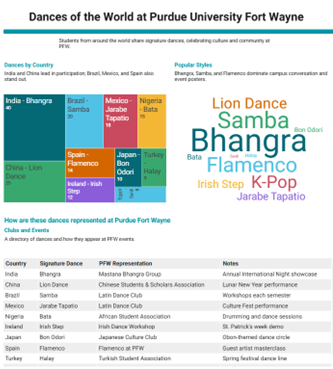
Dancing is symbolistic for many countries around the world and a way of communication. India, which has the leading number of international students at PFW, has a popular dance called Bharatanatyam which is known for its expressive gestures, storytelling and intricate footwork.
“When I’m dancing, I feel back home again for a moment,” said student performer Lisha Choudhary, from India. “The performance is a mix of traditional Indian dance and American pop culture.”
As the celebration wrapped up, performers were greeted with applause, hugs, and questions from students who wanted to learn more about the dances and songs they saw.
Some stayed long after the final performance ended, taking photos with their friends and continuing conversations about culture, identity, and what it means to be part of a diverse campus.
For those who attended, the Global Student Celebration marked more than just the end of a themed week. It was a reminder of the power the community holds and the diversity international students bring to Purdue Fort Wayne.
And for those few hours on Friday night, campus felt a little smaller and the world felt a little closer.
The president of Hispanos Unidos taught a Latinx hip-hop dance class on Nov. 21 that represented the culture of the Purdue Fort Wayne club well.
“Dancing is what brings families together,” says the PFW sophomore, explaining that Hispanos Unidos is an inclusive campus club open to all PFW students– not limited to students of Hispanic heritage.
The environment of the fitness studio transpired that sentiment during the dance. Some who attended had a background in dance, and others– like me– had very little prior experience. All six of the dancers continually encouraged each other to keep going and focus on having fun.
Daddy Yankee’s song “Que Tire Pa Lante” played repeatedly from a loudspeaker as we practiced the routine for a total of two hours– including several much-needed breaks for water and fruit snacks. We had an ever-changing audience as students continually peeked their heads in to see what we were up to, and some even stayed to learn a section of the dance.
Libni Sedano attended the hip-hop class and loves to dance in her spare time. Rather than dancing professionally, Sedano learned from her family, as she says dancing is a key tradition for Hispanic families.
The PFW sophomore is majoring in finance and Spanish, and has been part of Hispanos Unidos for two semesters. She said she joined because she likes to be part of people sharing her cultural background.
Haraguchi says that, at parties, dancing isn’t really about getting a work out. The purpose is to feel connected with friends and family, especially in Hispanic culture – whether it’s dancing with a partner, a friend, or a group.
“You eat and then burn [the calories] right off!” Sedano says. “If you get hungry again, there’s more food!”
The Latinx teacher has a diverse background in dance. Starting for fun in elementary school, she began learning elite dance in a studio in middle school and continued through high school. She has competed in a variety of competitions, including ballet, jazz, contemporary, lyrical and hip-hop.
The 20-year-old has stopped dancing professionally but still does hip-hop dances, and her skills were evident as she taught the Latinx class with ease.
“I still love dancing a lot,” says Haraguchi. She also had a chance to teach in September– another Latinx hip-hop combo that was a fundraiser for Hispanos Unidos. The club president and chemistry major stepped up as a leader after the scheduled teacher of the class never showed up.
Teaching hip-hop is not the first time Haraguchi showed her leadership skills. When the soon-to-be-freshman was touring PFW in 2018, she found out that Hispanos Unidos would no longer be a club unless someone volunteered to be president and get students involved.
Haraguchi took on the role and has since been a leader for her club and for her campus.
Haraguchi volunteered to teach on Nov. 21, planning the event herself following the success of the last class. She hopes that those who attended learned more about dancing.
“Dancing doesn’t require much experience or technique,” says Haraguchi. “It’s about feeling the music and having fun with others.”
After fine-tuning our dance moves, we recorded the routine and it is posted on the Instagram page for Hispanos Unidos. None of us were required to be featured in the video, but after a little extra self-esteem boost for the more shy dancers in our group, all six who learned the routine agreed to be recorded. Once again, an encouraging atmosphere was fostered with the help of the Hispanos Unidos club members, and the attitude was contagious.
Carolina Baltazar has personally experienced the inclusive nature of the club.
Baltazar attended a private school for most of her education. Born in America and growing up in a family with Mexican heritage, Baltazar’s family speaks Spanish at home. She thought that going to a public school in third and fourth grade would allow her to feel more included after being in a private school with very little diversity, but even though she found a group of people to hang out with, she still did not feel fully accepted.
Baltazar says she thought people at the private school viewed her as a Hispanic girl who didn’t have high standards and acted “ghetto” with no manners. Her friends at the public school would tell her that she acted “white” and Baltazar could not find the balance between the two labels.
The PFW freshman says she was so excited to join Hispanos Unidos and finally be with a group that does not care about labels. “I’m with my people,” says Baltazar.
Baltazar hopes to be part of the club’s advertising committee to spread the word and form a stronger PFW community.
Haraguchi says future classes may be possible after the night’s turnout, with a grand total of 11 who signed the safety waiver and attendance forms. The free class was open to all PFW students and staff.
The Latinx hip-hop dance class was taught in the Hilliard Gates Fitness Studio, located inside the Hilliard Gates Sports Center, from 7 p.m. to 9 p.m. Nov. 21 as posted on the Instagram pagefor Hispanos Unidos.
Anyone who wants to learn more about Hispanic culture and be involved in a group dedicated to inclusivity is welcome to join Hispanos Unidos.