Climate Policy in a Divided Nation: Why States Take Different Paths

By Cincade Drudge

Climate change policy in the United States is anything but consistent. Our policies can be described as fragmented and contradictory, with no real uniform policies linking all the states. This lack of connection is not an accident. It reflects a deeper reality for the United States: while the federal government sets broad environmental standards (or chooses not to set standards), much of the authority over energy, infrastructure, and regulation lies with the states. The result is a country where climate policy is shaped as much by geography and economics as it is by politics.

At the center of this divide is the all too familiar distinction of “red” and “blue” states. These labels, while imperfect and reductive, point to broader governing ideas that influence how states approach climate change. Some states prioritize rapid emissions reductions and regulatory action, while others focus on economic stability, energy independence, and marketdriven solutions. Neither approach exists in a vacuum, and both are shaped by the practical realities each state faces.

“Red, Blue, and Purple” States by Control of State Legislatures. Sourced from CenterForPolitics.org

Of course, as the labels of red and blue would suggest, one of the most significant drivers of these policy differences is political ideology. Over the past several decades, national party platforms have increasingly influenced state-level policy decisions. Democratic leadership has generally supported emissions targets, renewable energy mandates, and participation in climate agreements. Republican leadership has often emphasized skepticism toward regulation, opposition to carbon taxes, and support for domestic energy production.

Public opinion tends to mirror this divide. Surveys consistently show that concern about climate change and support for government intervention vary widely across regions. In some areas, climate change is framed primarily as an environmental and public health issue. In others, it is discussed more as an economic or regulatory question. These differences in framing shape not only policy outcomes, but also the political feasibility of certain solutions.

Needless to say, state economics also plays a decisive role. States that rely heavily on fossil fuel production face a different set of incentives than those with more diversified economies. In energy-producing states like Texas and West Virginia, policies that restrict oil, natural gas, or coal can carry immediate consequences for jobs and tax revenue, which will affect local communities in these areas. By contrast, states with less dependence on these industries may find it easier to adopt aggressive emissions targets or transition toward renewable energy.

State Government Fossil Fuel Revenue. Sourced from Resources for the Future

Even within this divide, the picture is more nuanced than it first appears. Texas, often categorized as a red state, leads the nation in wind energy production. This growth has been driven less by climate-focused mandates and more by favorable geography, existing infrastructure, and market incentives. It serves as a reminder that positive climate outcomes, like expanding renewable energy, can emerge from very different motivations than expected.

Demographic factors further shape how climate policy is experienced and debated. States with large urban populations often face visible environmental challenges such as air pollution, heat islands, and flooding. These conditions can make climate action feel immediate and tangible. In more rural states, concerns may focus on energy costs, agricultural impacts, and land use. It should be noted, though, that some policies, like those perceived to increase fuel or electricity prices, can face almost universally strong resistance, regardless of their environmental intent.

At the core of these differences is a divide over the role of government in addressing climate change. Some states favor regulatory approaches, such as mandating emissions reductions, setting renewable energy standards, and adopting legally binding climate goals. While others emphasize limited intervention, focusing on voluntary action, innovation, and market-driven solutions.

These contrasting philosophies are reflected in areas like transportation policy, where some states are phasing out gasolinepowered vehicles while others resist mandates but still support electric vehicle production for economic reasons. These approaches often extend into the legal system, where states challenge federal climate policies as either too aggressive or too weak, contributing to ongoing uncertainty and shifting policy direction.

However, at the end of the day, we will all feel the effects of climate action or the lack thereof. Some may experience higher upfront costs associated with transitioning to cleaner energy systems, alongside long-term environmental and public health benefits. Others may benefit from lower regulatory burdens and stronger ties to traditional energy industries, while facing a slower shift toward renewable energy and more potential for future climate ramifications.

At the same time, the impacts of climate change itself do not follow political boundaries. Extreme weather, shifting growing seasons, flooding, and heat waves affect communities across the country, regardless of how their states approach policy. This shared vulnerability exists alongside deeply different strategies for addressing it.

Climate change will ultimately affect all communities, regardless of how policy is divided today. While state-by-state approaches may seem workable in the short term, the longterm consequences of inaction will extend across the entire country. The United States may not yet be politically aligned for a unified national response, with a government largely against climate action, but the need for broader dialogue is becoming increasingly difficult to ignore. Climate policy is not a simple binary choice; it reflects a complex balance of economic priorities, political beliefs, and regional realities. As pressures from climate impacts grow, the push for a more coordinated and forward-looking approach will only become more urgent.

Review: Marvel Television’s Wonder Man, a Fascinating Stroll Through Marvel’s Hollywood Boulevard

By Elijah Noggle, SCO Cultural Critic

On January 27, the newest TV series in the long running Marvel Cinematic Universe released all eight of its episodes, and I am really excited to share my thoughts on it. Wonder Man stars Yahya Abdul Mateen II as Simon Williams, a struggling actor in the MCU’s version of Hollywood/Los Angeles, who has powers but must keep them a secret for the sake of his career. He learns that esteemed director Von Kovack is doing a remake of the 1980s cult classic Wonder Man, and sees this as the opportunity of a lifetime. He is accompanied by veteran actor Trevor Slattery, a returning character first introduced all the way back in 2013’s Iron Man 3.

This is easily one of the most unique MCU series to date. It was such a pleasant surprise! My favorite Marvel projects tend to be the ones that feel different compared to everything else. For example, WandaVision was a tribute to television sitcoms, and Werewolf By Night was an homage to 1930s monster movies.

And Wonder Man is another one of those for me. It’s essentially a love letter to Hollywood, taking place in the MCU’s version of the famous capital of American cinema. There are several references to real life actors and real life movies, making this version of Los Angeles feel more like the real life one, only that it just so happens to be in a world where superheroes exist.

One of the strongest aspects of this series is the character writing. Simon Williams is a very compelling character. He’s also flawed in a way that makes him relatable. For example, something you see a lot in the series is that he sometimes has trouble trusting others. It feels like a consistent theme in the series. Also, I found Trevor compelling in this series because he truly does care about the art of acting, but at the same time has to deal with his past playing The Mandarin, a literal terrorist on live television. Furthermore, Yahya Abdul Mateen II and the great Sir Ben Kingsley are at the top of their game in these roles.

The writing in this series overall has a really genuine sincerity and earnestness to it. These characters’ struggles in the world of Hollywood feel very real. It doesn’t rely on the same type of quippy humor that Marvel movies and shows have been known for in the past- it instead chooses to mostly focus on the emotional beats and the characters, which works in its favor. Whenever there was humor, for the most part it felt natural to me.

The most noticeable flaw in this series is the pacing. Multiple times in this season, there were episodes that felt like they didn’t quite advance the plot as much as they could have. This results in some plot points not feeling quite as fleshed out as they could. Without directly spoiling anything, episodes 2, 4, and 5 exemplify this quite a bit. Episodes where it feels like the characters go on a “side quest” of sorts.

I just have to mention though (without spoilers) that even though episode 4 titled “Doorman” does grind the pacing to a halt, this one-off episode focusing on an entirely different character ended up being one of my favorite episodes of the entire series. It really showcased this show’s artistic vision and willingness to take risks.

The show’s visual look and cinematography feel very in line with this show’s identity of being about Hollywood and the experience of a struggling actor. Someone online mentioned that it felt like an A24 production, and I couldn’t agree more. Tonally, I love how different it felt to me compared to many of the marvel projects I’ve watched in the past few years.

Wonder Man was a really enjoyable watch. It’s got a couple of small issues I think could be ironed out if this received a second season. But overall, the amount of heart present in this season of TV really elevated it for me. It was very focused in what it wanted to say about Hollywood, the experience of acting and what goes into making a movie, and even superheroes. I would give this an 8.5 out of 10. I think you can really enjoy this even if you have never seen any MCU film or series, so I heavily recommend it.

Students Rally in Indianapolis to Support Immigrant Communities, Challenge ICE Practices

By Caeden McConnell

INDIANAPOLIS – Students around the state of Indiana gathered at Monument Circle in Indianapolis on Feb. 13 to protest Immigration and Customs Enforcement.

The event, Students Against ICE, was organized by a 17-year-old high school student from Indianapolis who is an immigrant. About 40 to 50 students attended, holding signs and chanting.

During the protest, the student organizer delivered a speech explaining her motivation. She described being picked on by her classmates for being born in another country before moving to Indianapolis. 

This dehumanizing behavior she experienced as a kid, she said, motivated her to advocate for herself and others with similar experiences. The Students Against Ice protest grew directly out of that desire.

One of the speakers was Stephen Lang, a member of the Party for Socialism and Liberation.

“It is important for students to stand up for their first amendment rights,” Lang said.

Lang, who comes from a predominantly Black and Latino community in Indianapolis, pointed out the compassion of his immigrant neighbors. When he was sick, he said, many of them helped him and even brought him groceries without being asked. Lang said he would like to see his great immigrant neighbors stay in his neighborhood.

One protester, Jeremy, attended the event with his wife and child, holding a sign featuring a crossed-out swastika.

“I have a certain vision I would like to see,” Jeremy said. “One including freedom, democracy, a healthy nation in which people live freely and take care of their community.”

However, what Jeremy is now seeing is far different.

“Oppression, fascism, people being detained and arrested without due process, people being harmed, beaten, killed, for seemingly no reason,” Jeremy said.

He added that what he is seeing is hurtful and scary, and that he hopes for change.

No members of the Department of Homeland Security or ICE were present at the protest. However, several police officers blocked nearby streets to allow protesters to assemble safely. Attempts to interview DHS officials before the event were unsuccessful, with multiple contacts referring inquiries elsewhere. Emails sent to DHS received no response.

A photographer present at the protest, Chris, a second-generation American, said he attended out of concern for himself, his family and his community. 

Chris found out about the protest from a social media post. He said that many people in his family and community come from another country, and he wants to see them stay where they are now living.

Chris simply asked that ICE have more empathy and that more people become aware of the situation. He understands that the immigrant issue doesn’t affect every American, but almost everybody knows a person that could be profiled based on the color of their skin, or how they look.

Lang, Chris and Jeremy shared a similar message when asked what they would like to say directly to an ICE agent:

“I would tell them to quit their job,” Lang said.

“Quit, put your gun down, go home and apologize to your spouse,” Jeremy stated.

“Just got to calm the f*** down man, there is no reason to be doing all this,” Chris said.

Many protestors at the event had such strong emotion over the issue. In one way or another, the issue has affected them personally. Through chanting, speeches, holding signs, and the honking of passing cars, the event reflected that this community can really come together as one.

Fort Wayne Students Protest Amid Growing Concerns Over ICE Actions

By Max Nordman

As of 2026, Immigration and Customs Enforcement operations have reached an all-time high, sparking a series of protests nationwide and taking an effect on education systems, including some of the schools of Fort Wayne, Indiana.

Tasiana Neer, a student at Wayne High School, expressed her concerns regarding recent political events and ICE’s actions.

“It scares me to know that they have been approaching schools where minors attend in an attempt to deport people,” she mentioned.

Those concerns are shared by other students and faculty members in area schools.

Starting in February, students and staff at local FWCS schools in Indiana joined together for weeks of walkouts, protests, and other events to speak out against the perceived harm and violence perpetrated by ICE.

 Some schools involved in the recent protests include South Side High School and Wayne High School.

On Feb. 7, the students at South Side formed a walk out. The protest quickly sparked a pattern amongst the other schools in the district.

At Wayne High School, students and staff held their own protest on Feb. 12. They walked out of their classes and onto the baseball field closest to the school, and shared concerns about the work and possible risks they faced when discussing political issues.

“We didn’t think we would get approval honestly,” said Chloe Ruckman, a senior at Wayne. “It was surprising that our principal agreed to it.”

According to Ruckman, it was difficult to pinpoint who had started the initial protest idea. Many of the students had claimed that social media posts started circulating after South Side’s protest on Feb. 2.

The first social media post, dated Feb. 3, was posted by an anonymous Instagram account and suggested a walkout at Wayne High School. Different posts involving plans, routes, sign ideas, and staff involvement all came into fruition soon after.

Several students were caught off guard by the number of teachers and adults who wanted to be involved with the protest. But a large group of students also found that they themselves did not care about political matters, and just wanted an excuse to skip school for the rest of the day instead.

“You know it’s crazy when the students do something about it,” said Aaron Rehrer, a teacher at Wayne. “I’ve been working here for years, and I don’t think we’ve ever had a walkout like this.”

Their efforts strive to hold the ICE administration accountable for the perceived misuse of power within the nation since the 2024 election. More than ever people have increased concerns of being at risk of injury, murder, deportation, kidnap, assault, and more from ICE.

Certain groups in society have banded together to fight against ICE’s actions and bring back the meaning of justice and equality as a community.

Due to careful planning and the help of the staff members at these local schools, there have been no reported incidents of any injuries or violence taking place during these peaceful protests in the FWCS district. Additionally, FWCS mentioned that all five high schools in the district have met together for discussions about these matters of concern.

 Neer, the Wayne student, discussed the community building these protests have had on the schools. She expressed that much of the administration had worked with the students to help them in their efforts.

“I’m glad so many people are protesting lately,” she said. “Especially now when it’s actually getting serious.”

All-Female Cast Brings Suffrage-Era Twist to “The Taming of the Shrew”

By Lilly Crone

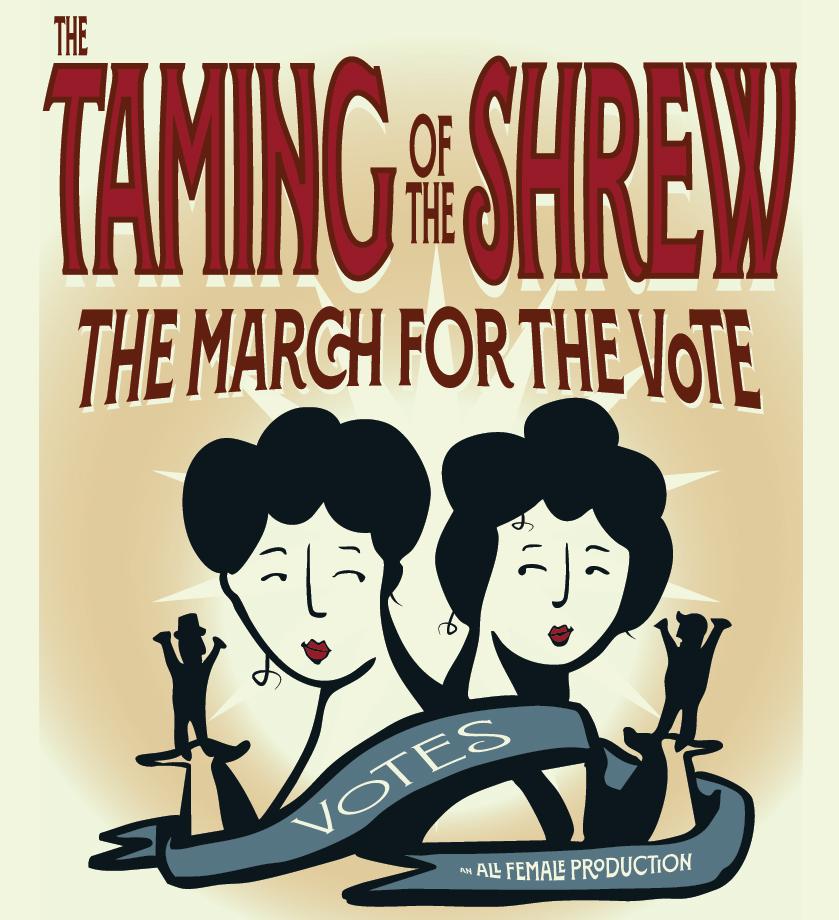
An all-female cast transformed Ernest E. Williams Theatre at Purdue University Fort Wayne on Friday night, Feb. 20, with a reimagined version of The Taming of the Shrew.

The Taming of the Shrew: The March for the Vote, set against the backdrop of the 1919 women’s suffrage movement in Chicago, blended Shakespeare’s original comedy with a historical framing device that placed the story inside a women’s social club rehearsing the play amid suffrage marches and social change. The layered approach created a performance that felt both classic and strikingly relevant.

The production drew students, faculty, and members of the local community.

In Shakespeare’s original play, suitors compete for the hand of Bianca while her outspoken sister Katherine must marry first. This adaptation reframed that narrative through conversations about women’s rights and autonomy, encouraging audiences to reconsider themes of obedience and gender roles through the lens of 1919.

Tailor Grant, the lead cast member, portrayed Mrs. Victoria Van Dyne, a shy but passionate supporter of women’s suffrage. She also stepped into the role of Petruchio during the Shakespearean portions of the performance, shifting between two sharply contrasting energies on stage.

“Being the lead in this specific performance feels really special to me,” Grant said. “My character, Mrs. Van Dyne, is very shy but passionate about suffrage, which is fun to explore because I’m not shy or quiet. I love that contrast.”

Grant said balancing the dual roles required careful attention to physicality and voice.

“It’s kind of a play within a play,” she said. “I really have to think about my body language and my voice and everything when I’m doing all of the acting for it.”

Throughout the performance, that contrast was evident. Grant transitioned from the reserved, thoughtful presence of Mrs. Van Dyne to the bold, commanding energy of Petruchio, reinforcing the production’s layered storytelling.

The cast spent approximately seven weeks preparing for the show. For Grant, the production marked her first experience performing Shakespeare.

“We started the process by learning how to read and perform Shakespeare because this is my first Shakespeare performance,” she said. “We broke down scenes and worked through them together.”

Rehearsals often extended late into the evening as the cast ran full performances. Grant described the process as demanding but rewarding.

“It’s a very big commitment, but it’s definitely paid off over time,” she said.

The suffrage-era setting added historical weight to the production. While Shakespeare’s original play has long sparked debate over its portrayal of women, the 1919 framing encouraged audiences to reflect on women’s political and social limitations during that period. The 19th Amendment, which granted women the right to vote nationally, would not be ratified until 1920.

Grant said she believes the themes remain relevant today.

“It’s about women finding their voices and standing up for what they believe in,” she said. “That definitely still resonates.”

As the curtain closed Friday night, the production left audiences entertained yet reflective, reconsidering a centuries-old comedy through the lens of women’s ongoing fight for equality.

A$AP Rocky Makes a Big Return with “Don’t Be Dumb,” but Was it Worth the Wait?

By Elijah Noggle, SCO Cultural Critic

This year, A$AP Rocky, the beloved hip hop artist and one of the genre’s stand out figures of the past 15 years, finally released Don’t be Dumb, his long-awaited fifth album. It has been seven years since his last project, Testing, and the long gap created a lot of hype and high expectations. Let’s find out whether it makes up for the wait.

I want to start with the biggest positives. On his previous albums, people were drawn to the particular ear for production that Rocky seemed to have. This album is no different. Like his other projects, it does not fall into the category of “formulaic trap production” that a lot of this decade’s hip hop genre finds itself in.

There’s some really great experimentation, something you can find plenty of on his previous albums. “Punk Rocky,” with its indie rock guitars and mellow atmosphere, and “Robbery,” with its late-night jazz/lounge vibe with piano and saxophone are a couple of examples.

The features are a standout on the track list. They really elevate the quality of some of the songs. For example, rising star Doechii’s feature on the song “Robbery” is much more than a simple verse: the song contains her and Rocky trading off lines and their chemistry is really great, with their vocal deliveries both being rather subdued in a way that compliments each other.

Another example is from Tyler, the Creator on the song “Fish N Steak (What it is).” Any time Tyler has popped up on someone else’s album in the past few years, it has been one of my favorite moments. His energy and lyrics are some of the best in the hip hop genre right now.

This album finds its strength in variety. You have more experimental Rocky on songs like “Don’t Be Dumb,” you have the “high energy bangers” type of style on songs like “Helicopter,” and you have more moderate energy songs that still hit pretty hard, like “No Trespassing.”

Some favorites include “Stop Snitching,” which stood out with its clever use of sound effect sampling, memorable guest verse from relative unknown Sauce Walka, and really layered beat. Another standout is the aforementioned “Robbery”, and I hope this song wins some awards. By the end of the year, it will still remain one of the coolest and most unique songs of 2026.

There’s plenty of criticism to this long-awaited release, however. I don’t think Rocky’s lyrics on this album are particularly memorable. He has plenty of charisma and energy as a rapper, but I found myself way more connected to this album’s production than much of what was said on it. While Rocky has been known in the past for his really cool flow as a rapper, with great technical ability, I don’t think that aspect of his rapping is quite as good as it is on his previous albums.

The song I probably liked the least on this album was “STFU.” It tries too hard to be really crazy and high energy. It just sounded a little messy. I felt the vocal delivery by the guest rappers was clunky on this one, and some of the rapping just felt like it wasn’t on beat, which was odd.

To conclude this review, do I think this album was worth the wait? And does it live up to the quality of his previous albums? In my personal opinion, kind of. It’s pretty close, at least. There are very strong moments, but some songs drag on for a little long, and some of them are a tad bit forgettable. Overall, I don’t think it’s as good as his best records, but it’s a solid enough release that proves A$AP Rocky can still deliver.

I’m going to give this a solid 6.5/10. Teetering on a 7/10. It’s a really fun listen, despite some flaws. I really do recommend giving it a listen if you’re interested.

Upcoming Forum to Discuss Student Experience in Higher Education

By Andrew Danielson

College students and recent graduates will have a chance to relate their educational experiences with the Fort Wayne community at a unique forum opportunity on Tuesday.

The forum, entitled “Students Speak Out” is open to the general public and will be held Feb. 24 from 6:30 p.m. to 8 p.m. in Meeting Room B at the Allen County Public Library, 900 Webster Street, Fort Wayne, Indiana.

Organized by the Higher Education Working Group, the forum is a chance for students to share their positive and negative experiences of studying at an institution of higher education in a public, “citizen’s hearing” style of meeting.

“It’s important to hear from local people about how higher education works,” Dr. Leonard Williams said.

Williams is one of the main organizers of the event and he’s no stranger to education. Now a professor emeritus in political science, Williams spent nearly 40 years teaching American politics and political philosophy at Manchester University before retiring from there in 2020.

Now, Williams is returning to his educational roots.

In 2024, Williams, together with a few colleagues and friends, formed an informal organization called the Higher Education Working Group.

“It’s a group of faculty, students, staff members, some current and some former, who got together to kind of raise the profile of higher education issues in the Fort Wayne area and northeast Indiana generally,” Williams said.

He said that the group held a teach-in event last November, focusing on issues in higher education. The response from that first event was so engaging that the group began planning their next event, the “Students Speak Out” forum.

“The reception we received there was that we need to have more events to kind of talk about what’s happening to higher ed, not just in Indiana, but across the country,” Williams said.

That passion for sharing the student perspective is shared by one of Williams’ co-members of the Working Group, Dr. Noor Borbieva O’Neill.

O’Neill is the President of the Indiana Conference of the American Association of University Professors (AAUP) and a Professor of Anthropology at Purdue University Fort Wayne. She explained that this meeting, sponsored in part by the Indiana Conference of the AAUP, was a chance to hear from the students’ perspective on higher education.

“We’re hoping this second event [of the Working Group] is going to give us a much clearer sense of what needs to be done to help students, to make sure that higher education is serving their needs, our needs as a community,” O’Neill said.

O’Neill explained that the Working Group is hoping to hold a third event in the coming months with a possible screening of the film “Freedoms Under Assault” (date to be determined).

Folks not able to attend the forum can still participate and share their experiences by emailing the Higher Education Working Group at their email address: HiEdWkGp@gmail.com

Climate Change Tipping Points: When Gradual Warming Becomes Irreversible

Climate change is often discussed as a steady rise in global temperatures, tenths of a degree here, incremental carbon emissions there. But the more urgent concern among scientists is not just gradual warming. It is the risk of crossing crucial tipping points: critical thresholds in Earth’s climate system where small increases in temperature can trigger abrupt, self-reinforcing, and potentially irreversible change. 

A tipping point occurs when a climate system shifts from a stable existence into rapid transformation. Once crossed, feedback loops amplify the damage, making it difficult—or in some cases impossible—to reverse, even if temperatures later stabilize. 

These tipping elements exist across the planet: in ice sheets, forests, permafrost, coral reefs, and ocean circulation systems. Scientists warn that several of them are already under stress as global temperatures rise more than 1.1°C above pre-industrial levels. Crossing 1.5°C to 2°C could push multiple systems beyond their limits. 

One of the clearest and most immediate examples is coral reef collapse

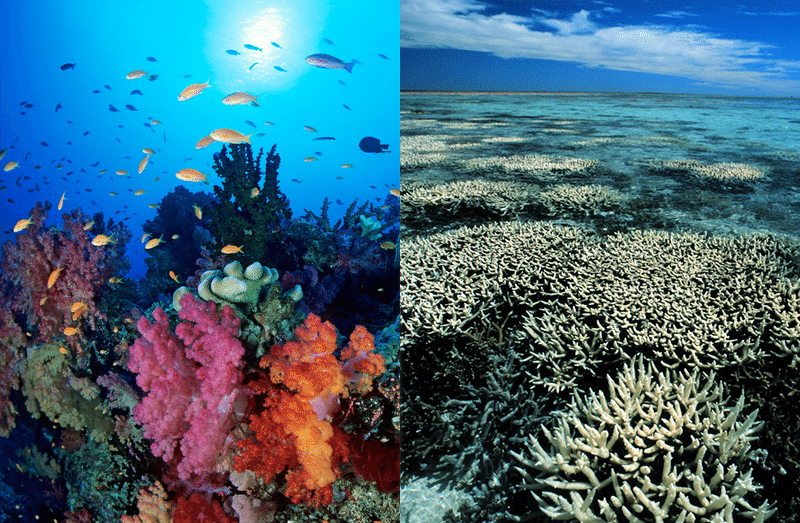
Healthy Coral Reef (Left) versus Bleached Coral Reef (Right).
Left photo by Gary Bell / Oceanwideimages.com. Right photo by Greenpeace / Roger Grace.

Coral reefs are extraordinarily sensitive to temperature. A sustained increase of just 1–2°C can trigger coral bleaching, a process in which corals expel the symbiotic algae (zooxanthellae) that provide them with food and color. Without these algae, corals lose both their vibrant appearance and their primary energy source. 

The world has already experienced multiple global bleaching events, including severe episodes in 1998, 2010, and 2016–2017. In 2016 alone, approximately 29% of coral in the northern section of the Great Barrier Reef died in a single year due to extreme marine heat. 

Bleaching becomes a tipping point when it happens too frequently. If reefs do not have time to recover between heat events, they shift from vibrant, biodiverse ecosystems into algae-dominated rubble. Once that shift occurs, erosion accelerates, fish populations decline, and water quality worsens. Even if ocean temperatures later stabilize, the ecological structure needed for recovery may be gone. 

This matters far beyond marine biology. Coral reefs support roughly a quarter of all ocean species and provide food security, tourism revenue, and coastal protection for more than 500 million people worldwide. Their collapse would represent not just an ecological tipping point, but a social and economic one. 

Coral reefs are not alone in facing dangerous thresholds. 

The Amazon Rainforest presents another looming tipping element. Often called the “lungs of the Earth,” the Amazon plays a crucial role in carbon storage and rainfall regulation. But deforestation, drought, and climate change are pushing it toward a savanna-like state. 

Roughly 17% of the forest has already been lost. Scientists estimate that crossing a 2025% deforestation threshold could trigger widespread dieback, as the rainforest would no longer generate enough moisture to sustain itself. Such a shift would release vast amounts of stored carbon, intensify regional drought, and disrupt global climate systems. 

Communities living in the Amazon are already experiencing longer dry seasons and more frequent wildfires. The tipping point is not theoretical—it is unfolding in real time. 

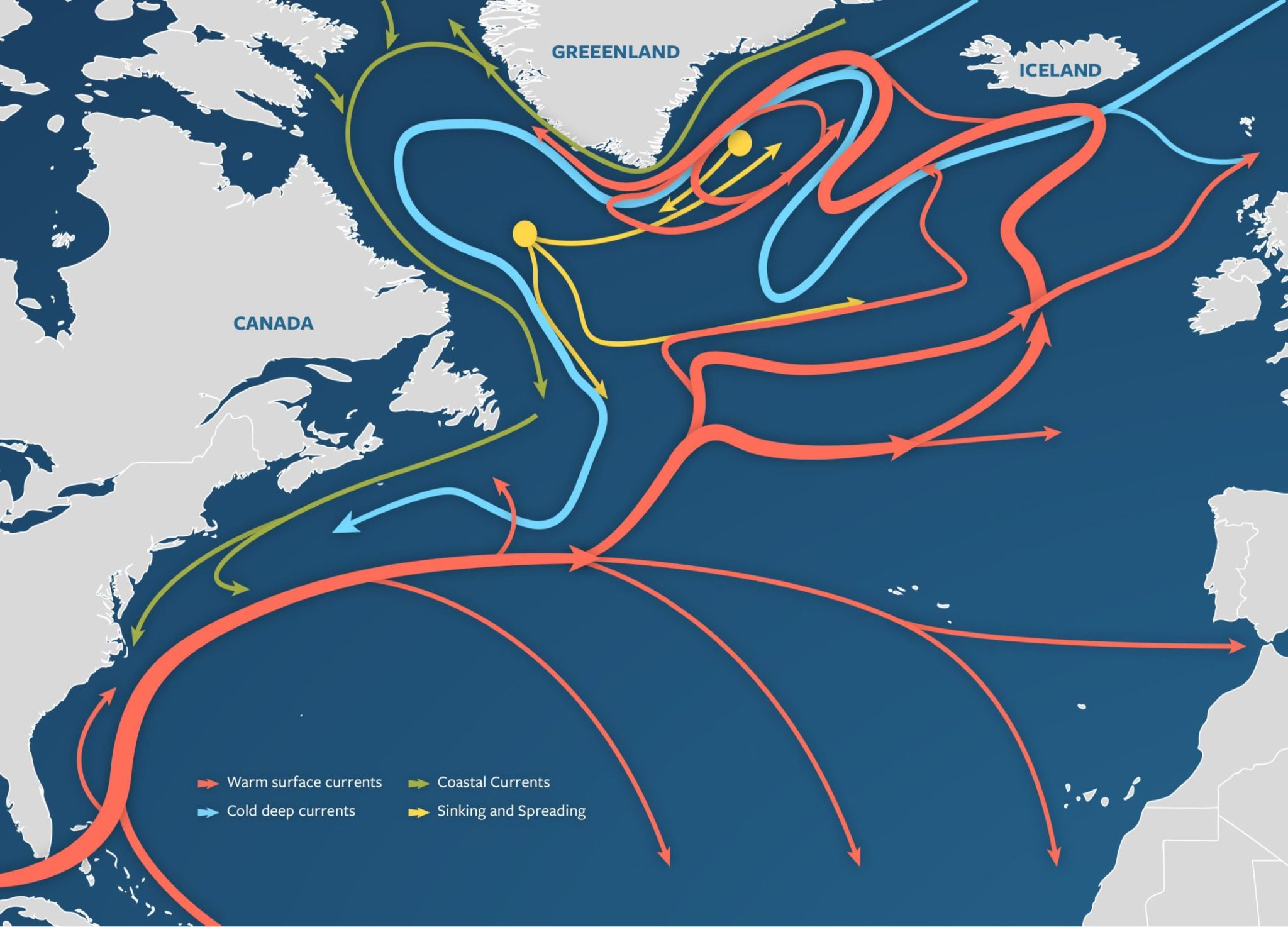
The Atlantic Ocean contains yet another tipping element: the Atlantic Meridional Overturning Circulation (AMOC). This vast system of currents acts like a global conveyor belt, moving warm water northward and cold water southward. It plays a critical role in regulating the climate, particularly in Europe. 

Visual representation of the AMOC (Illustration by Eric S. Taylor, © Woods Hole Oceanographic Institution)

Freshwater from melting Greenland ice disrupts the salinity balance that drives this circulation. Evidence suggests the AMOC has weakened by roughly 15% over the past half-century. Continued slowdown could dramatically alter weather patterns, disrupt food systems, and intensify regional climate extremes. 

Each of these tipping points is different. But they share a common feature: once these negative feedback loops take hold, change accelerates. 

Yet these systems are not beyond influence. The difference between 1.5°C and 2°C of warming may determine whether coral reefs survive in reduced form or largely vanish. It may shape whether ice sheet melt accelerates gradually or crosses into a runaway decline. 

Reducing global greenhouse gas emissions remains the most critical action. Limiting warming slows feedback loops before they spin out of control. This, of course, faces limitations as our government has recently limited its ability to regulate emissions.  

Local and regional measures matter as well. Marine Protected Areas can strengthen coral resilience by reducing overfishing and pollution. Coral restoration efforts—nurseries, selective breeding for heat tolerance, assisted gene flow—are being tested. Improving water quality reduces stress on reef systems. Early warning systems allow faster response to marine heatwaves. 

The concept of tipping points can feel overwhelming. The language of it all: irreversible, collapse, runaway, all suggest inevitability. 

But tipping points are thresholds, not set-in-stone prophecies. 

The climate system responds to actions, not despair. Slowing warming slows negative climate feedback. Stabilizing temperatures stabilizes systems. Action taken before thresholds are crossed carries far greater impact than action delayed. 

The lesson of climate tipping points is not that collapse is certain. It is that timing matters. The window for avoiding the most destabilizing shifts is narrower than it once was, but it remains open for now.  

Whether these systems cross their thresholds depends on decisions made in the present, not centuries from now. 

Discovering Middle-Earth for the First Time: A Newcomer’s Take on “The Fellowship of the Ring”

By Elijah Noggle, SCO Cultural Critic

This past week, all three of Peter Jackson’s Lord of the Rings movies (the extended editions) were re-released in theaters worldwide. Surprisingly, I had never seen these films before, and have no nostalgia for this franchise at all. But I am intrigued by it. This felt like the perfect opportunity to finally experience this franchise in some way for the first time.

I decided to watch only the first movie because reviewing the entire trilogy in one go would be too massive of an undertaking, especially given that I’m relatively new to reviewing movies. Even so, I thought it would be interesting to take a look at The Fellowship of the Ring from the unique perspective of someone experiencing Tolkien’s world for the very first time.

As a new, fresh cinematic experience for me, I have to say this was absolutely incredible—magical, even. I was immediately in awe of the scenery, as I had heard a bit about the filming locations, but seeing them in motion was mesmerizing. Much of the first hour takes place in the Shire, home of the Hobbits, and many of my favorite aspects of the movie are introduced here.

The score, for example, is one of the most beautiful things I have ever heard. The end-credits theme, the themes that play in the Shire scenes, and the Rivendell motifs are all going on my sleep playlist for sure. It is an astounding achievement not just in film scoring but in music overall. The soundtrack transports you to the world of Middle-Earth just as effectively as the visuals do. Maybe even more so.

Experiencing Tolkien’s storytelling in any form for the first time was truly special. Of course, I don’t know which lines of dialogue are directly from the novel, but I thought the dialogue in this movie had a compelling earnestness to it, and was also genuinely poetic at times. Gandalf, in particular, delivers several moments of powerful “sage wisdom” that felt really impactful. Regardless of how much of the dialogue in this adaptation is Tolkien’s own words, I can really understand why people consider him one of the greatest writers of all time.  

I was also incredibly impressed that, despite this being the extended edition of The Fellowship of the Ring —clocking in at 3 hours and 28 minutes— it never felt like it dragged. I’ve seen extended cuts of movies before where the added content disrupts the pacing, but this version of Fellowship flowed perfectly for me.

Given that this is a film based on Tolkien’s novels, one of the most iconic works of high fantasy ever created, there’s plenty of larger-than life scenery and breath-taking action sequences in this film. My favorite was the final battle with the orcs in the forest. I love the camera work, special effects, and fight choreography on display in this sequence.

And [[SPOILERS AHEAD]] Boromir’s sacrifice was truly emotional and became one of my favorite moments in the film. Another standout scene was Gandalf fighting the Balrog. As a new viewer, getting to see the “You shall not pass!” moment on the big screen is something I will never forget. Both scenes are incredibly powerful and speak to how much of a cinematic achievement this film is.

To conclude, Peter Jackson’s version of The Lord of the Rings: The Fellowship of the Ring is a timeless film. Even as someone with zero nostalgia for the franchise, I found that it holds up one thousand percent. It’s an easy recommendation for anyone looking for a truly memorable viewing experience.

PFW Graduate Students Lead Wildlife Conservation Efforts in Indiana

By Andrew Danielson / Photos by Lauren Lee and Justin Moore

A species of ground squirrels. A unique camera trap with motion-activated cameras. And the states of California and Rhode Island.

As it turns out, all those items have a lot in common, particularly when it comes to the wildlife biology laboratory of Dr. Scott Bergeson, associate professor of animal biology at Purdue University Fort Wayne in the department of biological sciences.

For over a year, two of Bergeson’s graduate students, Justin Moore, originally from Rhode Island, and Lauren Lee, who hails from California, have been working on separate but complementary research projects focusing on wildlife conservation and management.

Lee, who received her undergraduate degree in biology from the University of California, Santa Barbara, is working on a project to survey and identify the variety of small mammal species that exist throughout Indiana.

“The goal is to survey the entire state for small mammals,” Lee said.  

Lee’s mentor, Bergeson, explained that the last time a survey of small mammals in Indiana was completed was around 2007. That means that wildlife conservation officials such as those at the Indiana Department of Natural Resources have no fresh statistics on the health and population figures for small mammals.

Mammals are good indicators of the health of a particular ecosystem. If there is a diverse population of mammals in the area, that ecosystem is probably healthy.

“All of these small mammals and all of the other things help maintain the health of these natural spaces,” Bergeson said. “Even our agriculture would suffer if we didn’t have the natural spaces that help filter the pollutants that would otherwise get into our crops. Everything is connected.”  

Smile – You’re on Camera

Lee’s project, which is funded by a $150k grant from the Indiana Department of Natural Resources, is ambitious to say the least. If she were to use traditional trapping methods to conduct her survey, as was done in the 1960s, her project would take many years to complete.

But Lee and Bergeson have a solution: camera technology and upside-down buckets.

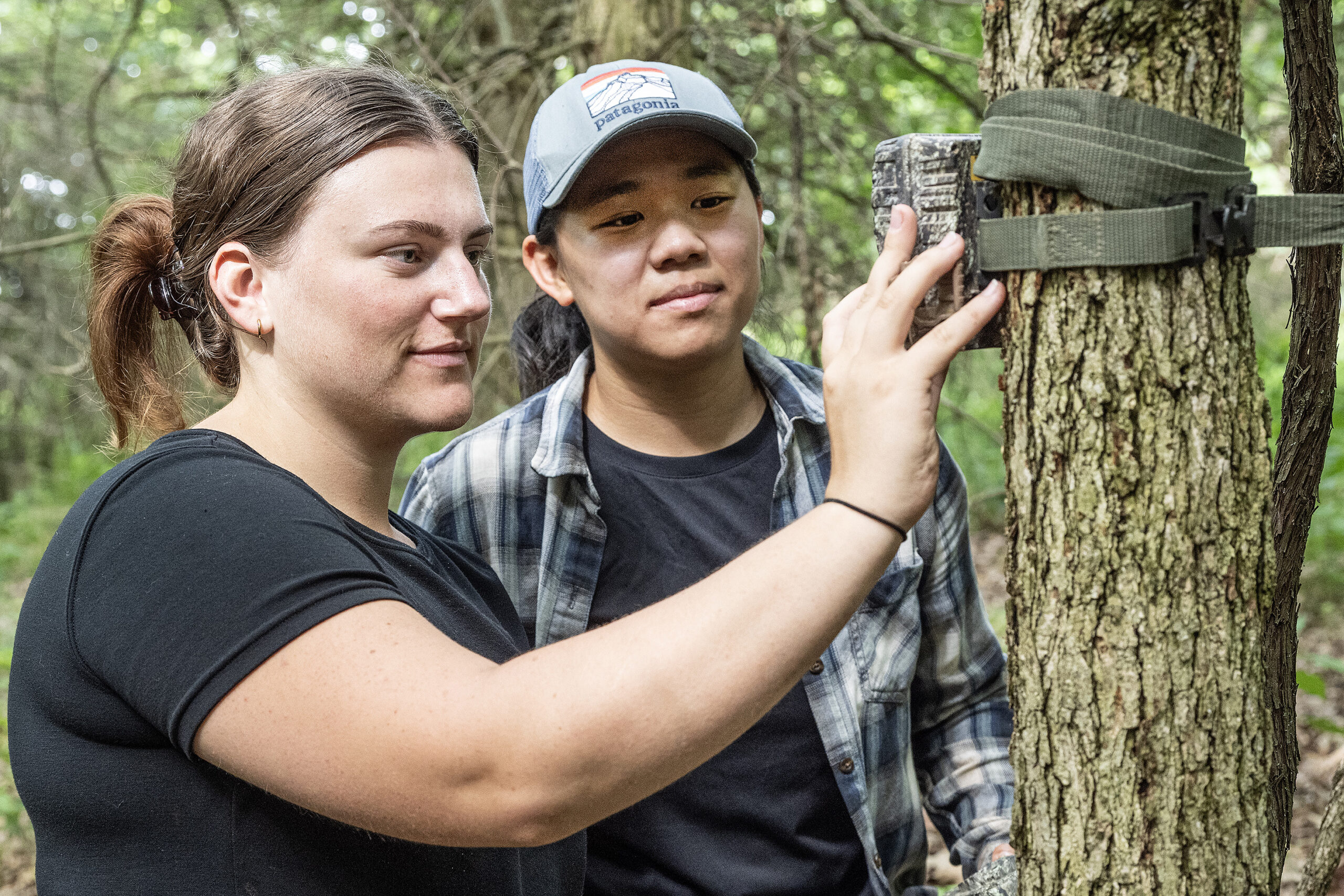
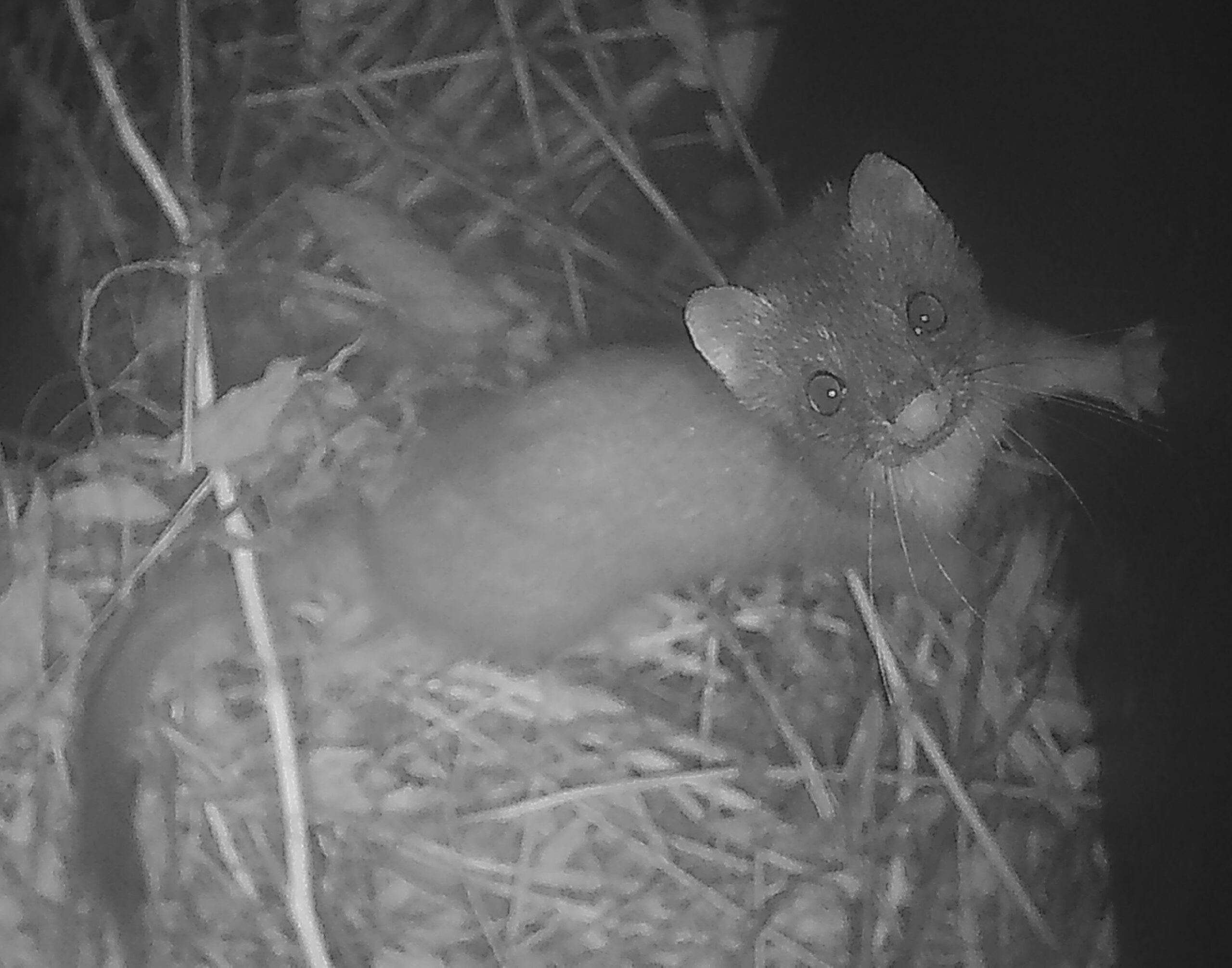
Lee explained that she installs “camera traps” on publicly-owned property, at least 100 meters away from any trail or road.

Each camera trap consists of a temporary “wall” made of a plastic material that leads to overturned buckets. An upside-down bucket with entrance holes cut into the bottom houses the actual camera.

The traps don’t use any bait, relying instead on animals’ natural curiosity or scent. When an animal approaches the trap, the “wall” barrier naturally guides them to the hole in the bucket. Once the animal walks into the bucket, their photo is snapped.

The cameras are infrared-equipped and motion activated, so there’s no bright flashes when the camera snaps photos. The lenses used on the camera are designed to provide close-up, magnified views of the animals, providing easier identification of the small furry visitors.

Lee explained that she currently has 102 camera trap sites, spread across the entire state. To collect the photos taken from her cameras, she has to drive to each site, swap out SD cards in the cameras, and perform maintenance on the site as needed.

From those sites, Lee has collected 1.5 million photos, with hundreds of thousands of photo sequences.

To help collect and process all of that information, Lee is being assisted by two undergraduate technicians and an artificial intelligence software. The AI automatically sorts through the sequences of photos and provides Lee with some basic species identification. She then checks what the artificial intelligence has done, making sure that the identifications are accurate.

“So, the whole idea is that we have this huge database of photos from everywhere and then for the next 100 years we can start mining that data to figure out other sorts of things,” Bergeson said.

A Squirrel’s View on Indiana

Yet another of Bergeson’s graduate students, Justin Moore, is also undertaking an ambitious wildlife conservation project with the assistance of two undergraduate technicians.

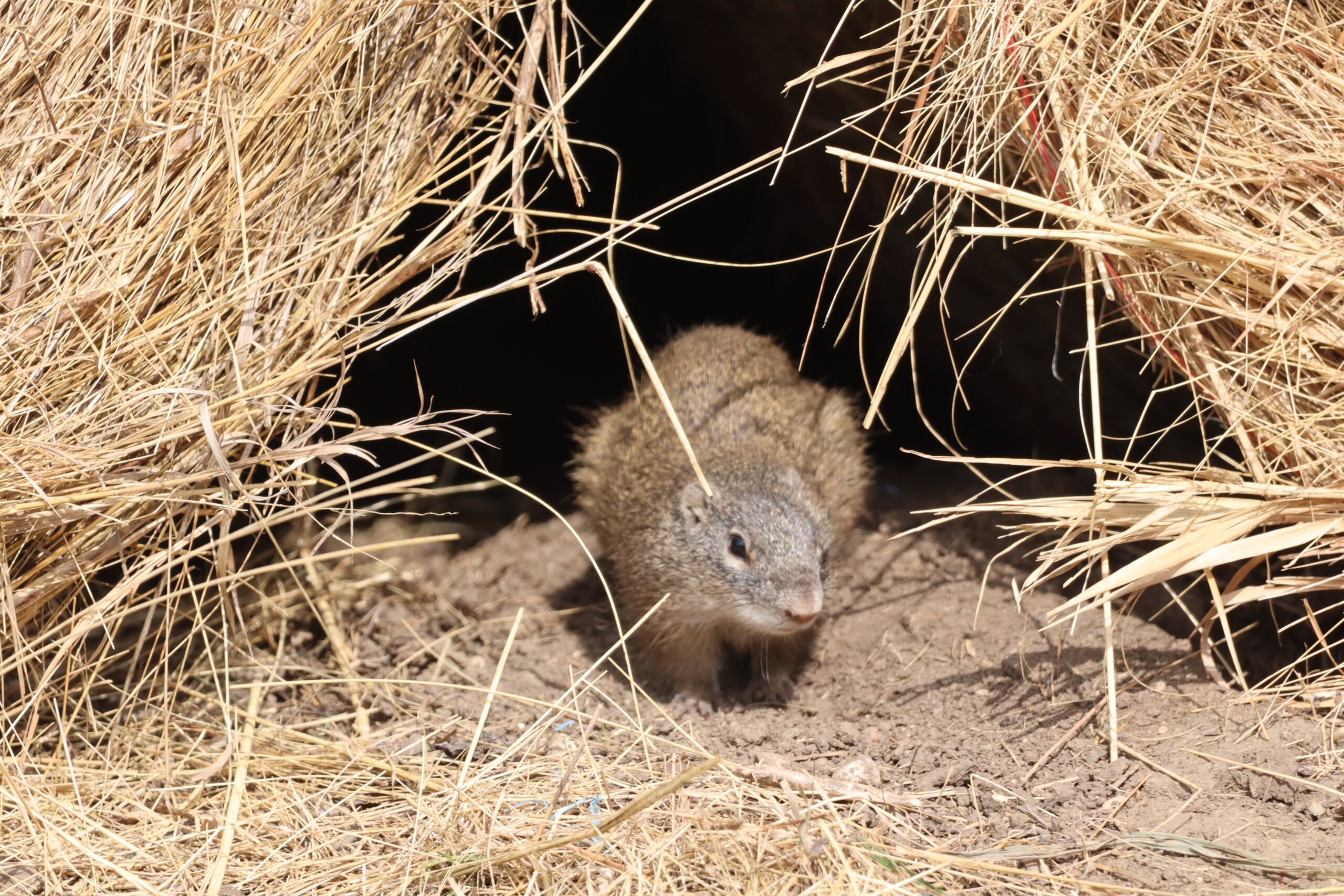
Moore, who received his undergraduate degree in wildlife conservation from the University of Rhode Island, is working to help stabilize a population of ground squirrels here in Indiana, called the Franklin’s ground squirrel.

Moore explained that ground squirrels are similar to tree squirrels, but they’re actually separate species with different diets, preferred habitat, and behavior.

According to Moore, Franklin’s used to have a fairly wide range in Indiana. However, due to the loss of prairies across the state, the ground squirrel’s preferred habitat, that population has shrunk to just one natural population in the region.

“They are state endangered in Indiana, and they’re declining across most of the Midwest,” Moore said.

Moore’e project, which is also fully funded by a roughly $200k grant from the Indiana Department of Natural Resources, is to help stabilize the Franklin’s population by re-locating healthy specimens from other states to Indiana. His project is a pilot study, so the techniques he is using will help in future re-location projects of either Franklin’s or other small animals that are endangered.

How to Move a Squirrel: Carefully!

Moore explained that, together with his mentor Bergeson, they identified a strong, healthy population of Franklin’s in South Dakota. Moore and Bergeson quickly formed an agreement between wildlife conservation officials in South Dakota and Indiana, enabling them to bring Franklin’s from South Dakota back here to Indiana.

But moving squirrels is no easy task.

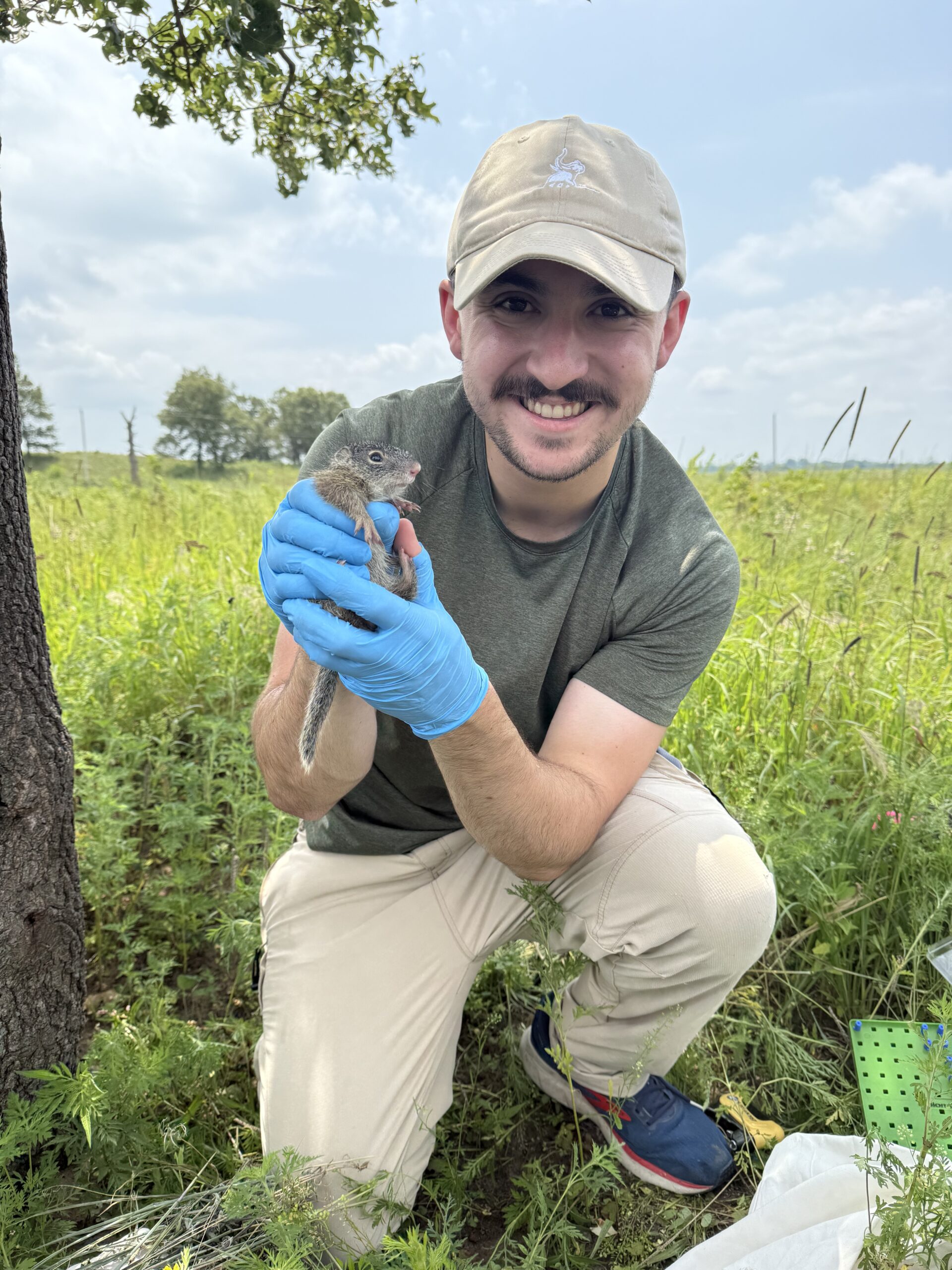
“There’s a lot that goes into the trapping to make sure that the squirrels and we [the researchers] are safe,” Moore said.

The capture sites for the squirrels in South Dakota are designed to minimize stress and discomfort to the animals, including routine checks on the traps and special coverings to provide shade to captured animals in the traps.

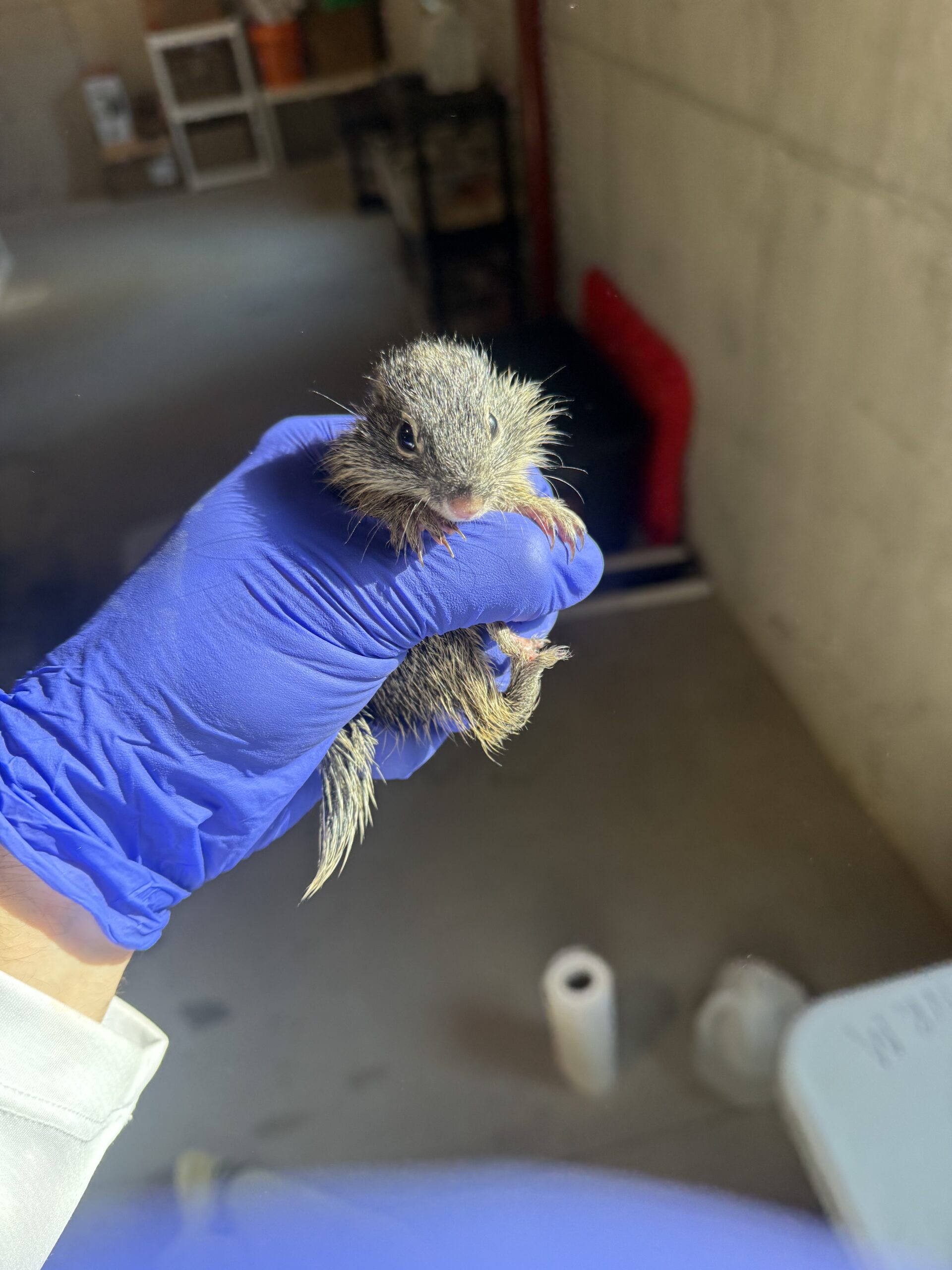
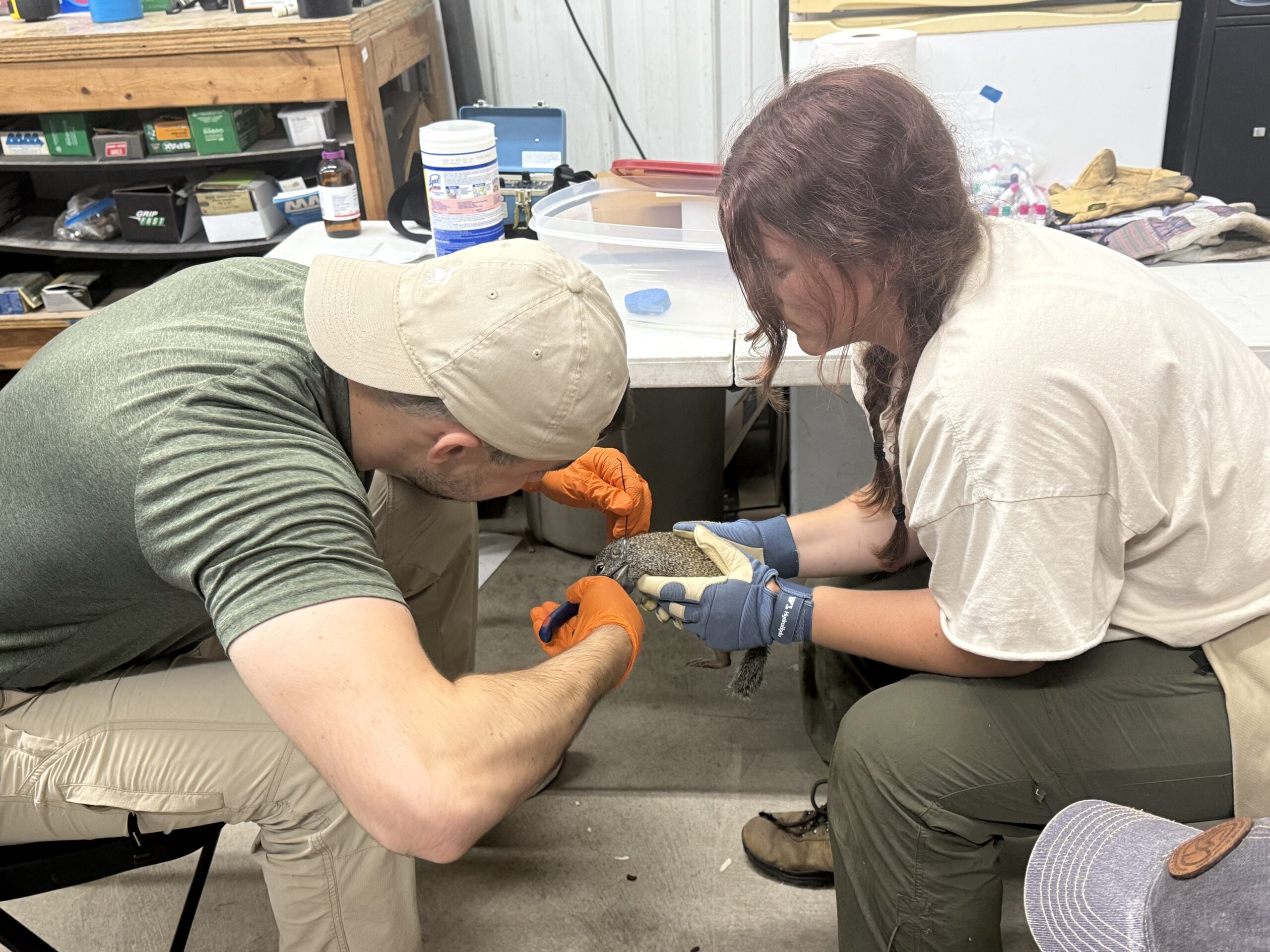
Researchers receive rabies vaccines before interacting with the animals, and all captured animals are initially handled through special handling cones that keep the squirrels calm and unable to bite the researchers.

Once the animals have been captured, they undergo a thorough process of medical checkups, including treatments for any diseases spread by ticks or lice. A veterinarian check-up and a full 21-day quarantine period are also rigorously followed to ensure that diseased animals are not brought into Indiana.

Once Moore brings the squirrels to Indiana, he releases them into what are called “soft release” enclosures, allowing the newly translocated squirrels to get used to their new habitat before being fully released into their Indiana home.

To keep tabs on the squirrel population and its well-being, Moore uses small radio transmitters attached to the Franklin’s that allow him to track their movements using a small receiver and antenna.

The new Franklin’s ground squirrels being brought to Indiana are being released in Newton County on property owned by The Nature Conservancy, a non-profit group that advocates for wildlife conservation.

PFW Biology Students Having National Impact with Research

Both of these research projects are forging new ground in the world of wildlife conservation.

Dr. Bergeson said that Lee’s project has already resulted in a research protocol that is now being shared among various states engaged in wildlife research. That protocol, coupled together with her unique use of artificial intelligence, will provide other researchers with tools and techniques needed in today’s field of wildlife conservation.

Moore’s project is also making inroads into the field of wildlife conservation.

As he talked about his project, Moore said that the project will hopefully result in Franklin’s populations stabilizing. That means the population will, one day, grow strong enough to be removed from the state endangered classification.

And these projects are already paying dividends for their researchers, as Moore, Lee, and their technicians, all gain conservation experience from their projects.  

“I feel like any new experience with any kind of wildlife is really, really cool,” Lee said.

Moore agrees with that view.

“I couldn’t imagine doing anything else,” he summarized.

It’s a win-win situation for Lee, Moore, and their two undergraduate research technicians who assist them with their projects. They all gain valuable research experience and the opportunities to do future projects or write and publish their findings in research journals.

For the undergraduate technicians, the field research training they are gaining will help them strengthen their potential future applications to graduate school.

But perhaps the greatest benefit these projects are providing is the effect they have on wildlife conservation.

Bergeson said that projects like Lee’s camera traps and Moore’s squirrel translocations are having valuable impacts on Indiana’s conservation efforts.

“Our lab has actual impacts on that, which is super cool,” Bergeson said.