The Lifetime Cost of Renewables: Investing Now to Save Later

By Cincade Drudge

From rising fuel prices to worsening climate change, the global energy debate increasingly centers on one key question: Are renewable energy sources truly worth the cost? While wind turbines, solar farms, and battery storage systems often require large upfront investments, experts argue that the long-term economics of renewable energy tell a very different story.

Renewable energy sources such as wind, solar, and hydroelectric power are frequently criticized for their installation costs. However, evaluating energy systems based only on initial construction expenses ignores the broader financial picture. The lifetime cost of energy, which includes installation, operation, maintenance, fuel, and eventual decommissioning, provides a far more accurate measure of economic value.

When viewed through this lens, renewable energy has become one of the most cost-effective forms of electricity generation in the world. Unlike fossil fuels, which rely on finite and often volatile fuel markets, renewable energy sources depend on naturally replenishing resources such as sunlight and wind. Because these resources are free, renewable systems avoid many of the long-term costs associated with coal, oil, and natural gas.

One of the most important tools used to compare energy costs is the levelized cost of energy, or LCOE. LCOE measures the total cost of building and operating an energy source over its lifetime, divided by the amount of electricity it produces. Over the past decade, renewable energy technologies have seen dramatic reductions in LCOE due to technological improvements, increased efficiency, and large-scale production. Solar and wind energy now provide some of the cheapest electricity in much of the world.

Wind energy demonstrates how high upfront costs can translate into long-term savings. Onshore wind farms typically cost between $1.3 and $2.2 million per megawatt to install, while offshore projects can cost significantly more due to difficult ocean construction and maintenance conditions. Despite these high startup costs, wind turbines have relatively low operating expenses once operational. Maintenance, insurance, land rental, and repairs generally average only one to two cents per kilowatt-hour produced.

Wind turbines are designed to operate for roughly 20 to 25 years, and many continue functioning even longer with upgrades and maintenance. Because turbines require no fuel, electricity generation costs remain relatively stable over time. Most wind farms recover their initial capital investments within the first decade or two and continue generating comparatively inexpensive usable electricity afterward. As turbine technology continues improving, efficiency gains and lower maintenance demands are expected to further strengthen wind energy’s long-term economic viability.

Solar energy has experienced an even more dramatic decline in costs. Since 2010, the price of solar power has fallen by more than 80 percent, largely due to cheaper photovoltaic panels and advances in manufacturing efficiency. Utility-scale solar farms now cost around $1 million per megawatt to construct, while residential systems average between $15,000 and $25,000 before incentives.

Once installed, solar systems are relatively inexpensive to maintain. Since sunlight is free, operating costs are minimal, averaging only around $10 to $15 per megawatt-hour. Most solar panels last between 25 and 35 years, gradually losing small amounts of efficiency each year rather than suddenly failing. Even after their estimated lifespan, many panels continue producing usable electricity at reduced output levels.

The falling LCOE of solar energy has made it one of the cheapest electricity sources available today. Federal tax credits (current status uncertain), state incentives, and net metering programs have further improved the financial outlook for residential and commercial solar adoption. For many homeowners and businesses, solar panels represent not only an environmental decision but also a long-term economic investment capable of producing decades of reduced energy costs.

Beyond direct financial savings, renewable energy also avoids many of the hidden costs associated with fossil fuels. Coal, oil, and natural gas production contribute heavily to air pollution, greenhouse gas emissions, and public health problems.

These damages often impose economic burdens on governments and communities through healthcare expenses, environmental cleanup, and disaster recovery costs. Because these external costs are rarely reflected in the market price of fossil fuels, traditional energy sources can appear cheaper than they truly are. When these factors are included, renewable energy becomes even more economically advantageous.

Despite the promising economics of renewables, challenges and costs remain. Wind and solar generation are intermittent, meaning electricity production depends on weather conditions and time of day. To ensure reliable power delivery, renewable systems often require battery storage, backup generation, or modernized electrical grids capable of distributing energy more efficiently. These infrastructure improvements involve significant investment and remain a major barrier in many regions.

Geography and local policy can also complicate renewable energy expansion. Some areas lack the environmental conditions necessary for efficient renewable production, while others face political resistance or restrictive zoning laws. Policies such as solar setback regulations can limit where renewable projects may be built, slowing the transition toward cleaner energy systems.

Still, the broader trajectory of renewable energy suggests continued growth. Technological improvements in battery storage, grid efficiency, and manufacturing are steadily reducing costs while improving reliability. As economies of scale continue expanding, many analysts expect renewable energy to become even more financially competitive in the coming decades.

Individuals also play a role in shaping the future of renewable energy. Supporting community solar projects, advocating for clean energy policies, and investing in residential renewable systems when financially possible can help accelerate the transition away from fossil fuels. Public awareness and political engagement will likely play a major role in determining how quickly renewable infrastructure expands.

Ultimately, the debate over renewable energy is no longer simply about environmental responsibility. Increasingly, it is about long-term economic sustainability. While renewable systems often require significant upfront investment, their low operating costs, stable energy production, and reduced environmental impacts make them one of the strongest long-term energy investments available today. The question is no longer whether renewable energy is affordable over its lifetime, but whether societies are willing to invest in the future now rather than pay far greater costs later.
When the Climate Changes the Cost of Living: How Rising Temperatures Are Driving Up Food Prices

By Cincade Drudge

Climate change is often discussed in terms of melting ice caps, rising sea levels, and extreme weather. But for many Americans, especially here in Indiana, one of the most immediate and tangible effects shows up in a much more familiar place: the grocery store. As global temperatures rise and weather patterns grow more unpredictable, the cost of producing food is increasing, and those costs are steadily being passed on to consumers.

At its core, climate change refers to long-term shifts in temperature and weather patterns, largely driven by human activities such as burning fossil fuels. While these shifts may seem gradual, their effects on agriculture are anything but subtle. Farming depends heavily on stable weather conditions, and even small disruptions in temperature or rainfall can significantly impact crop yields. As these disruptions become more frequent, the stability of the food supply is increasingly at risk.

One of the clearest ways climate change affects food prices is through extreme weather. Droughts, floods, and heatwaves can damage crops or wipe out entire harvests. A drought, for example, can severely reduce corn production, while excessive rainfall can delay planting or flood fields before crops have a chance to grow. When supply drops but demand remains steady, prices rise. This basic economic principle is now playing out more frequently due to climate-related disruptions.

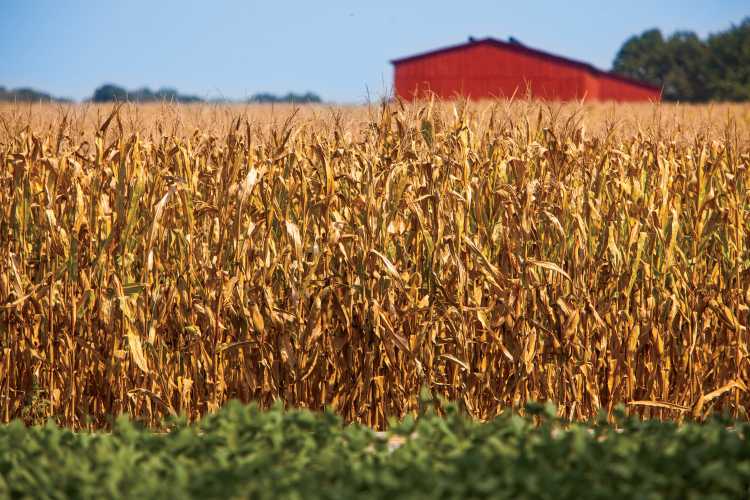
Indiana Corn Corp Sourced From MyHomeIndiana.com

However, the issue extends beyond just crop loss. Farmers are also facing rising production costs as they attempt to adapt to changing conditions. More frequent droughts mean greater reliance on irrigation systems, while unpredictable weather increases the need for fertilizers, pest control, and crop insurance. Each of these adjustments adds to the overall cost of farming. These expenses do not stay on the farm; they move through the supply chain and ultimately show up in the prices consumers pay for food.

Transportation and distribution systems are also vulnerable. Flooded roads, damaged infrastructure, and disrupted supply chains can delay the movement of goods, increasing costs for producers and retailers alike. Because the modern food system is highly interconnected, disruptions in one region can ripple across the country. A drought in a major agricultural region, whether in the United States or abroad, can influence global prices, which in turn affect local grocery bills in Indiana.

In a state like Indiana, these challenges carry particular weight. Agriculture is a central part of the state’s economy, generating over $31 billion in annual sales. Crops such as corn and soybeans dominate production, but they are also especially sensitive to weather conditions. Warmer temperatures and shifting rainfall patterns have already made growing seasons less predictable. A hot, dry summer can significantly reduce yields, while excessive spring rain can delay planting and shorten the overall growing period.

Research suggests that these trends could worsen in the coming decades. Some studies indicate that corn yields could be cut in half under higher global temperature scenarios expected within this century. Even under more moderate warming levels, such as those targeted by international agreements, yields could still decline by nearly 20 percent. For Indiana farmers, this represents not just an environmental challenge, but an economic one with direct consequences for income stability and long-term planning.

Livestock producers are also feeling the effects. Higher temperatures place stress on animals, reducing productivity and increasing the need for cooling systems and additional feed. These changes drive up the cost of producing meat and dairy products, which again translates to higher prices for consumers.

While rising food prices affect everyone, they do not affect everyone equally. Low-income households are particularly vulnerable because they spend a larger share of their income on food. Even modest price increases can place significant strain on household budgets. Rural communities face a unique double impact, as many residents are both consumers and participants in the agricultural economy. Farmers themselves face increased financial risk, balancing the possibility of higher prices with the reality of more unpredictable and costly production conditions.

Despite these challenges, there are pathways forward. One important approach is the development of climate-resilient agriculture. This includes planting drought-resistant crops, improving soil health, and using more efficient irrigation systems. These strategies can help stabilize production even as environmental conditions change.

Strengthening local food systems is another potential solution. By relying more on locally produced food, communities can reduce their exposure to global supply chain disruptions. Policy also plays a crucial role. Government support for agricultural research, infrastructure improvements, and financial assistance for farmers adapting to climate change can help mitigate some of the economic pressures.

We, as consumers, too, have a role to play. Reducing food waste and supporting sustainable farming practices can contribute to a more resilient system. While individual actions alone will not solve the problem, they are part of a broader effort to create stability in the face of uncertainty.

Ultimately, however, the most effective way to address rising food prices linked to climate change is to confront climate change itself. Reducing greenhouse gas emissions and slowing the pace of global warming are essential to preventing further disruptions to the food system. Without broader action, the trends already being observed are likely to intensify.

For Hoosiers, climate change is no longer a distant or abstract issue. It is becoming an economic reality that affects everyday life. As grocery bills continue to rise, the connection between environmental change and personal cost is becoming harder to ignore. What was once seen primarily as an environmental concern is increasingly understood as a direct challenge to economic stability and food security, both in Indiana and beyond.

Urban Heat Islands in Fort Wayne: A Growing Local Challenge 

By Cincade Drudge

It starts as a walk. The kind you’ve taken a hundred times before, down the same familiar city streets, past the same buildings, maybe heading to a nearby store or just trying to get some fresh air. But something feels different. The heat seems to cling to the pavement, rising up toward you with every step. There’s no breeze between the buildings, no tree-shade to break the sun. Even as the evening sets in, the air doesn’t cool the way you expect it to. You find yourself wondering: Has it always felt this hot? 

As we find ourselves heading into the warmer seasons of the year, this question becomes more and more common. City folks increasingly find themselves victims of the sweltering effects of Urban heat islands, often referred to as UHIs, which are an increasingly visible part of city life, especially during the summer months.  

The concept is simple: urban areas experience significantly higher temperatures than their rural surroundings. But the causes and consequences are far more complex. As cities expand and natural landscapes are replaced with concrete, asphalt, and buildings, heat becomes trapped, creating pockets of elevated temperatures that can reshape how communities experience their environment. 

In Midwestern cities like Fort Wayne, this effect is especially noticeable. Paved roads, parking lots, and rooftops absorb heat throughout the day and release it slowly at night, preventing the city from cooling down. While rural areas benefit from vegetation and open space that allow for quicker temperature drops, urban environments hold onto heat. The difference can be striking, sometimes as much as 8 degrees warmer than the surrounding areas

At the heart of the urban heat island effect is a shift in land use. Trees and green spaces, which naturally cool the environment through shade and evapotranspiration, are often replaced with materials that do the opposite. Asphalt and concrete have low reflectivity and high heat absorption, meaning they store solar energy and gradually release it back into the air. Buildings can also trap heat by limiting airflow, creating what some describe as “heat canyons” between structures. 

This buildup of heat comes with a range of environmental costs. Temperatures remain elevated well into the night, increasing overall exposure during heat waves. As a result, energy demand rises, with more residents relying on air conditioning to stay comfortable. This not only leads to higher utility bills but also puts added strain on local power grids. Increased energy use often means higher greenhouse gas emissions, particularly when electricity is generated from fossil fuels, contributing to a cycle that reinforces climate change. 

Beyond environmental impacts, urban heat islands pose serious public health risks. Prolonged exposure to high temperatures increases the likelihood of heat-related illnesses such as heat exhaustion and heatstroke. Vulnerable populations, including the elderly and those without reliable access to air conditioning, face the greatest risks. Heat can also worsen air quality by accelerating the formation of ground-level ozone, while raising water temperatures in nearby rivers and streams, affecting local ecosystems. 

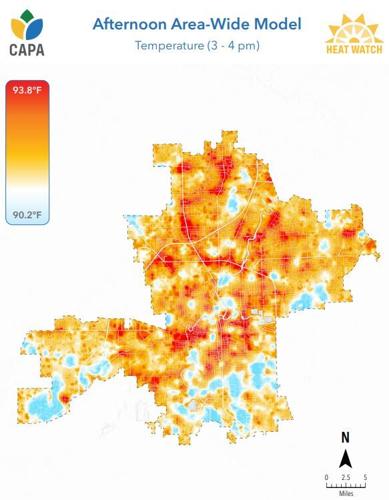
Fort Wayne has taken steps to better understand and address this issue. In a recent local study, volunteers collected ground-level temperature data across the city, revealing just how uneven heat distribution can be. Some neighborhoods were recorded as much as 10 degrees hotter than others, highlighting how urban heat islands are not evenly spread but concentrated in specific areas. 

Afternoon Temperature Chart From Fort Wayne Study. Sourced from WFFT-TV

One of the most effective solutions to this problem is also one of the simplest: planting more trees. Expanding tree canopy coverage helps reduce both surface and air temperatures by providing shade and releasing moisture into the air. Even a single mature tree can make a measurable difference, and when scaled across neighborhoods, these efforts can significantly reshape local microclimates. 

Local initiatives, including those supported by organizations like the Community Greenways Fund, are working to increase tree coverage and promote green infrastructure. These efforts often focus on neighborhoods with fewer existing trees, helping to address both environmental concerns and social disparities. In addition to cooling benefits, trees improve air quality, reduce stormwater runoff, and enhance overall quality of life. 

However, it is important to note that the effects of urban heat islands are not felt equally. Communities with less tree cover and more pavement tend to experience higher temperatures, and these areas are often home to lowerincome populations.  

This creates a situation where those with the fewest resources are exposed to the greatest environmental risks. At the same time, city infrastructure, from roads to power systems, faces increased stress under prolonged heat, leading to higher maintenance costs and long-term challenges for local governments. 

Addressing urban heat islands requires a combination of strategies. Tree planting is a key piece, but it is not the only one. Cities can invest in green infrastructure such as rain gardens, green roofs, and permeable pavement, all of which help reduce heat absorption while improving water management. Reflective materials used in “cool roofs” and “cool pavements” can also limit how much heat is absorbed in the first place. 

Policy plays an important role as well. Local governments can implement zoning regulations that encourage green space, provide incentives for sustainable development, and invest in long-term environmental planning. Partnerships between city officials and community organizations help ensure that these efforts are both effective and equitable. 

Public awareness is another critical factor. Many residents may not fully realize how much impact something as simple as a tree can have on their neighborhood’s temperature and livability. Encouraging community involvement in tree planting and maintenance can strengthen not only environmental outcomes but also civic engagement. 

Urban heat islands may not always be as apparent as other environmental issues, but their effects are felt every day, on sidewalks that radiate heat, in homes struggling to stay cool, and in neighborhoods that bear the brunt of rising temperatures. As cities like Fort Wayne continue to grow, the challenge will be finding ways to build and adapt in a way that keeps communities not just functional, but livable. 

Jacob Kaufman and ‘Heart of Iris’ Debut Concept Album at PFW

By Elijah Noggle, SCO Cultural Critic

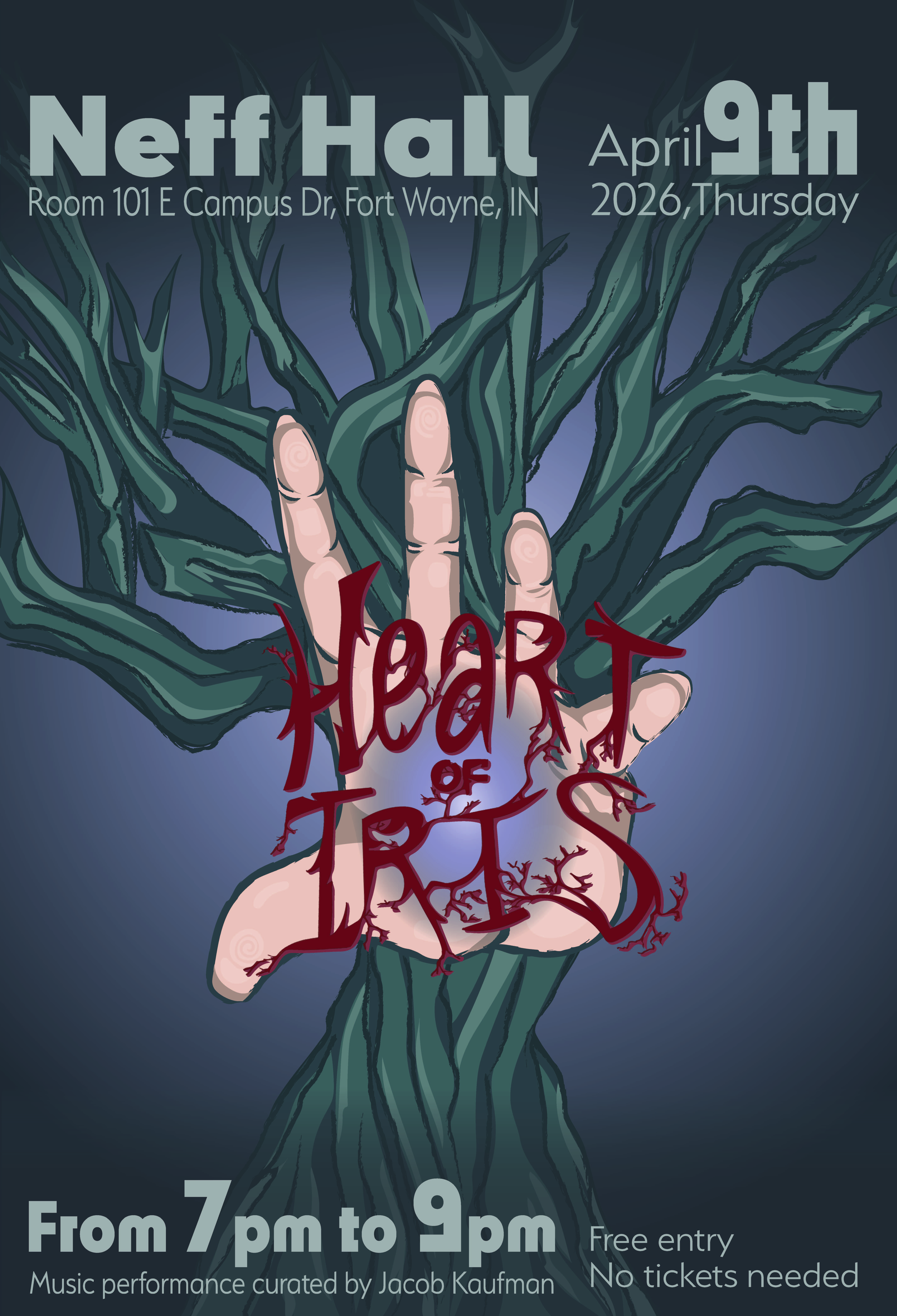
Kaufman and his band will bring the album to life in a full live performance on Thursday, April 9 at 7 p.m. in Neff Hall Room 101.

Recently, I sat down to speak with Jacob Kaufman, a performance and songwriting major at PFW and a talented, passionate musician with some unique influences. Kaufman and his band, Heart of Iris, have been hard at work on their ambitious debut album, which was recently released on streaming platforms. The band will perform the album live in its entirety Thursday, April 9 at 7 p.m. in Neff Hall Room 101.

This self-titled concept album is a passion project for Kaufman. When asked about his musical influences, he said that while he does pull from aspects of art rock and progressive rock, the vast majority of his inspiration actually comes from films and novels – particularly horror. He cited the works of the great Stephen King and H.P Lovecraft, to be more specific. He’s a massive fan of cosmic horror, which heavily informs the album’s themes.

Cosmic horror, Kaufman explained, is “the fear of the unknown or the unknowable, or in other words, it’s the thinking man’s horror.” The music is a very diverse and unique blend of all of these influences. “It utilizes elements of art rock, but I wanted to go for an entirely unique sound in itself,”  Kaufman said.

Kaufman also discussed his philosophy on strong songwriting. He spoke about how what can really elevate a song’s quality is when the music matches up with the lyrics. He compared his approach to an acoustic performance, which I thought was really interesting.

“If you go to an acoustic show, you’re there to listen to the storytelling – the acoustic guitar is just there to help move the story forward but it’s just a chord progression,” Kaufman said. That was essentially how he approached this album creatively. “When I wrote this album, the goal was to make the music that you hear just as important as the lyrics that you listen to and then also they ebb and flow and work in tandem with each other,” he said.

Because it is a concept album, this dynamic between the lyrics and the instrumentation really complements the story, and helps to more effectively communicate the story and what the characters are experiencing.

Kaufman and I also spoke about his extensive musical background prior to his journey here at PFW and making this album. To Jacob, experience is everything – a sentiment I think a lot of us, regardless of the field we are in, can relate to. With more than 1,000 performances in his career, he explained how that helped him develop as an artist and as a performer.

“Taking those opportunities, taking the risk, and getting the experience is what turns you into a great musician,” Kaufman said. “It makes future endeavors easier and better.”

From a marketing perspective, Kaufman emphasized his goal of accessibility. “Prog rock in general can get a little crazy and technical, and I wanted to write something that was both musically interesting, and at the same time digestible for the masses,” he said. “I would like to see more interesting music on the radio – I think a lot of us would.”

I really liked this sentiment because Jacob’s music balances complexity with catchy, melodic songwriting in a way that is very accessible. And I too would really love to see a wider variety of music on the radio, or in other words, a prioritization of music that was made for the love of the craft rather than popularity.

Kaufman is a highly skilled musician, and learning about his creative process was a very enjoyable experience. This was a really fascinating interview to do. It offered an in-depth look at his artistic vision, and audiences can experience it firsthand when Heart of Iris performs April 9.