

By Cincade Drudge
It starts as a walk. The kind you’ve taken a hundred times before, down the same familiar city streets, past the same buildings, maybe heading to a nearby store or just trying to get some fresh air. But something feels different. The heat seems to cling to the pavement, rising up toward you with every step. There’s no breeze between the buildings, no tree-shade to break the sun. Even as the evening sets in, the air doesn’t cool the way you expect it to. You find yourself wondering: Has it always felt this hot?
As we find ourselves heading into the warmer seasons of the year, this question becomes more and more common. City folks increasingly find themselves victims of the sweltering effects of Urban heat islands, often referred to as UHIs, which are an increasingly visible part of city life, especially during the summer months.
The concept is simple: urban areas experience significantly higher temperatures than their rural surroundings. But the causes and consequences are far more complex. As cities expand and natural landscapes are replaced with concrete, asphalt, and buildings, heat becomes trapped, creating pockets of elevated temperatures that can reshape how communities experience their environment.
In Midwestern cities like Fort Wayne, this effect is especially noticeable. Paved roads, parking lots, and rooftops absorb heat throughout the day and release it slowly at night, preventing the city from cooling down. While rural areas benefit from vegetation and open space that allow for quicker temperature drops, urban environments hold onto heat. The difference can be striking, sometimes as much as 8 degrees warmer than the surrounding areas.
At the heart of the urban heat island effect is a shift in land use. Trees and green spaces, which naturally cool the environment through shade and evapotranspiration, are often replaced with materials that do the opposite. Asphalt and concrete have low reflectivity and high heat absorption, meaning they store solar energy and gradually release it back into the air. Buildings can also trap heat by limiting airflow, creating what some describe as “heat canyons” between structures.
This buildup of heat comes with a range of environmental costs. Temperatures remain elevated well into the night, increasing overall exposure during heat waves. As a result, energy demand rises, with more residents relying on air conditioning to stay comfortable. This not only leads to higher utility bills but also puts added strain on local power grids. Increased energy use often means higher greenhouse gas emissions, particularly when electricity is generated from fossil fuels, contributing to a cycle that reinforces climate change.
Beyond environmental impacts, urban heat islands pose serious public health risks. Prolonged exposure to high temperatures increases the likelihood of heat-related illnesses such as heat exhaustion and heatstroke. Vulnerable populations, including the elderly and those without reliable access to air conditioning, face the greatest risks. Heat can also worsen air quality by accelerating the formation of ground-level ozone, while raising water temperatures in nearby rivers and streams, affecting local ecosystems.
Fort Wayne has taken steps to better understand and address this issue. In a recent local study, volunteers collected ground-level temperature data across the city, revealing just how uneven heat distribution can be. Some neighborhoods were recorded as much as 10 degrees hotter than others, highlighting how urban heat islands are not evenly spread but concentrated in specific areas.
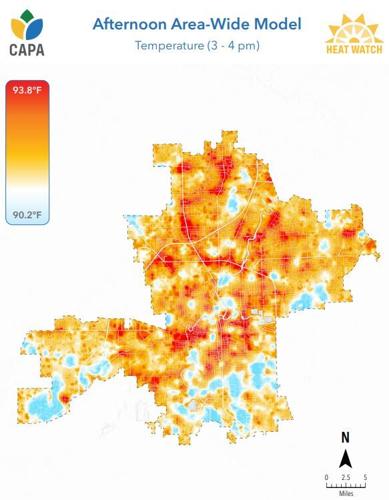
One of the most effective solutions to this problem is also one of the simplest: planting more trees. Expanding tree canopy coverage helps reduce both surface and air temperatures by providing shade and releasing moisture into the air. Even a single mature tree can make a measurable difference, and when scaled across neighborhoods, these efforts can significantly reshape local microclimates.
Local initiatives, including those supported by organizations like the Community Greenways Fund, are working to increase tree coverage and promote green infrastructure. These efforts often focus on neighborhoods with fewer existing trees, helping to address both environmental concerns and social disparities. In addition to cooling benefits, trees improve air quality, reduce stormwater runoff, and enhance overall quality of life.
However, it is important to note that the effects of urban heat islands are not felt equally. Communities with less tree cover and more pavement tend to experience higher temperatures, and these areas are often home to lower–income populations.
This creates a situation where those with the fewest resources are exposed to the greatest environmental risks. At the same time, city infrastructure, from roads to power systems, faces increased stress under prolonged heat, leading to higher maintenance costs and long-term challenges for local governments.
Addressing urban heat islands requires a combination of strategies. Tree planting is a key piece, but it is not the only one. Cities can invest in green infrastructure such as rain gardens, green roofs, and permeable pavement, all of which help reduce heat absorption while improving water management. Reflective materials used in “cool roofs” and “cool pavements” can also limit how much heat is absorbed in the first place.
Policy plays an important role as well. Local governments can implement zoning regulations that encourage green space, provide incentives for sustainable development, and invest in long-term environmental planning. Partnerships between city officials and community organizations help ensure that these efforts are both effective and equitable.
Public awareness is another critical factor. Many residents may not fully realize how much impact something as simple as a tree can have on their neighborhood’s temperature and livability. Encouraging community involvement in tree planting and maintenance can strengthen not only environmental outcomes but also civic engagement.
Urban heat islands may not always be as apparent as other environmental issues, but their effects are felt every day, on sidewalks that radiate heat, in homes struggling to stay cool, and in neighborhoods that bear the brunt of rising temperatures. As cities like Fort Wayne continue to grow, the challenge will be finding ways to build and adapt in a way that keeps communities not just functional, but livable.